


Searching for Data Suite Shopee? Start by separating your own shop reports, Shopee advertising reports and external marketplace observations. They answer different questions. This guide explains how to check the tools available to your account, compare metrics consistently and combine seller reports with a scoped dataset from Easy Data without treating a sample as the whole market.
What is Data Suite Shopee?
Shopee’s public Malaysian documentation uses names such as Business Insights, Shopee Ads and Brand Portal. The sources reviewed for this guide do not establish “Data Suite Shopee” as one universal official product with the same features for every seller. Check the actual report name, market, account eligibility and help text in your Seller Centre before relying on a feature.
For a useful analytics setup, distinguish three types of evidence:
- Your own shop reports: visits, orders and sales, where available, with the report’s stated definitions and update time.
- Advertising reports: spend and attributed results, with their attribution window and eligible campaigns.
- External observations: selected listings, prices and other available fields captured at a recorded time; these do not reveal a competitor’s private customer records.
A dashboard can help you frame a decision. It does not by itself prove why sales changed or guarantee an accurate demand forecast.
Related blog: E-Commerce Data Tools for Shopee Sellers: Top Solutions for 2025

Why use Shopee’s seller analytics?
Shopee Malaysia’s seller training covers Business Insights and reviewing past sales and promotions to set goals. Useful goals for your own reporting include:
- Learning the definitions behind the metrics you use.
- Comparing like-for-like periods before deciding what to change.
- Recording an action and checking its outcome against a baseline.
These are reporting practices, not evidence of a product launch rationale or a promise of growth. Record which tools your account actually provides.
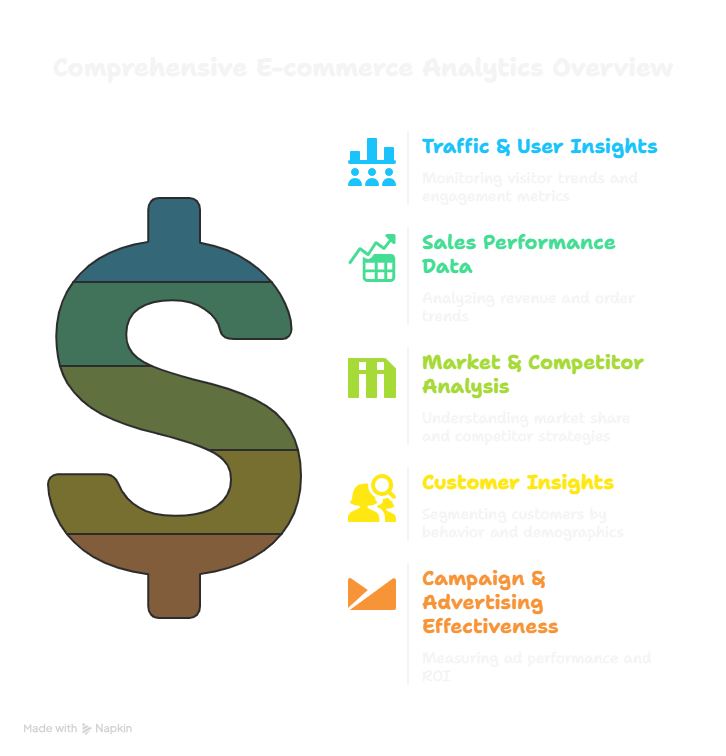
Five areas to check in your Shopee reports
Use the following as an audit checklist, not a universal feature list. A report may be unavailable or use a different definition in your market.
1. Traffic & user insights
- Visits: distinguish unique visitors from page views and identify the reporting period.
- Click-through rate: check what counts as a click and an impression; do not assume every CTR describes product thumbnails.
- Conversion rate: record the numerator and denominator, such as buyers versus visitors or orders versus clicks.
- Timing: check the reporting time zone, refresh delay and whether hourly detail is actually available.
Compare equivalent weekdays and campaign conditions. An increase in visits alone does not tell you whether a listing change improved purchasing behavior.
2. Sales performance data
- Sales: confirm the order-status scope, rebate treatment and currency before comparing totals.
- Orders: distinguish placed, paid, completed, cancelled and returned orders where the report allows it.
- Products: preserve item and variant identifiers when comparing units or sales across exports.
- Average order value: divide a consistently defined sales total by the matching order count; label the definition.
For example, Shopee Malaysia’s January 2026 Sales update deducts seller rebates and leaves earlier GMV history unchanged. The documented Sales measure can include paid and unpaid orders as well as cancelled or returned/refunded orders. Do not treat it as settled cash or profit, or splice it into an older GMV series without explaining the definition change.
3. Market & competitor analysis
- Category comparisons: check the benchmark population, coverage and eligibility before calling a percentage market share.
- Price comparisons: match country, currency, variant, pack size, shipping and promotion conditions.
- Competitor trends: distinguish observed listing changes from verified orders, revenue or customer behavior.
Some benchmark features are conditional. Shopee Malaysia’s Brand Max guide describes an Audience tab with competitor benchmarking for Brand Max users. This does not establish universal access for all sellers, and an audience benchmark is not a full competitor sales ledger.
4. Customer insights
- Audience reports: confirm that an aggregate field exists in your account before using it; do not assume age or gender is available.
- Repeat purchasing: document the customer definition, observation period and treatment of cancelled orders.
- Product combinations: use appropriately authorized order-level data if you need to analyze items bought together.
Keep analysis at the minimum detail needed. A public product dataset is not a substitute for authorized customer records, and a correlation between products is not evidence that a bundle will increase sales.
5. Campaign & advertising effectiveness
- Campaign results: distinguish attributed sales from incremental sales caused by the campaign.
- Ad efficiency: compare spend with clicks or attributed sales using the same currency, dates and attribution settings.
- Profit: include product cost, platform fees, fulfillment, returns and other relevant costs; return on ad spend is not profit.
A before-and-after sales increase may also reflect stock, pricing, seasonality or other promotions. Record these factors and use a suitable controlled comparison when evaluating causality.
Benefits of a consistent reporting workflow
The value comes from using definitions and evidence consistently, rather than from a dashboard name:
- Centralized records: keep export dates, report names and metric definitions together.
- Data-backed decisions: connect a question to the evidence that can answer it.
- Budget review: compare campaign outcomes against a clearly defined baseline.
- Listing review: use traffic and order evidence to choose a specific change to test.
- Inventory planning: combine historical orders with lead times, stock constraints and uncertainty.
- Shared interpretation: make the assumptions understandable to the people acting on the report.
These practices can reduce avoidable reporting mistakes. They do not guarantee higher ROI, fewer stockouts or increased market share.
Limits to check before combining reports
A useful comparison needs more than two exports. Check:
- Coverage and access: Some reports concern your own shop; others may contain eligible aggregate benchmarks. Record the actual population instead of assuming either complete market coverage or no external comparisons.
- Definitions and presentation: Keep the original export and its help text. Reconcile field names, missing values, time zones and order-status filters before building a chart.
- Cross-platform consistency: Shopee, Lazada and TikTok Shop reports may define similar labels differently. Use a documented mapping and retain platform-specific fields rather than adding unlike totals.
Easy Data: adding scoped marketplace observations
External data can complement your seller reports when you need to compare a defined set of public listings. Agree on the marketplace, country, categories, fields, sample selection and collection time before interpreting the results.
A collected sample describes the observations it contains. Missing shops, unavailable fields, inaccessible pages and collection failures must remain visible. Neither a sample nor a multi-platform export establishes a complete market view.
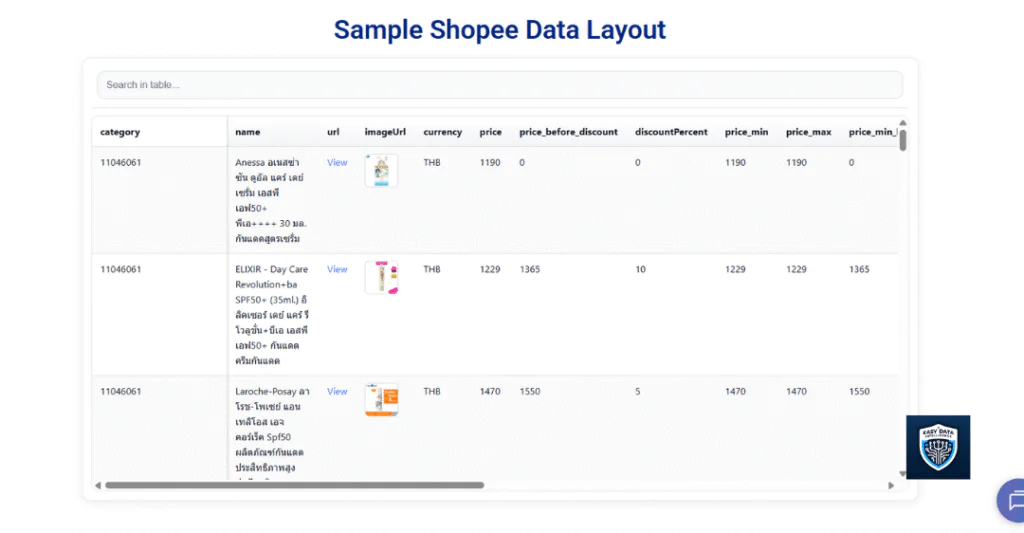
What does Easy Data offer?
For Shopee data scraping services, provide example URLs and the decision you want to support. Confirm permissions, feasibility, coverage, output format and acceptance criteria with Easy Data before assuming a field or refresh schedule is available.
- Marketplace scope: Specify Shopee, Lazada or TikTok Shop and the exact country; do not assume equivalent coverage.
- Fields: Request the listing, price, rating or review fields you need, and agree how unavailable values will be represented.
- Exports: Agree on CSV, Excel or JSON and stable identifiers, currency and capture timestamps.
- Existing samples: Check each Shopee dataset for its stated period and scope. An archive date is not a promise of continuous updates.
How can external data complement seller reports?
Keep own-store performance and sampled external observations separate, then join only fields that have compatible identities, dates and meanings. The two sources support different questions:
| Seller and advertising reports | Scoped external dataset |
|---|---|
| Measures defined for your authorized shop, campaigns or eligible benchmarks | Available observations for the agreed sample and capture time |
| Check order-status, attribution, rebate and reporting rules | Check country, currency, variant matching and missing observations |
| Supports investigation of your own operations and campaigns | Supports a bounded listing comparison; does not establish total market share or private competitor sales |
A practical combined review can:
- Compare matched listing prices while recording differences in packs, shipping and promotions.
- Describe how the sampled assortment changed without extrapolating to all sellers.
- Use your own order history for planning, with external observations as context rather than a substitute.
- Identify a follow-up question or pilot before committing to a new product or market.
For the distinction between observed listings and sales evidence, see our Shopee insights guide. For a source and tool comparison, use the Shopee analytics tools guide.
A report comparison worksheet
Before comparing two periods, record the same seven checks for both. If a definition changes, keep the series separate or explain a documented reconciliation.
| Check | What to record |
|---|---|
| Identity | Market, shop, report name and product/variant identifiers |
| Time | Start/end dates, time zone, export time and reporting delay |
| Sales basis | Order statuses, rebate treatment and currency |
| Rates | The numerator and denominator of each percentage |
| Ads | Attribution window and campaign scope |
| External sample | Selection rule, matching rules and missing observations |
| Decision | One proposed action, owner and follow-up date |
Worked example: more sales, lower order conversion
Fictional illustration, not Shopee or client data. Suppose two comparable periods use the same currency, order-status rules and visitor definition. Period A has 1,000 visitors, 40 qualifying orders and 20,000 currency units of qualifying sales. Period B has 1,200 visitors, 42 orders and 23,100 sales.
- Visits increased 20%, orders 5% and sales 15.5%.
- Orders per visitor fell from 40/1,000 = 4% to 42/1,200 = 3.5%, a decrease of 0.5 percentage points.
- Sales per qualifying order rose from 20,000/40 = 500 to 23,100/42 = 550, an increase of 10%.
This example suggests investigating order mix and the visit-to-order journey. It does not establish that an ad campaign caused the increase, that profit improved, or that the shop gained market share. “Orders per visitor” is this example’s explicit ratio; use the definition shown by your actual dashboard when reporting its conversion metric.
Conclusion
Start with the reports available in your own Shopee account. Record definitions, dates and eligibility, then add external data only where its documented scope answers a specific question. Keep samples, attributed results and settled financial outcomes distinct. This produces a report that others can check without promising a complete market view or guaranteed growth.
Need a dataset for a defined comparison? Contact us with your target market, example URLs, required fields, dates and acceptance criteria.
Leave a Reply