

Introduction to Cross-Border E-Commerce
Cross-border e-commerce means ordering goods or services online across national borders. It can involve businesses selling to consumers (B2C), businesses buying from other businesses (B2B), or transactions between consumers (C2C). A physical product ordered online still needs fulfilment; a digital service may be delivered online.
For example, a Vietnam-based craft business might evaluate selling to a customer in the United States. Before accepting an order, it needs to confirm seller eligibility, product requirements, the delivered price and a workable return route. Access to an online audience alone does not establish a viable export business.
This guide revisits the cross-border themes of 2025 with a source review dated 3 October 2026. The 2023 WTO, IMF, OECD and UNCTAD measurement handbook distinguishes digitally ordered trade from digitally delivered trade. B2C sales, all ecommerce, platform revenue and gross merchandise value are not interchangeable totals. Use the pilot checklist and cost example below to evaluate a specific route instead of combining forecasts with different definitions.
Why Cross-Border E-Commerce Matters in 2025?
Five areas help structure a cross-border market assessment: connectivity, demand, technology, mobile usability and trade arrangements. Each needs evidence for the particular customer group and destination.
| Area | What to verify |
|---|---|
| Connectivity | Check the reachable audience; internet users are not a buyer count. |
| Demand | Compare a defined basket with local alternatives at the delivered price. |
| Technology | Test one task and measure errors; security is not guaranteed by a tool name. |
| Mobile | Test variants, address entry, delivery charges and payment confirmation. |
| Trade arrangements | Verify the applicable origin evidence and destination procedure. |
1. Increasing Internet and Smartphone Penetration
ITU’s Facts and Figures release of 17 November 2025 estimates 6 billion internet users in 2025, up from a revised 5.8 billion in 2024. Internet users are not the same as smartphone owners, online buyers or customers reachable by your business. Validate connectivity and device use for the audience you intend to serve.
2. Growing Demand for International Products
A product unavailable locally can be a reason to buy internationally, but interest does not establish willingness to pay the delivered price. Compare a defined product basket with local alternatives, including delivery, returns and customer support. For beauty or fashion, test a specific brand, variant and price range rather than assuming a whole category is in high demand.
3. Technological Advancements
AI, augmented reality and transaction-recording tools are possible experiments, not prerequisites for selling abroad. Test one task, such as translation review or product visualisation, against the existing process. Measure errors, support workload and completed orders. Blockchain alone does not guarantee transaction security or resolve a delivery dispute.
4. Rise of Mobile Commerce
Check the mobile buying journey directly: product images, variant selection, address entry, delivery charges and payment confirmation. Segment your own visits and completed orders by device. A mobile sales share from a different country or survey should not be treated as a global cross-border benchmark.
5. Regional Trade Agreements
Trade arrangements need route-specific verification. For example, Singapore Customs describes an Approved Exporter Scheme under RCEP with origin-related conditions for self-certification. That is a specific procedure, not automatic eligibility for every online seller. Confirm the relevant origin evidence, product treatment and destination requirements before assuming a tariff or processing benefit.
Cross-Border E-Commerce Examples
The following examples illustrate different operating models. A marketplace’s international presence does not mean every seller, product or fulfilment programme is eligible in every destination.
Alibaba Cross-Border E-Commerce
Alibaba Group’s business FAQ distinguishes consumer retail marketplaces from wholesale marketplaces used by business buyers. Its businesses include AliExpress and Alibaba.com. When assessing an Alibaba route, identify the actual platform, buyer type and seller programme; group-wide user or revenue figures do not describe the opportunity available to an individual merchant.
For a proposed electronics export, build a product-level comparison: model and variant, order quantity, applicable product documentation, destination, delivery terms and returns. Confirm these with the specific platform and carrier. Do not infer that a listing can be sold in every market simply because the group operates internationally.
Cross-Border E-Commerce Shopee
Sea lists Shopee as its ecommerce business. For a Shopee cross-border pilot, confirm the programme available to the seller’s registered business and the destination catalogue in the local seller tools. Check category eligibility, fulfilment, payout and return responsibilities before advertising availability. A domestic seller account or a livestream feature does not by itself demonstrate access to a foreign market.
Amazon and eBay
Amazon Global Selling describes regional or country-specific accounts, product selection, tax and compliance requirements, listing and fulfilment. eBay International Shipping currently specifies eligible sellers in the US and Canada; its item and programme rules also apply. These are distinct routes. A Vietnam-based business should verify the programme applicable to its own entity instead of assuming eligibility from a country-count headline.
Etsy and ASOS
Etsy’s Creativity Standards define permitted creative items through categories covering seller-made, seller-designed, handpicked and sourced items. Check the detailed criteria for the intended product. ASOS describes its business through own brands and partner brands with several fulfilment models. These are different commercial relationships; ASOS is not a general open-listing substitute for Etsy.
The Cross-Border B2C E-Commerce Market
Cross-border B2C describes a business selling to an overseas consumer. Before using a market-size estimate, record its year, currency, countries, included products or services, and whether it measures orders, sales or platform revenue. Do not combine a B2C forecast with a broader ecommerce forecast from another methodology to calculate market share or growth. For a seller, a reachable category and a viable delivered price are more useful starting points than an unsupported global total.
🚀 Explore Our E-commerce Data Services
Explore scoped data collection for Shopee, TikTok Shop, and Lazada.
Key Segments in Cross-Border B2C E-Commerce
- Apparel and accessories: compare sizes, materials, brand authorisation where relevant, delivery costs and the handling of exchanges. Track returns by reason during the pilot.
- Electronics and media: distinguish physical devices from digital products. For physical goods, verify the exact model, destination compatibility, warranty process and carrier acceptance.
- Personal care and beauty: confirm the product and labelling requirements for the destination before building a catalogue. Compare like-for-like pack sizes and variants.
- Payment methods: record supported merchant countries, currencies, settlement timing, fees and refund handling. Wallet or card usage in one survey is not proof that the same method is available or preferred for your checkout.
Regional Insights
- Asia-Pacific: compare countries separately. Our 2025 Southeast Asia country table distinguishes ecommerce GMV from the wider digital economy. Neither measure isolates cross-border sales or gives an individual seller’s market share.
- North America: choose a destination and seller programme, then document delivery coverage, returns and the price customers see at checkout. Do not treat the United States and Canada as a single operating market.
- Europe: specify the country, language, fulfilment route and responsible business entity. A Europe-wide ecommerce estimate does not establish cross-border demand or a uniform set of selling requirements.
Challenges in Cross-Border E-Commerce
Cross-border operations require a clear record of who performs each task, who pays each cost and what happens when an order fails. Review these five areas before launch.
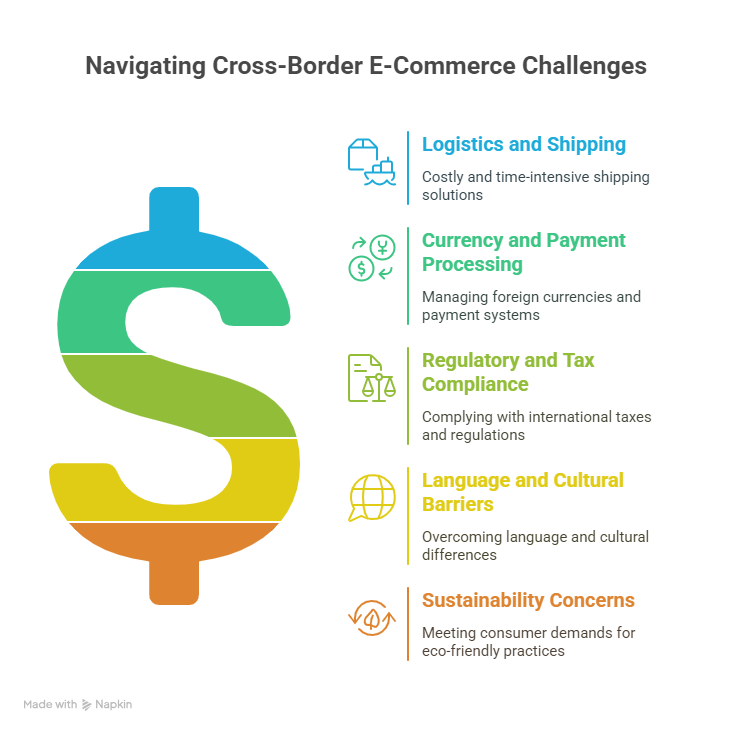
1. Logistics and Shipping
Obtain shipping quotes for the actual origin, destination, parcel dimensions, weight and product. Compare pickup-to-delivery estimates, customs handling, tracking, loss claims and returns on the same basis. A generic China-to-Europe transit time or air-to-sea price multiple is not a dependable quote. Run a small route trial and record actual delivery dates before promising a service level.
2. Currency and Payment Processing
Separate the price shown to the customer from the currency and amount settled to your business. Compare provider fees, exchange costs, payout timing and refund treatment for the supported account. Test a payment method only where it is available, and reconcile paid, failed and refunded orders separately.
3. Regulatory and Tax Compliance
Before launch, identify the seller, importer where relevant, product documentation, destination requirements and responsibility for duties, taxes and returns. Obtain confirmation for the actual product and route from the appropriate authority or adviser. Competitor prices do not establish compliance, and a trade agreement does not replace this review.
4. Language and Cultural Barriers
Translate and review the whole transaction, including product variants, units, delivery estimates, return instructions and support messages. Ask a fluent reviewer to test whether a customer can understand the offer and complete the process. Measure misunderstandings and support requests during the pilot.
5. Sustainability Concerns
Make environmental claims specific and supportable. For a packaging change, record material use, parcel dimensions, damage and return rates, as well as cost. An offset purchase alone does not prove that every part of a shipment is carbon-neutral or that customers will become more loyal.
Strategies for Success in Cross-Border E-Commerce
Use the following practices as pilot tasks with an owner and an observable result. Expand only after the proposed route works at a sustainable cost.
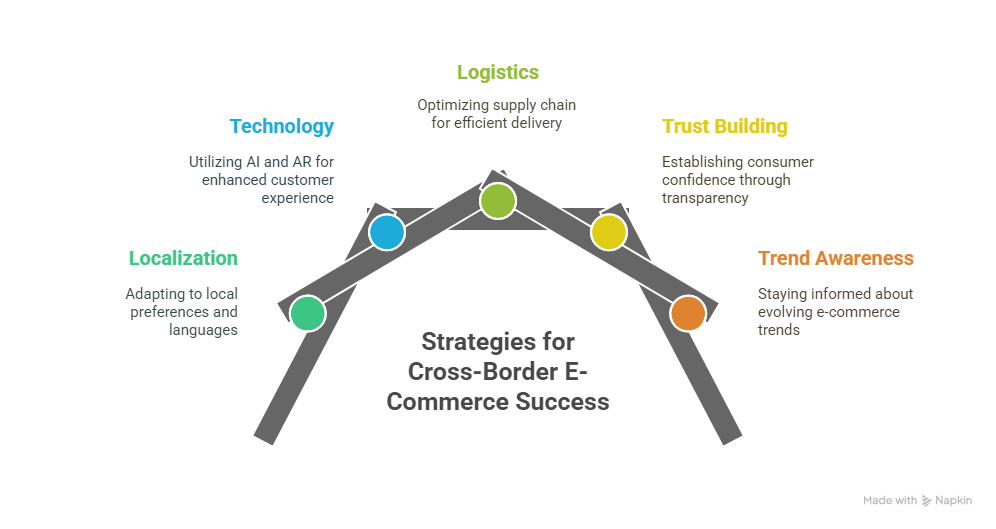
1. Localization
Choose one destination and product basket. Review language, sizes, currency, customer-facing delivery terms and local payment availability together. Record which parts of the offer differ from the domestic version, then test those differences with representative users.
2. Leveraging Technology
Start with one measurable problem, such as repeated translation errors or slow catalogue updates. Compare the tool-assisted workflow with a simple baseline. Retain human review for product claims and customer-facing exceptions; an AI or AR feature does not itself establish a conversion improvement.
3. Optimizing Logistics
Compare direct international shipping with local stock using the same demand assumptions. Include inbound freight, storage, minimum charges, unsold inventory and returns. A shorter delivery estimate can still leave a worse contribution after all costs.
4. Building Trust
Show the total known price, realistic delivery expectations, return route and a working support contact. Use accurate product information and authentic reviews. Check that the published policy matches how an actual exception would be handled.
5. Staying Updated on Trends
Treat trends as hypotheses to test. Our review of ten 2025 ecommerce trends connects each theme to practical evidence. Record the source date and reassess platform requirements before a new launch.
The Future of Cross-Border E-Commerce
The next decisions should follow evidence from the chosen route. These four themes can be monitored without assuming a particular market forecast or guaranteed sales outcome:
- Social commerce: identify the country-specific checkout route, creator costs and fulfilment responsibility. Compare completed and retained orders with views; a livestream audience is not a sales total.
- Sustainability: test a defined material or shipping change and retain evidence for any customer-facing claim.
- AI and personalisation: measure errors, review effort and commercial outcomes against a baseline before increasing automation.
- Cross-border trade arrangements: monitor the actual rules and procedures for the route. An announcement or agreement name alone does not establish an immediate operational benefit.
Cross-Border Pilot Checklist and Cost Example
Use one record per route and product basket. Set the period and pass/fail criteria before selling, then reconcile all orders after the chosen return window. This is an operating worksheet, not a forecast or tax calculation.
| Area | What to verify |
|---|---|
| Route and product | Record origin, destination, SKU/variant, parcel dimensions and the fulfilment model. |
| Eligibility | Retain the relevant seller, product and shipping requirements with a check date. |
| Customer price | Document item price, delivery, known taxes and duties, and who pays each charge. |
| Settlement and costs | Record collected revenue, payment/FX fees, platform fees, goods, shipping, promotion and returns. |
| Delivery and exceptions | Track dispatch, arrival, failed deliveries, refunds and the reason for each exception. |
| Decision | Set a contribution threshold and service-level target before the pilot; review after the return window. |
Fictional example, not a customer result: 100 paid orders at US$40 produce US$4,000 in initial receipts. Ten full refunds leave US$3,600. Suppose the pilot incurs US$1,600 in goods costs, US$800 in outbound freight, US$360 in platform/payment/FX charges, US$400 in promotion, US$200 in duties and handling paid by the seller, and US$150 in return/loss costs. Total costs are US$3,510 and contribution is US$90 before fixed overhead and income tax. These invented amounts are not quoted fees or tax rates. Include costs on refunded orders and apply any inventory recoveries consistently.
An extra US$1 in shipping cost on each of the 100 orders adds US$100, changing that contribution to minus US$10. This sensitivity check explains why an attractive sales total alone is insufficient. Replace every assumption with your own quotes, settlement records and return evidence.
Conclusion
Cross-border e-commerce can connect a business with overseas customers when platform access, the product offer, fulfilment and returns work together. Compare specific routes and retain the evidence behind each assumption. The pilot result should guide the next investment, rather than a global growth forecast.
Use the pilot checklist to document eligibility, costs and delivery outcomes. Revisit our 2025 ecommerce trends review when choosing the next experiment, and keep observed marketplace data separate from your own completed-order and profit records.
📥 Want to see real data in action?
Book a free demo with our team to get data samples, pricing, and technical consultation tailored to your use case.
Book a Demo Now
Leave a Reply