
In Southeast Asia’s fast-moving e-commerce market, staying competitive isn’t just about having good products anymore. What really matters is how fast you can react, whether it’s price changes, competitor moves, or shifts in demand across Shopee, Lazada, and TikTok Shop. That’s where the advantages of web scraping come in, not as a technical add-on, but as something businesses rely on to keep up and stay ahead.
- The advantages of web scraping in Southeast Asia e-commerce lie in speed, scale, and real-time decision-making across platforms like Shopee, Lazada, and TikTok Shop.
- Manual tracking fails because prices, rankings, and demand shift within hours (especially during campaign periods).
- Businesses use web scraping to monitor competitors, detect product trends early, and analyze cross-border markets with real data.
- Marketplace data is the key to understanding real ecommerce sales behavior in SEA.
- E-commerce data scraping service help transform raw data into actionable insights without technical complexity.
Why Web Scraping Matters in Southeast Asia E-commerce
Prices, competition, and demand are always changing across platforms, sometimes within just a few hours. By the time you look at outdated data, the opportunity is often already gone. This is exactly why many businesses are turning to web scraping for e-commerce to turn fast-moving signals into something actionable.
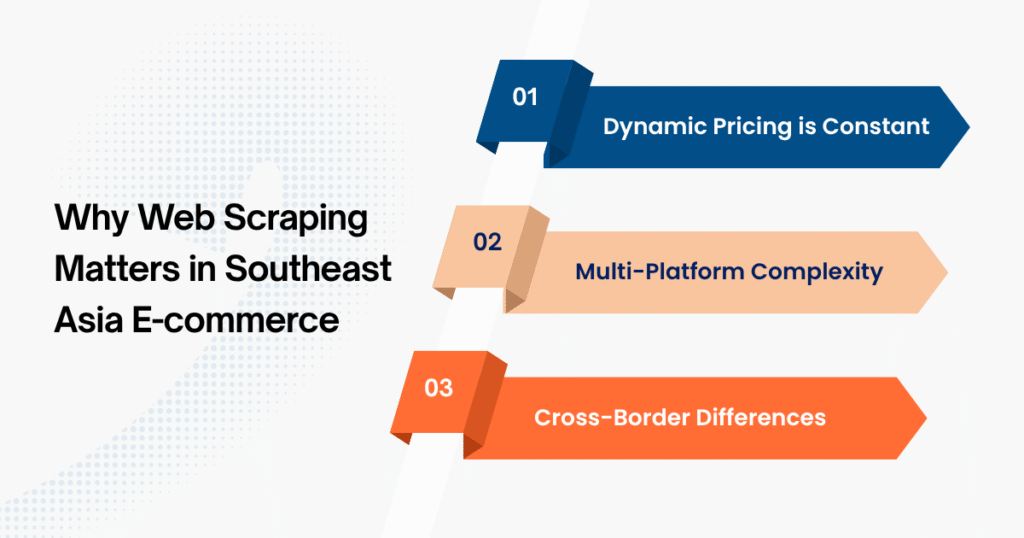
Dynamic Pricing Culture Across Campaign Events
Pricing in Southeast Asia is driven by continuous campaigns (double-day sales, payday deals, flash sales, and major events). On normal days, prices may change a few times; during peak periods, it can happen every few hours.
For example, a Shopee electronics seller might update prices multiple times a day just to stay visible. Without continuous tracking, these changes are easy to miss. This is where the advantages of web scraping become clear: it turns constant price movements into structured, trackable data.
Multi-Platform Ecosystem Complexity
E-commerce in Southeast Asia is not dominated by a single platform. Shopee, Lazada, and TikTok Shop all operate at once, each with its own display methods, ranking systems, and seller behaviors.
This makes cross-platform comparison difficult. Looking at one platform alone rarely gives the full picture. One of the key advantages of web scraping is its ability to standardize data across platforms, helping teams analyze everything in a single, unified view instead of dealing with fragmented datasets.
Cross-Border Expansion Challenges
Expanding across Southeast Asia is attractive but complex. Each market has different pricing expectations, competition levels, and demand patterns.
A product performing well in Vietnam may already be saturated in Indonesia. Without reliable data, these differences are hard to detect early. The advantages of web scraping help businesses analyze localized data across markets, reducing the risk of costly expansion mistakes.
Why Manual Monitoring Fails in Multi-Platform Marketplaces
Manual monitoring might work at a small scale, but it quickly breaks down as you track more products across multiple platforms.
Take a Lazada seller who checks competitor prices once a day, thinking that’s enough. In reality, prices can change every few hours, especially during campaigns. Flash deals come and go quickly, and by the time the seller checks again, the market has already moved.
The result is missed opportunities, lower visibility, and weaker conversions. It’s not about effort, it’s about speed. Manual tracking simply can’t keep up, which is exactly why the advantages of web scraping become essential rather than optional.
Real Advantages of Web Scraping
The advantages of web scraping aren’t theoretical; they directly impact how teams operate every day.
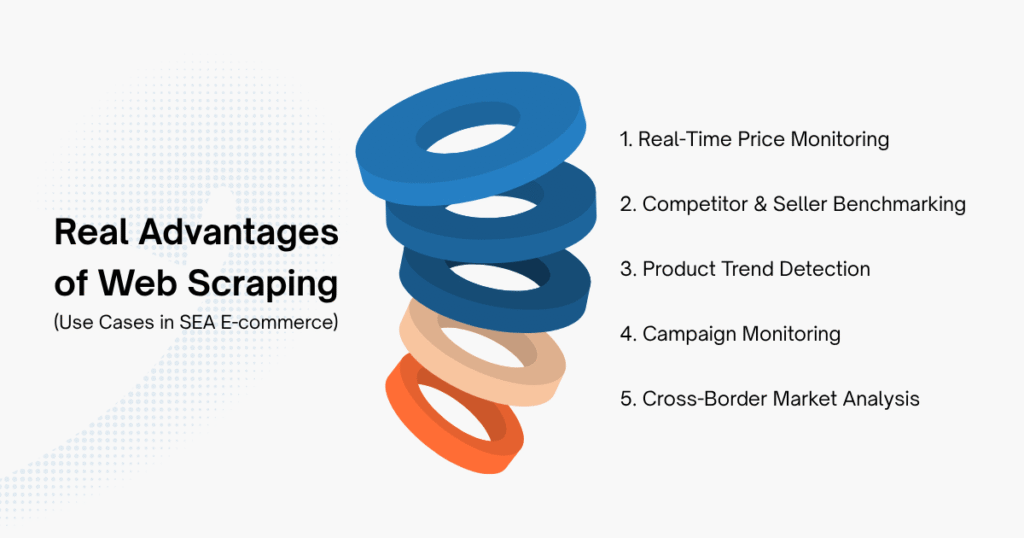
Real-Time Price Monitoring
One of the most immediate advantages of web scraping is the ability to track competitor pricing continuously rather than periodically.
Instead of reacting hours or days later, businesses can detect price drops almost as they happen. For example, a beauty seller tracking hundreds of competing products can quickly adjust pricing in response to competitor changes, maintaining competitiveness without constantly checking manually
Competitor & Seller Benchmarking
Beyond pricing, businesses also need to understand how competitors operate. The advantages of web scraping extend to analyzing seller behavior, including how top sellers build reviews, position products, and maintain ratings.
In one scenario, a TikTok Shop seller discovered that top competitors were not competing on price but on review growth. This insight led to a shift in strategy, focusing on customer acquisition and review generation rather than aggressive discounting.
Product Trend Detection
Another practical advantage of web scraping is the ability to detect emerging product trends early. Instead of relying on intuition, businesses can observe increases in listings, reviews, and engagement signals. A category manager, for instance, may notice a rapid rise in a specific skincare product across multiple platforms and decide to enter the market before it becomes saturated.
Campaign Monitoring
Campaign periods in Southeast Asia significantly reshape marketplace dynamics. Prices fluctuate, rankings shift, and competition intensifies.
By leveraging the advantages of web scraping, businesses can track what actually happens during these campaigns. Instead of guessing, they can analyze discount strategies, observe ranking changes, and understand how competitors perform before, during, and after major events.
Cross-Border Market Analysis
Finally, one of the most strategic advantages of web scraping is enabling cross-border comparison. Rather than making expansion decisions based on assumptions, businesses can analyze real data across countries, including pricing levels, seller density, and demand signals. This allows teams to identify markets with genuine opportunities instead of entering already saturated spaces.
How Different E-commerce Teams Use Web Scraping to Make Decisions
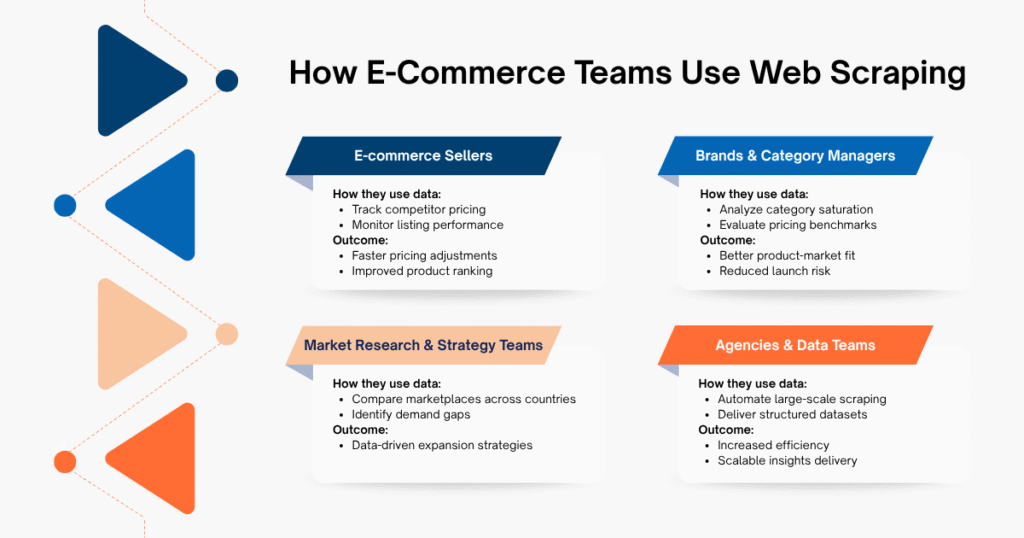
The advantages of web scraping become clearer when looking at how different teams use data in practice. Each role (from sellers to strategy teams) relies on structured marketplace data in a different way, but all of them depend on speed, scale, and consistency to make better decisions.
For E-commerce Sellers
Sellers operate in an environment where small pricing differences can significantly impact visibility. By using scraped data, they can monitor competitors continuously and adjust pricing much faster than before.
In practice, a seller tracking hundreds of SKUs can reduce reaction time from a full day to just a couple of hours, leading to better positioning and improved conversion rates.
For Brands & Category Managers
For brands, the challenge is less about reacting quickly and more about making the right strategic decisions.
Using marketplace data, category managers can evaluate how crowded a category is, identify pricing benchmarks, and decide whether launching a product is viable. This reduces the risk of entering highly competitive markets without differentiation.
For Market Research & Strategy Teams
Strategy teams often struggle with fragmented or outdated data. The advantages of web scraping allow them to compare markets across Southeast Asia with a consistent dataset. This enables clearer insights into demand gaps, competitive intensity, and potential growth areas, making expansion decisions more structured and less speculative.
For Agencies & Data Teams
For agencies handling multiple clients, scalability is a major concern. Collecting data manually for each client is not sustainable. With automated web scraping, agencies can collect data more efficiently and deliver structured insights at scale without compromising data quality.
Web Scraping vs Manual Monitoring
When you compare it directly to manual tracking, the advantages of web scraping become clear. As product catalogs grow and marketplaces move faster, manual methods simply can’t keep up.
| Factor | Manual Monitoring | Web Scraping |
| Speed | Slow, periodic checks | Near real-time tracking |
| Scale | Limited products | Thousands of SKUs |
| Accuracy | Prone to inconsistency | Structured and reliable |
| Frequency | Occasional updates | Continuous monitoring |
| Insight Depth | Surface-level | Data-driven insights |
Challenges of Web Scraping in Southeast Asia
Even with the clear advantages of web scraping, it’s not always easy to implement. From platform restrictions to messy data and constant updates, there are a few challenges businesses need to handle to keep data reliable.
- Platform anti-bot mechanisms: E-commerce platforms actively protect their data through CAPTCHA systems, rate limits, and dynamic page structures. This means scraping systems need to be continuously maintained and adapted.
- Data cleaning & standardization: Raw data is rarely usable immediately. It often needs to be cleaned, deduplicated, and standardized before analysis. Without this step, insights can become misleading rather than helpful.
- Frequent platform changes: Marketplace layouts and structures evolve regularly. As a result, scraping systems must be flexible enough to adapt quickly without breaking data pipelines.
How Easy Data Supports E-commerce Data Scraping
The advantages of web scraping become much more practical when businesses don’t have to handle the technical side themselves.
With Easy Data’s e-commerce data scraping services, businesses get exactly the data they need (whether by keyword, category, competitor, or brand) so everything collected is directly aligned with real business goals.
The data is also cleaned and standardized before delivery, allowing teams to skip the manual work and start analyzing right away. Flexible update schedules (daily, weekly, or custom) ensure businesses always have up-to-date insights into pricing, competitors, and market trends.
By handling the entire process, Easy Data helps e-commerce teams focus on what truly matters: making faster decisions, optimizing strategies, and fully leveraging the advantages of web scraping in real-world scenarios.
Conclusion
In a region where marketplaces can shift by the hour like Southeast Asia, the ability to access and act on data quickly is a clear competitive advantage.
The advantages of web scraping go beyond automation. They reflect a move from reactive decision-making to a more proactive strategy. Businesses that use real-time, structured data can respond faster, gain a clearer view of the competition, and expand with more confidence. By contrast, relying on manual monitoring increasingly means falling behind in a data-driven market.
Leave a Reply