
Understanding the advantages of web scraping is essential for e-commerce teams operating in Southeast Asia. Marketplace prices change constantly, competition is intense, and manual monitoring cannot keep up. Web scraping for ecommerce helps businesses collect real marketplace data at scale and turn it into actionable insights.
Why Web Scraping Is Especially Valuable in Southeast Asia
E-commerce across Southeast Asia moves fast. Major marketplaces constantly introduce new sellers, flash sales reshape pricing structures, and cross-border competition adds further complexity. In this environment, businesses that rely on occasional manual checks often miss important signals.
This is where the advantages of web scraping becomes evident, by enabling companies to observe marketplace behavior continuously instead of reacting too late.
Highly Dynamic Pricing Culture
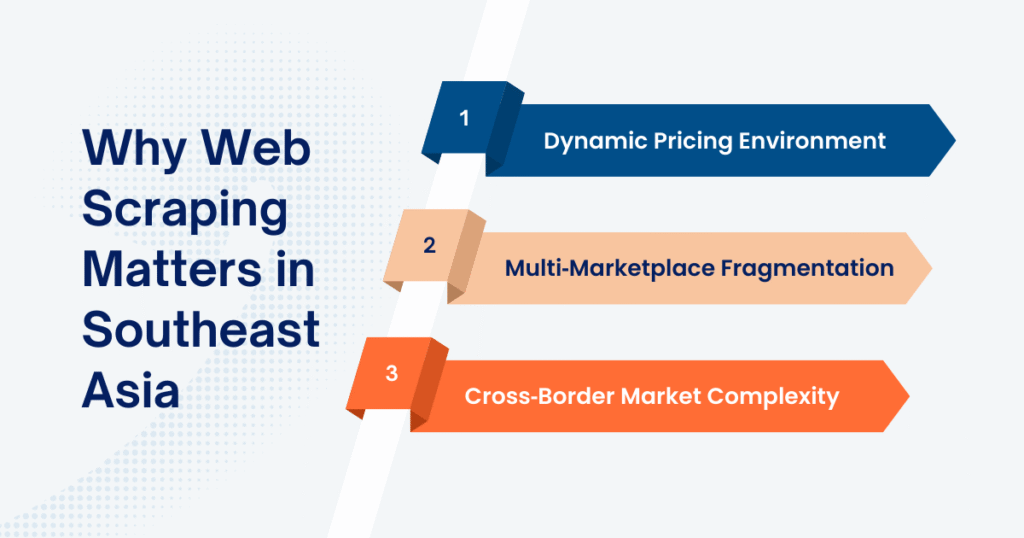
Pricing in Southeast Asian marketplaces changes constantly. Sellers frequently adjust prices in response to competitor actions, flash sales, or platform-wide campaigns. During large promotional events such as 9.9 or 11.11 sales, thousands of products may experience multiple price updates within a single day.
For e-commerce businesses trying to stay competitive, relying on occasional manual checks is simply not enough. Web scraping enables continuous price tracking, allowing companies to monitor competitor movements in near real time.
Instead of reacting days later, businesses can immediately identify pricing gaps, discount strategies, and emerging pricing trends. This visibility is one of the clearest advantages of web scraping, particularly in environments where price elasticity directly affects conversion rates.
Fragmented Marketplace Ecosystem
In Southeast Asia, major marketplaces such as Shopee, Lazada, and TikTok Shop coexist with regional niche platforms and cross-border sellers. Each marketplace has different data structures, seller behaviors, and listing formats. For businesses operating across multiple platforms, manually consolidating information becomes extremely time-consuming.
Here, the advantages of web scraping go beyond speed. Scraping systems can automatically extract and standardize data from multiple platforms, creating a unified dataset that supports meaningful comparison and analysis. This is one reason many companies adopt ecommerce data scraping strategies when they begin scaling across the region.
Cross-Border Expansion Complexity
Southeast Asia’s e-commerce growth is heavily driven by cross-border trade. Brands often launch products simultaneously in several countries, each with unique pricing dynamics, seller competition, and consumer behavior. Without structured data collection, understanding these differences becomes nearly impossible.
One of the most strategic advantages of web scraping is the ability to gather localized marketplace data across multiple countries and evaluate demand signals before making major expansion decisions. Instead of relying on assumptions, businesses can analyze real product listings, pricing trends, and seller distribution before entering a new market.
5 Core Advantages of Web Scraping for E-commerce Businesses
While web scraping can serve many analytical purposes, its greatest value in e-commerce comes from enabling scalable market intelligence. This implies that the benefits of the advantages of web scraping directly influence pricing strategy, category planning, and competitive analysis.
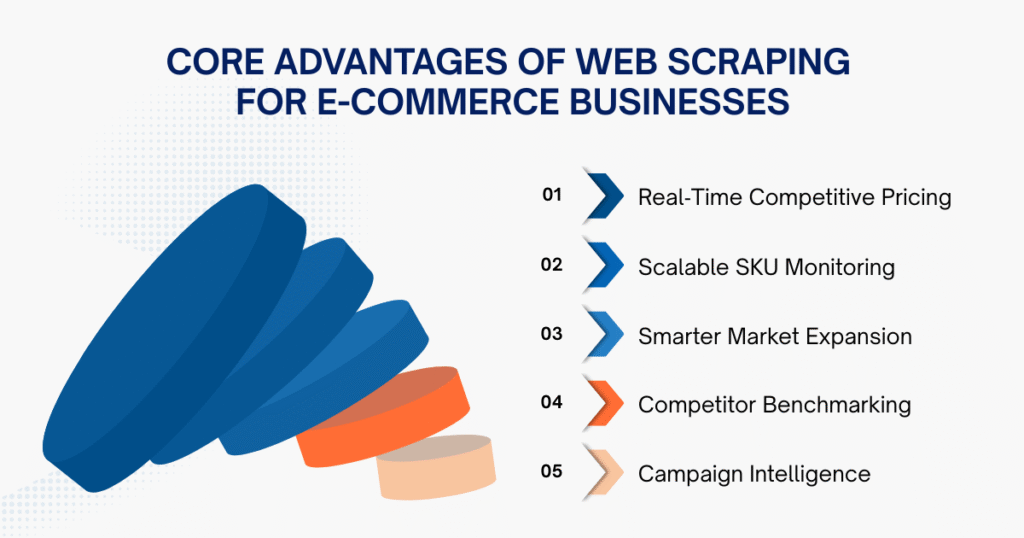
1. Real-Time Competitive Pricing Intelligence
One of the most immediate advantages of web scraping is the ability to track competitor pricing continuously.
Manual monitoring typically covers only a handful of products and is updated infrequently. In contrast, automated scraping can monitor thousands of SKUs simultaneously and refresh the data several times per day. This allows businesses to:
- Detect competitor price drops quickly
- Identify undercutting strategies
- Track discount patterns during campaigns
- Adjust pricing dynamically
For sellers operating in highly competitive categories such as electronics or beauty products, even small price differences can significantly affect conversion rates. Access to near real-time competitor pricing data enables faster and more confident pricing decisions.
2. Large-Scale SKU Monitoring
As product catalogs grow, manual monitoring quickly becomes impractical. A brand managing hundreds or thousands of SKUs cannot realistically track every competitor listing or price movement.
Another major advantage of web scraping is large-scale SKU monitoring. Automated web scraping can track:
- Product listings
- Price changes
- Review counts
- Seller ratings
- Inventory availability
Instead of looking at isolated products, businesses gain a comprehensive view of their entire category landscape. This broader perspective allows teams to identify emerging competitors, category shifts, or pricing patterns that might otherwise remain hidden.
3. Faster Market Expansion Decisions
Expanding into a new marketplace or category is always risky. Businesses need to evaluate demand, competitor density, and pricing viability before committing resources.
One of the most strategic advantages of web scraping is that it enables data-driven expansion analysis. By extracting marketplace data in advance, companies can examine:
- Number of active sellers in a category
- Average product pricing
- Review volume as a demand indicator
- Product positioning across competitors
This information helps teams determine whether a market is saturated or still offers room for growth. Instead of relying on intuition, expansion decisions become grounded in real marketplace evidence.
4. Seller & Competitor Benchmarking
Understanding competitors goes far beyond price tracking. E-commerce teams also need to understand how other sellers position their products, manage promotions, and accumulate reviews.
Another important advantage of web scraping is seller benchmarking. With consistent data collection, businesses can analyze:
- Top performing sellers in a category
- Product listing strategies
- Review accumulation patterns
- Rating trends across competitors
This type of competitive benchmarking reveals what actually drives success in a given marketplace. For example, a seller might discover that top competitors rely heavily on review velocity rather than aggressive pricing. That insight can significantly influence marketing and customer acquisition strategies.
5. Campaign & Promotion Optimization
Large promotional campaigns are a defining feature of Southeast Asian e-commerce. Events such as 9.9, 10.10, and 11.11 dramatically reshape pricing strategies and product visibility. Without data tracking, it is difficult to understand what actually happens during these campaigns.
One of the more overlooked advantages of web scraping is the ability to analyze campaign dynamics over time. By collecting data before, during, and after promotional events, businesses can study:
- Competitor discount strategies
- Price fluctuation patterns
- Product ranking shifts
- Review growth during campaigns
These insights allow companies to design more effective promotional strategies in future sales events.
Web Scraping vs Manual Monitoring
Manual monitoring is still used by some sellers, but it becomes difficult to maintain as product catalogs and marketplaces expand.
| Criteria | Manual Monitoring | Web Scraping |
| Speed | Slow, requires manual checks | Automated and near real-time |
| Scale | Limited number of products | Thousands of SKUs simultaneously |
| Accuracy | Prone to human error | Consistent structured extraction |
| Frequency | Occasional updates | Continuous monitoring |
| Strategic Depth | Surface-level insights | Enables advanced analytics |
The comparison highlights a fundamental shift. Manual monitoring may work for small product catalogs, but it quickly becomes unsustainable as operations scale.
The real advantages of web scraping appear when businesses need continuous, structured, and scalable marketplace intelligence. Instead of reacting to isolated observations, companies can build systematic insights that inform pricing, expansion, and promotional strategy.
Important Considerations Before Implementing Web Scraping
Although the advantages of web scraping are substantial, successful implementation requires careful planning.
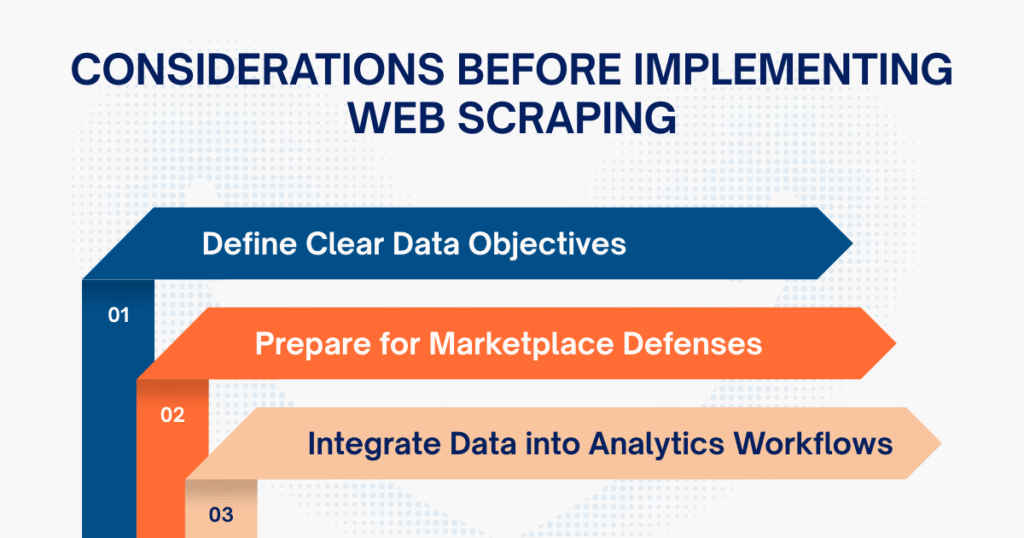
- Define data objectives clearly: Identify the exact fields needed for analysis (prices, reviews, seller metrics, rankings). Collecting unnecessary data can create complexity without delivering meaningful insights.
- Prepare for marketplace defenses: E-commerce platforms may use rate limits, CAPTCHA challenges, or layout changes. Stable scraping systems need monitoring and regular adjustments to maintain reliable data extraction.
- Integrate data into analytics workflows: Raw datasets are most valuable when integrated into dashboards, pricing tools, or internal decision systems.
For businesses without internal scraping infrastructure, partnering with providers like Easy Data can simplify the process. Instead of building complex systems in-house, companies can rely on a dedicated ecommerce data scraping service to collect structured marketplace data on customized schedules, with datasets cleaned and standardized before delivery.
This allows ecommerce teams to track competitor prices, analyze market signals, and make faster pricing or expansion decisions with far less operational effort.
Conclusion
In Southeast Asia’s competitive digital marketplaces, businesses that rely solely on manual monitoring often struggle to keep pace with changes in market. The advantages of web scraping lie in its ability to transform scattered marketplace information into structured, reliable datasets that support real decision-making. When implemented thoughtfully, web scraping becomes a strategic foundation for data-driven growth across Southeast Asia’s rapidly evolving e-commerce landscape.
Leave a Reply