

A web scraping example website is more than a platform you can crawl, it’s a real-world data source that reveals how ecommerce markets actually behave. In fast-moving marketplaces shaped by pricing shifts, campaign cycles, and seller volatility, the right examples show what ecommerce web scraping can unlock strategically. This guide explores ten ecommerce platforms that demonstrate the real analytical power behind web scraping.
What Makes a Strong Web Scraping Example Website?
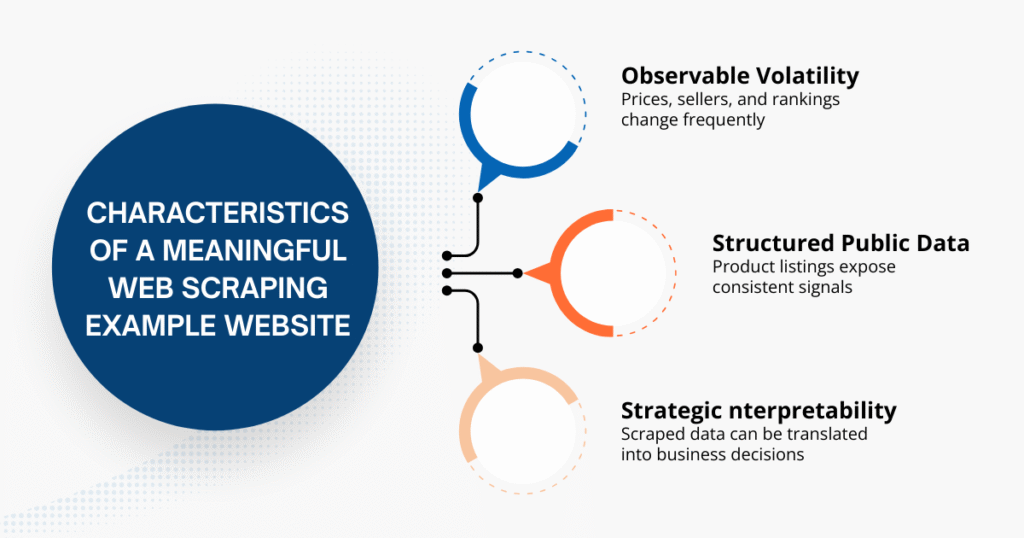
Not every ecommerce site is a meaningful web scraping example website. The best examples share three characteristics:
- Observable volatility – prices, sellers, and rankings change frequently
- Structured public data – product listings expose consistent signals
- Strategic interpretability – scraped data can be translated into business decisions
A good example doesn’t just allow scraping. It allows comparative observation over time, which is where real competitive insight emerges.
Top 10 Web Scraping Example Websites for Ecommerce
Below are ten ecommerce platforms structured as a complete ecommerce intelligence ecosystem (from upstream supply signals to downstream consumer marketplaces). Each platform represents a different analytical layer of competitive insight.
1. Alibaba (Upstream Supply Layer)
Alibaba is the world’s largest B2B sourcing platform and a foundational layer of the global supply chain. While retail marketplaces reflect consumer demand, Alibaba reveals upstream manufacturing capacity, supplier competition, and production economics.
As a web scraping example website, it offers forward-looking signals before products reach retail saturation.
What data is typically scraped:
- Minimum Order Quantity (MOQ)
- Tiered pricing by volume
- Supplier verification status
- Years active and transaction history
- Product certifications
- Newly listed SKUs
- Export regions and production lead times
Scraping Alibaba allows teams to:
- Estimate potential profit margins before market entry
- Detect early-stage product trends at manufacturing level
- Measure supplier concentration in a category
- Compare factory pricing against Amazon or Shopee retail prices
- Evaluate barriers to entry based on MOQ
A surge in supplier listings often precedes downstream price compression, making Alibaba a predictive competitive signal.
2. AliExpress (Cross-Border Retail Supply)
AliExpress operates as the consumer-facing extension of upstream suppliers. It bridges factory pricing and global retail dropshipping markets.
Data fields with exploitable values:
- Product price
- Order volume
- Shipping regions
- Seller ratings
- Variant listings
Scraping AliExpress helps:
- Estimate margin spread between supplier and retail markets
- Identify trending SKUs before local saturation
- Detect global shipping strategy shifts
- Map supplier-to-retail competitive pipelines
It connects sourcing intelligence with consumer marketplace behavior.
3. TikTok Shop (Demand Acceleration Layer)
TikTok Shop represents the convergence of content distribution and commerce. Demand can spike within hours due to viral exposure.
In Southeast Asia, it is reshaping product discovery and compressing product life cycles dramatically.
Teams typically scrape the following data fields:
- Product ranking
- Influencer-linked SKUs
- Engagement metrics (views, likes, shares)
- Livestream frequency
- Discount duration
Scraping TikTok Shop enables teams to:
- Detect viral product acceleration early
- Correlate engagement velocity with ranking shifts
- Identify short lifecycle patterns
- Forecast temporary spikes vs sustainable growth
- Monitor influencer-driven demand concentration
In SEA markets, engagement velocity often precedes ranking changes. This web scraping example shows how social signals convert into demand spikes (unavailable in traditional marketplaces).
4. Shopee (Campaign-Driven SEA Marketplace)
Shopee is the most campaign-driven ecommerce ecosystem in Southeast Asia. Flash sales, voucher stacking, and ranking volatility create structural price instability.
For SEA-focused businesses, Shopee is an ideal web scraping example website for pricing pressure and seller density.
Teams typically scrape:
- Base price vs discounted price
- Voucher combinations and campaign flags
- Units sold (cumulative and incremental)
- Shop ratings and response rate
- Follower growth
- Keyword-based ranking position
Scraping Shopee helps:
- Separate structural pricing from campaign distortion
- Detect seller entry velocity in categories
- Measure promotion dependency
- Identify ranking manipulation during mega campaigns (9.9, 11.11, 12.12)
- Forecast margin compression before revenue decline appears
On Shopee, ranking shifts often precede pricing changes, making volatility monitoring a competitive early-warning system.
5. Lazada (Structured SEA Marketplace)
Lazada operates within the same region as Shopee but with stronger official store influence and more structured brand positioning. It serves as a structural contrast to campaign-heavy marketplaces. This is a potential multi-market web scraping example website scenario.
Important data fields:
- Official Store vs marketplace seller status
- Promotional labeling
- Inventory availability
- Review velocity
- Brand portfolio presence
Scraping Lazada allows teams to:
- Measure official brand dominance
- Compare brand-controlled pricing vs marketplace discounting
- Detect inventory tightening before major campaigns
- Analyze cross-platform divergence between Shopee and Lazada
For regional expansion, Lazada often reveals brand-level pricing discipline not visible on Shopee.
6. Amazon (Global Retail Benchmark)
Amazon remains the most mature and algorithmically structured ecommerce ecosystem globally. Its ranking, pricing automation, and review-driven demand signals create measurable competitive dynamics.
What data is typically scraped:
- Product titles and ASINs
- Price (current and historical)
- Best Seller Rank (BSR)
- Ratings and review counts
- Seller information
Scraping Amazon enables:
- Category saturation detection
- Demand velocity estimation via review growth
- Competitive price compression analysis
- Private label opportunity benchmarking
Amazon data often functions as a proxy for global ecommerce demand behavior.
7. Walmart Marketplace (Hybrid Retail Model)
Walmart blends traditional retail pricing discipline with marketplace competition.
Data that teams care about most:
- First-party vs third-party price gaps
- Availability signals
- Promotional cycles
Scraping Walmart helps identify:
- Brand protection enforcement
- Channel conflict
- Price stabilization patterns
It is useful for analyzing hybrid retail–marketplace ecosystems.
8. eBay (Auction-Based Demand)
Unlike fixed-price platforms, eBay includes auction-based demand signals reflecting real buyer willingness to pay.
Valuable data to scrape:
- Final bid price
- Listing duration
- Seller rating
- Used vs new condition
Scraping eBay enables:
- Secondary market pricing analysis
- Lifecycle value validation
- Demand elasticity measurement
It provides demand validation often absent from fixed-price marketplaces.
9. Etsy (Niche & Personalization Market)
Etsy represents niche, handmade, and personalized ecommerce segments with premium positioning.
On Etsy, teams often focus on:
- Product variations
- Customization options
- Review depth
- Seller longevity
Scraping Etsy reveals:
- Micro-brand demand clusters
- Premium price tolerance
- Personalization-driven differentiation
For niche ecommerce strategies, Etsy is a highly specialized web scraping example website.
10. Zalora (Vertical Fashion Marketplace)
Zalora focuses on branded fashion across Southeast Asia and emphasizes seasonal inventory cycles.
Featured data:
- Brand portfolio distribution
- Seasonal discount timing
- Inventory rotation signals
Scraping Zalora enables:
- Seasonal pricing curve analysis
- Brand markdown strategy tracking
- Fashion trend timing observation
It provides vertical-specific intelligence for apparel markets.
How These Example Websites Are Used in Practice
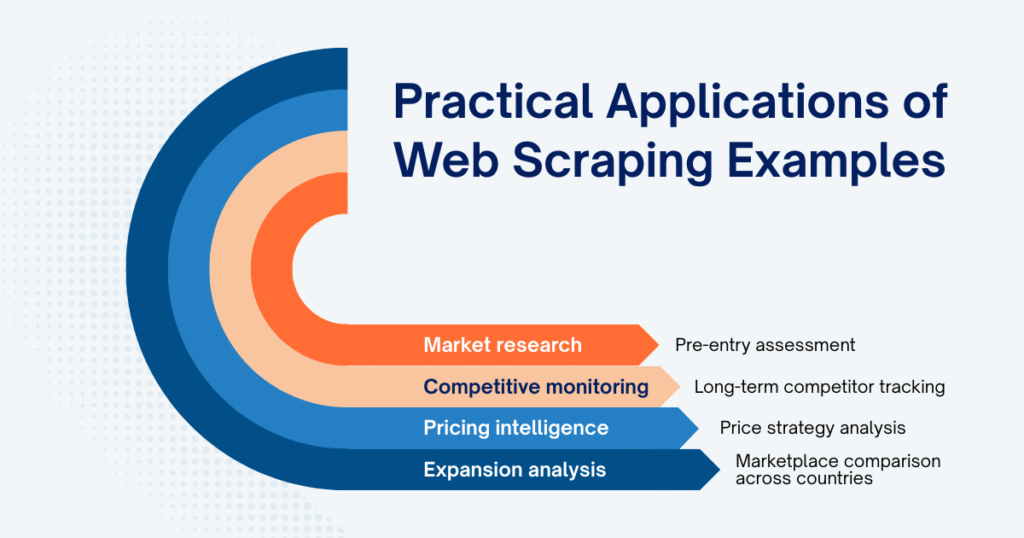
In practice, these web scraping examples like the ones above typically serve the following purposes:
- Market research: Pre-entry assessment
- Competitive monitoring: Long-term competitor tracking
- Pricing intelligence: Price strategy analysis
- Expansion analysis: Marketplace comparison across countries
However, keep in mind that a web scraping example only shows you the potential. If you want to implement it at scale, you need a clearer structure
From Example to Scalable System
Many people start with a simple web scraping example: try scraping 100 products. But when you need to track 10,000 SKUs, require daily data, or need to standardize prices across campaigns, etc., the small example is no longer sufficient. This is when you have to move from “practice” to “system.”
Many of Easy Data‘s Southeast Asian partners start with a DIY web scraping example, but after a few months face:
- Script errors when the layout changes
- Inconsistent data
- No long-term history
To help partners overcome these limitations, Easy Data’s ecommerce data scraping service is designed for custom scraping, collecting data daily, weekly, or by campaign phase, standardizing and updating continuously, aiming not just to scrape data but to ensure it’s stable enough for strategic analysis.
If you are also at that stage, learn more how to implement automated web scraping for data-driven strategies, thereby creating a real competitive advantage for your business.
Conclusion
A true web scraping example website not only shows you “what can be scraped”, but also helps you understand “what that data says about the market”. When viewed correctly, marketplaces like Shopee, TikTok Shop, Lazada, etc. are not just places to sell goods, but continuous sources of competitive signals.
Most importantly: “Understanding examples correctly is the first step. Turning it into a sustainable data system is the step that creates an advantage.”
Leave a Reply