

A web scraping service often becomes essential the moment an ecommerce team tries to track competitors manually. At first, analysts check product pages, enter prices into spreadsheets, and update reports weekly. But as product catalogs grow and promotions change daily, the process quickly breaks down. Automated web scraping turns that scattered market activity into structured datasets that teams can actually use.
What Is a Web Scraping Service?
A web scraping service is a specialized solution that automatically collects structured data from websites and delivers it in formats businesses can analyze, such as APIs, dashboards, or databases.
Unlike simple scraping scripts or one-off data exports, professional services are designed to run continuously and reliably. They monitor target websites, extract relevant information, clean inconsistencies, and deliver structured datasets that can be integrated into analytics systems.
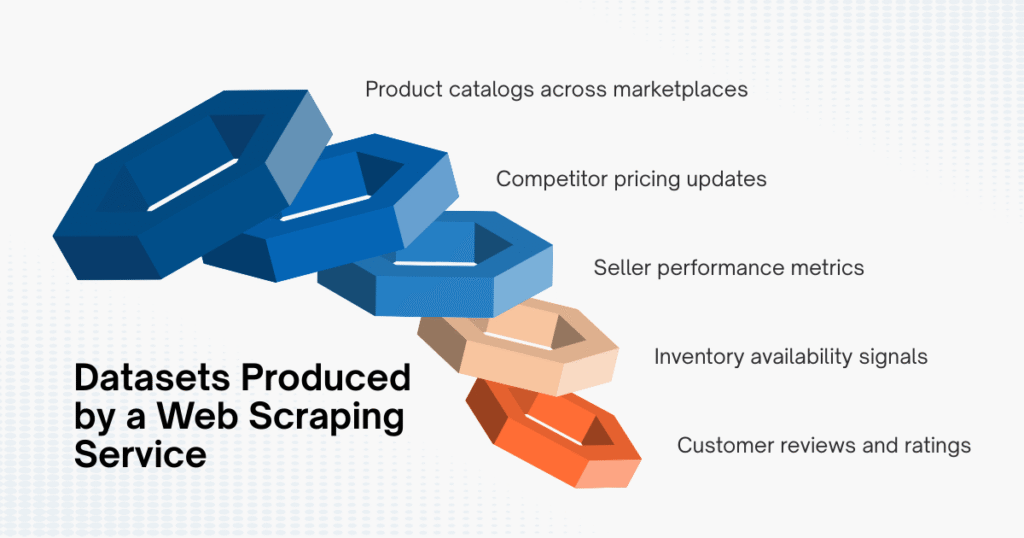
Typical datasets produced by a web scraping service may include:
- Product catalogs across marketplaces
- Competitor pricing updates
- Seller performance metrics
- Inventory availability signals
- Customer reviews and ratings
For organizations operating in competitive ecommerce environments, these datasets provide a near real-time view of the market. This capability is particularly valuable for companies building long-term strategies around web scraping for ecommerce.
Why Manual Data Collection Fails at Scale
Many businesses initially collect market data manually. Analysts visit product pages, copy pricing information into spreadsheets, and update reports periodically. This approach works when the dataset is small.
However, once businesses start monitoring hundreds or thousands of listings, manual data collection quickly becomes impractical. Several limitations emerge:
- Slow data collection: Updating thousands of listings manually can take days, meaning the information is already outdated when analysis begins.
- Inconsistent formatting: Different analysts may record data differently, leading to missing fields or inconsistent structures.
- Rapid marketplace changes: Flash sales, promotions, and competitor pricing adjustments happen frequently, making static spreadsheets unreliable.
A professional web scraping service addresses these limitations by automating the entire data pipeline (from extraction to structured delivery). The insight here is straightforward: the value of market data depends heavily on freshness and scale, two things manual workflows rarely provide.
Key Benefits of a Professional Web Scraping Service
Organizations invest in a web scraping service because it enables consistent access to external market data that would otherwise be extremely difficult to collect. Several strategic advantages explain why these services are increasingly common among e-commerce companies.
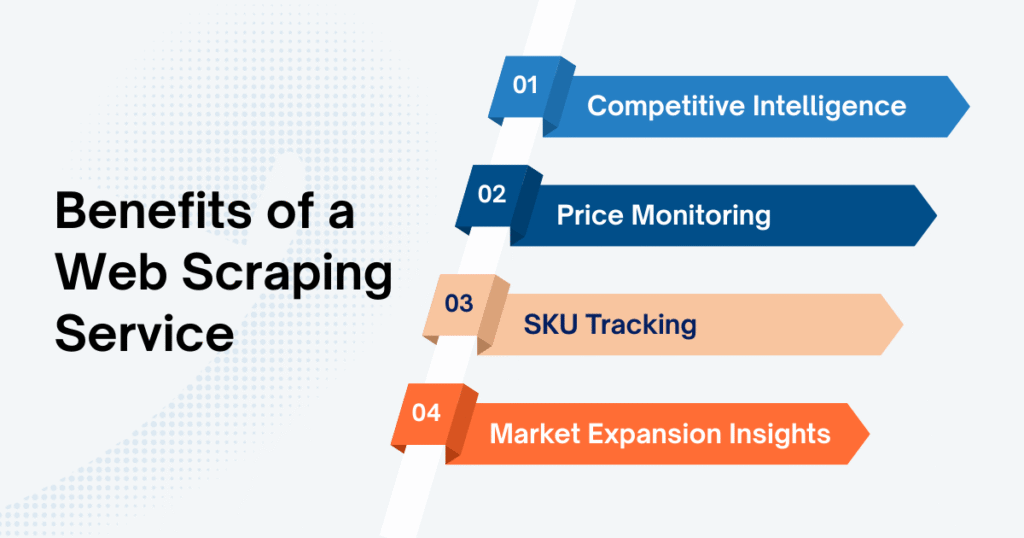
Competitive Intelligence
One of the most common reasons businesses use a web scraping service is to monitor competitor behavior. By collecting pricing, promotions, product listings, and seller activity across marketplaces, companies gain a clearer understanding of how competitors position their products. This information helps teams answer questions such as:
- Which competitors are lowering prices?
- Which products are gaining visibility in search results?
- Which categories are becoming more competitive?
Over time, these datasets reveal patterns that support smarter pricing and product strategies.
Price Monitoring
Retailers often track competitor pricing across marketplaces such as Shopee, Lazada, or Amazon to ensure their offers remain competitive. A web scraping service can monitor thousands of listings automatically and alert teams when prices change. This allows businesses to respond quickly to promotions or aggressive discounting by competitors.
SKU Tracking
Large marketplaces contain millions of product listings, and tracking individual SKUs manually becomes impossible as catalogs expand. With a dedicated web scraping service, companies can monitor specific product IDs across marketplaces to understand:
- Where their products are being sold
- How pricing differs between sellers
- Whether unauthorized resellers appear
This visibility is especially valuable for brands managing large product portfolios.
Market Expansion Insights
Companies entering new markets often lack reliable local data. A web scraping service allows them to analyze product availability, pricing trends, and seller competition before launching operations in a new region. By observing marketplace activity in advance, businesses can better estimate demand and identify opportunities for differentiation.
The broader insight is that scraped data does not simply describe the current market; it can also inform expansion strategy.
How a Web Scraping Service Actually Works
Behind the scenes, a professional web scraping service is built on a multi-layered data pipeline. While the technical details vary between providers, most solutions follow a similar structure.
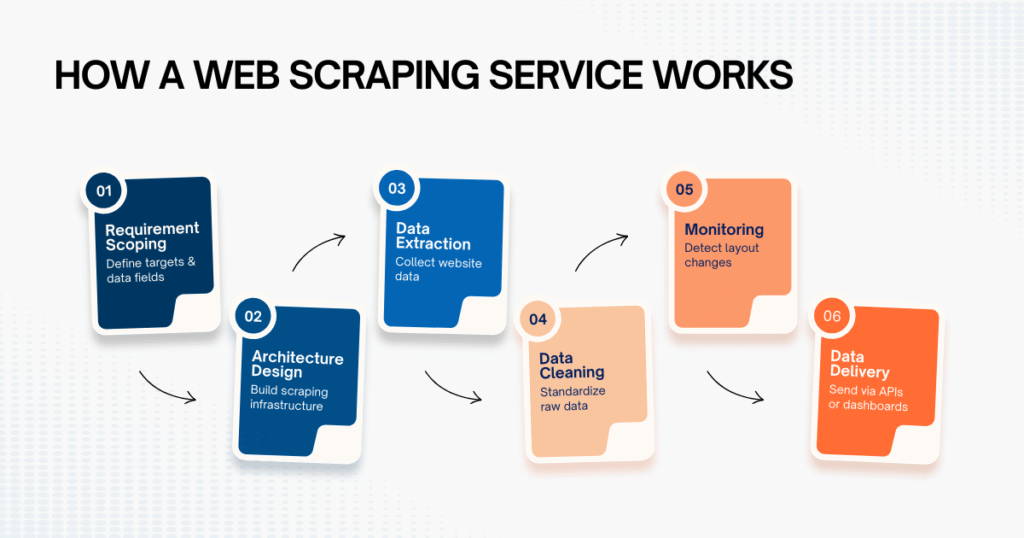
Requirement Scoping
Every project begins by defining the business objectives. This stage determines which websites will be monitored, what data fields need to be collected, and how frequently the data should be updated. Clear scoping ensures that the resulting dataset aligns with the company’s analytical goals.
Architecture Design
Once requirements are defined, engineers design the scraping infrastructure. This includes proxy management, request scheduling, and data storage architecture capable of handling large volumes of web data. The goal is to build a resilient system that can operate continuously without interruption.
Extraction Layer
At the extraction stage, automated scrapers access targeted web pages and retrieve the relevant data fields. Modern scraping systems often use a combination of headless browsers, parsing engines, and request automation to collect data efficiently.
Cleaning & Normalization
Raw web data is rarely clean. Prices may appear in different currencies, product names may contain inconsistent formatting, and seller information may vary across pages. Data cleaning and normalization processes standardize these fields so that datasets remain consistent and usable.
Monitoring & Alerts
Websites change frequently. When page structures update, scraping rules may break. Professional providers implement monitoring systems that detect these changes immediately and alert engineers so extraction rules can be updated.
Delivery Integration
Finally, the processed data is delivered to the client through APIs, dashboards, or scheduled exports. This integration step ensures that the web scraping service fits directly into the company’s existing data workflows.
Common Challenges & How Professionals Solve Them
Scraping websites at scale introduces several technical challenges that many organizations underestimate. Some of the most common obstacles include:
- Anti-bot systems that block automated requests
- Captcha protections on login or search pages
- IP rate limits imposed by large platforms
- Frequent HTML layout changes
- Geo-restricted content
Professional providers address these issues through a combination of proxy management, adaptive parsers, and continuous monitoring. The key insight here is that scraping infrastructure requires constant maintenance. Without dedicated expertise, even well-built internal scrapers often break within weeks or months.
When Should You Move from Internal Tools to a Web Scraping Service?
Many companies begin with internal scraping tools or open-source libraries. This approach works well for experimentation or small datasets. However, several signals often indicate it may be time to adopt a professional web scraping service.
- The number of monitored pages grows into the thousands
- Internal scripts break frequently when websites update
- Analysts spend significant time fixing data pipelines
- Data delivery must integrate with business systems
At this stage, maintaining internal scrapers can become more expensive than outsourcing the infrastructure. The transition is less about technical capability and more about operational efficiency.
Why Businesses Across SEA Work with Structured Providers
Southeast Asian marketplaces such as Shopee, Lazada, and TikTok Shop evolve rapidly. Page structures change frequently, promotional campaigns introduce new listing formats, and anti-bot protections are increasingly sophisticated. Because of this complexity, many companies in the region choose to partner with specialized web scraping service providers rather than build scraping systems internally.
Organizations working with providers like Easy Data often focus on the strategic side of market intelligence instead of the technical challenges of maintaining scrapers. Through scalable ecommerce data scraping pipelines, teams can monitor:
- Shopee data scraping insights
- Lazada data scraping trends
- TikTok Shop data scraping activity
Instead of managing infrastructure, companies receive clean, structured datasets ready for analysis. For fast-growing digital markets across Southeast Asia, this approach allows businesses to move from fragmented data collection to a consistent, long-term data strategy.
Final Thoughts
External market data is becoming a central component of modern digital strategy. A reliable web scraping service allows businesses to continuously monitor competitors, track pricing dynamics, and understand marketplace activity at a scale that manual research cannot achieve.
However, the true value of scraping lies not only in extracting information but in delivering clean, structured datasets that can support decision-making. Organizations that treat web scraping as part of their broader data infrastructure (rather than a temporary automation project) are far more likely to gain sustainable competitive advantages.
Leave a Reply