


Web scraping CAPTCHA: diagnose the interruption
Reviewed October 4, 2026. A CAPTCHA or anti-bot challenge can interrupt an e-commerce data collection job. The first task is to identify what the server returned and keep challenge pages out of the dataset. This guide explains the evidence to record, the limits of common tools and how to plan an authorized collection route. It corrects our earlier claims that proxy rotation, OCR or solving services would keep collection running without interruption. We have not benchmarked those products against a named marketplace.
CAPTCHA types and what their results mean
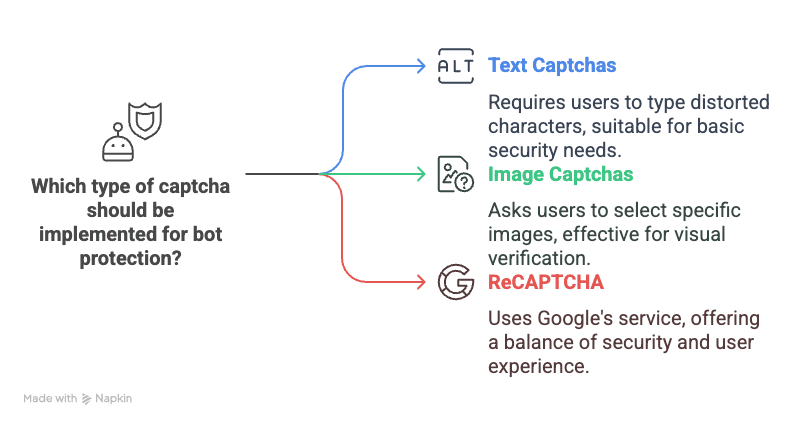
CAPTCHA stands for Completely Automated Public Turing test to tell Computers and Humans Apart. Text and image challenges ask for a response, but modern bot checks do not always display a puzzle. A page containing a security widget is not itself proof that every request was blocked.
- Text and image challenges: distorted characters or image-selection tasks are examples of interactive checks. Record that a challenge appeared separately from whether a product page was subsequently retrieved.
- Google reCAPTCHA: Google distinguishes checkbox and invisible v2 from score-based v3. A v2 checkbox may pass a visitor or request further interaction. v3 returns an interaction score for the site to evaluate; it is not simply an image puzzle.
-
Cloudflare Challenge Pages: Cloudflare documents the response header
cf-mitigated: challengeand atext/htmlcontent type. This identifies its Challenge Pages, not every provider’s bot protection. The absence of that header does not prove you received the expected data.
For a collector, the meaningful success condition is a valid response with the expected fields. A token, a rendered page or an HTTP success status alone does not demonstrate complete product data. Keep transport status, challenge classification and parsing validation as separate results.
Measure missing data and collection delays
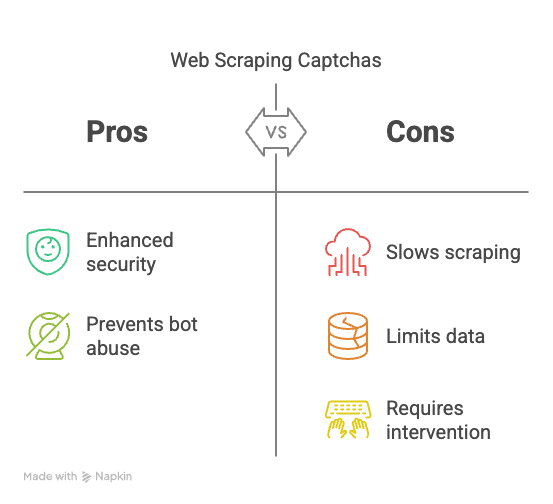
- Delay: record the last successful observation and the time the job stopped. An older price remains an older observation even if the job ran again today.
- Missing coverage: keep challenged, rate-limited and parsing-failed URLs in separate counts. A missing row is not evidence that a product was deleted, out of stock or sold zero units.
- Operational cost: measure usable unique records, elapsed time and retries. A request count or a solver response count is not a delivery-quality metric.
Fictional reconciliation example. A scheduled job has 100 unique product URLs, each attempted once: 72 produce valid rows, 18 return recognized challenges, 6 are rate-limited and 4 fail field validation. The categories are mutually exclusive and sum to 100. Usable coverage is 72 ÷ 100 = 72%; 28 URLs remain unresolved. This is a teaching example, not an Easy Data or marketplace success-rate claim.
For an average-price report, state that it uses the 72 observed products. Do not fill the other 28 prices with zero or claim the sample represents the entire category. If retries later yield records, reconcile by product and variant key rather than adding attempts to the unique-product count. Our website scraping workflow explains field validation before export.
Respond to challenges without corrupting your dataset
Agree on the collection route first: an official API, an owner-provided export, a licensed feed or a specifically permitted website workflow. Confirm the available fields, refresh interval, access scope and failure-handling contact. These routes have their own quotas and coverage limits; do not assume they reproduce every field shown in a browser.
| Observation | Next action |
|---|---|
| Recognized challenge | Quarantine the response; pause that collection route and record the evidence. |
| HTTP 429 | Record the rate-limit response and any Retry-After value; reschedule within the agreed access limits. |
| HTTP 200 with wrong fields | Reject the candidate row; inspect content type, login redirects and schema changes. |
| Valid expected fields | Validate identity, currency, timestamp and required values before accepting a record. |
| Unclear response | Keep an unknown category for review; do not silently classify it as a CAPTCHA or success. |
RFC 6585 defines HTTP 429 as rate limiting and allows a Retry-After header. A 429 is not, by itself, a CAPTCHA diagnosis. Reduce unnecessary repeat work through caching and deduplication within the agreed workflow; random delays do not establish permission or guarantee access.
- Solving services: our earlier list named 2Captcha, Anti-Captcha and DeathByCaptcha without a source-specific evaluation. This article makes no recommendation or availability claim for them. Before assessing any vendor, establish authorization, supported challenge type, data handling, cost per usable result, failure behavior and a bounded evaluation plan.
- Proxies: changing a network address does not prove a request came from a human or establish that the resulting data is complete. We withdraw the unsupported claim that residential proxies are especially effective for this use case; no comparative test was provided.
- OCR: Tesseract is a text-recognition engine that extracts printed text from images. That capability does not establish a general solution for image-selection challenges, interaction scoring or server-side verification. The earlier “Captcha Breaker” recommendation likewise lacked a tested configuration. See our AI extraction tool comparison for the distinction between extraction and validation.
- Your own protected site: Google requires server-side response verification; its reCAPTCHA response tokens expire after two minutes and can be verified once. For your own Turnstile integration, Cloudflare supplies dummy test keys for controlled pass/fail testing. Use them in a separate development environment and retain real protection in production. Test keys do not grant access to another operator’s site.
Check access terms and personal-data obligations
Technical access and permission to collect or reuse data are separate questions. For each source, record the applicable terms or agreement, allowed fields, refresh limits, retention and permitted recipients. Recheck them when the source, purpose or delivery scope changes. A successful request or solved challenge is not a legal clearance.
- Robots rules: honor the source’s crawler instructions. The Robots Exclusion Protocol explicitly distinguishes these rules from access authorization. An allowed path is not a blanket data-use license.
- Personal information: a joint statement by privacy regulators explains that publicly accessible personal information remains subject to privacy and data-protection law in most jurisdictions. Do not assume visible seller contacts or reviewer details are unrestricted. Assess the relevant jurisdiction and lawful basis, minimize collection and obtain qualified advice for unresolved legal questions.
- Third parties: document what a collection or solving vendor would receive. Avoid sharing session credentials, private account content or personal information outside the agreed purpose. Record who reviews failures and who can authorize a change in collection scope.
A practical collection handoff checklist
A dependable collection process reports what was observed and what remains missing. For the next job, prepare a short handoff:
- The source, approved route, intended use and collection owner.
- The unique URL or item list, required fields, variant key, currency and observation timestamp.
- The permitted rate, retry limit, stop condition and escalation contact.
- The counts of valid, challenged, rate-limited, invalid and unknown results, using one defined denominator.
- The unresolved coverage and any effect on the downstream report, with no invented replacement values.
Use the response worksheet to investigate an interruption before selecting a tool. Agree on a measurable deliverable—validated records and explicit gaps—rather than a promise to bypass every CAPTCHA. To discuss source access and a collection specification, visit Easy Data’s services or use the existing demo link below.
Leave a Reply