

By 2026, Southeast Asia’s ecommerce landscape has become far more competitive and volatile than it was just a few years ago. As marketplaces, social commerce, and pricing strategies continue evolving rapidly, ecommerce data has gradually become a core part of how businesses operate and make decisions.
That is also why demand for ecommerce data providers in Southeast Asia is growing rapidly. However, the market now includes many different types of data providers. In this article, Easy Data breaks down the most common ecommerce data provider models in SEA, the key differences between them, and which type of data partner fits different business use cases.
What is an Ecommerce Data Provider?
An ecommerce data provider is a company that specializes in collecting, processing, and delivering raw or standardized ecommerce data from online marketplaces to support market research, competitor analysis, pricing monitoring, and faster operational decision-making.
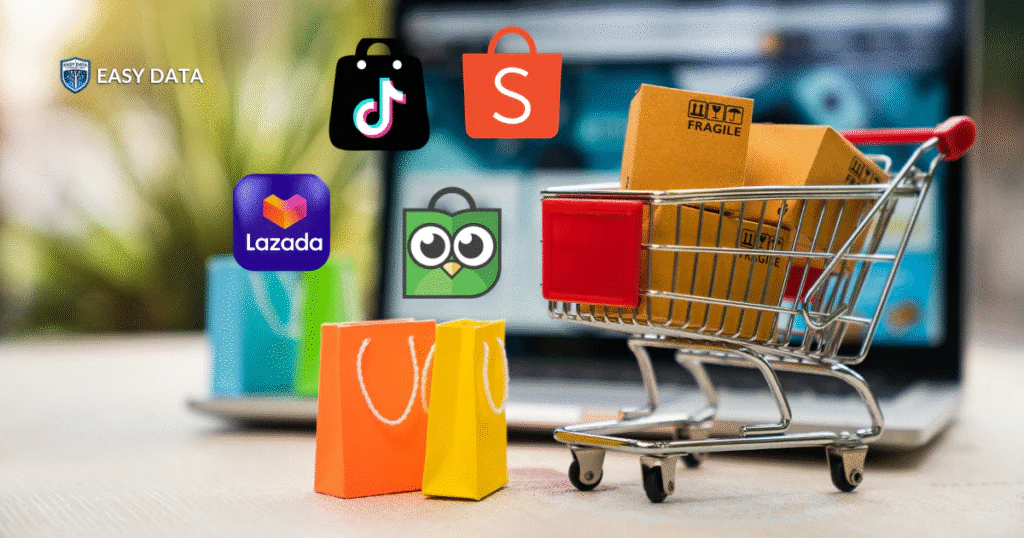
In Southeast Asia, the role of an ecommerce data provider often goes beyond simply supplying data. More importantly, they help businesses track how marketplaces are evolving across major regional platforms such as Shopee, Lazada, TikTok Shop, and Tokopedia, from pricing movements and product trends to seller competition and marketplace behavior.
What Does an Ecommerce Data Provider Actually Deliver to SEA Businesses?
In Southeast Asia, ecommerce data is no longer limited to high-level dashboards or periodic market reports. As marketplaces become increasingly competitive and shopping behavior shifts rapidly across platforms, businesses now require different layers of data to support everything from daily operations to long-term growth strategies.
As a result, ecommerce data providers today typically offer multiple categories of datasets and use cases, depending on what businesses want to monitor, analyze, or optimize across marketplaces.
What data does an ecommerce data partner in SEA provide?
| Data Category | Typical Data Included |
| Product Data | Product listings, SKU variations, inventory levels, sales volume, reviews & ratings, product rankings |
| Pricing & Promotion Data | Product pricing, voucher pricing, flash sales, free shipping, combo promotions, promotion frequency |
| Seller Intelligence | Seller performance, estimated sales, review growth, campaign participation, shop expansion |
| Keyword & Search Data | Trending keywords, search rankings, keyword visibility, search volume trends |
| Marketplace Trends | Category growth, market share movements, trending products, consumer demand signals |
| Livestream & Social Commerce Data | Creator performance, livestream engagement, watch time, viral product signals |
| Cross-border Ecommerce Data | International sellers, cross-border pricing, fulfillment activity, localization trends |
| Review & Consumer Feedback Data | Customer sentiment, review velocity, rating changes, feedback patterns |
| Operational Marketplace Data | Fulfillment speed, shipping performance, campaign participation, seller response metrics |
How SEA Businesses Actually Use Ecommerce Data
- Competitor Pricing Monitoring: Track competitor pricing, voucher changes, flash sales, and promotion frequency to respond quickly to pricing competition across Shopee, TikTok Shop, and other major SEA marketplaces.
- Marketplace Trend Tracking: Analyze category growth, trending products, market share movement, and consumer demand shifts to understand where the market is heading and which categories are growing fastest.
- Keyword & Search Visibility Analysis: Monitor trending keywords, search rankings, keyword visibility, and organic product positioning to optimize product discoverability on search-driven platforms such as Shopee and Lazada.
- Campaign & Promotion Analysis: Evaluate flash sale performance, livestream campaigns, pricing impact, and promotion timing to improve campaign effectiveness during major sales periods.
- Seller & Competitor Intelligence: Track seller performance, review growth, campaign participation, shop expansion, and category competition to understand how competitors are scaling and which sellers marketplaces are prioritizing.
- Livestream & Social Commerce Analytics: Analyze creator performance, livestream engagement, watch time, and viral product signals to measure how content and social commerce influence conversions.
- Cross-border Ecommerce Monitoring: Track international sellers, cross-border pricing, fulfillment activity, and localization trends across markets to support regional expansion and cross-border ecommerce strategies.
- Internal BI & Ecommerce Analytics: Sync marketplace data into Power BI, Looker Studio, or internal dashboards so teams can continuously monitor ecommerce performance instead of relying on manual reports or delayed datasets.
Types of Ecommerce Data Providers in Southeast Asia
Ecommerce data providers in Southeast Asia currently operate under very different models, with each model optimized for a specific set of business needs.
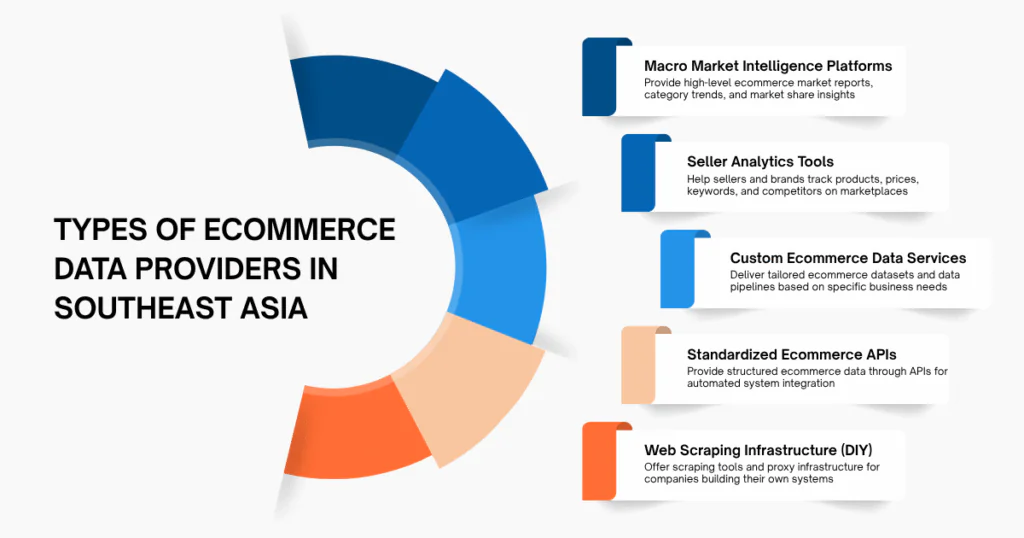
Before investing in any data solution, businesses should clearly understand the differences between provider categories to avoid choosing the wrong model, incurring unnecessary costs, or creating data systems that become difficult to scale later.
| Provider Type | Main Deliverables | Best Fit For | Common Ecommerce Data Providers |
| Macro Market Intelligence Platforms | Market reports, macro dashboards, monthly/quarterly category trends | FMCG brands, consulting firms, regional strategy teams | Cube Asia, Euromonitor, Statista |
| Seller Analytics Tools | Shop analytics dashboards, product insights, keyword tracking, marketplace trends | SMEs, marketplace sellers, MCNs, ecommerce enablers | Magpie (Magpie DBX), YouNet ECI, Kalodata |
| Custom Ecommerce Data Services | Custom datasets, real-time marketplace data, API/Webhook/S3 feeds | Enterprise brands, regional ecommerce teams, marketplace operations | Easy Data, XByte, iWebDataScraping, Grepsr |
| Standardized Ecommerce APIs | Fixed-format ecommerce APIs from Shopee, Lazada, Amazon, etc. | Developer teams, internal analytics systems | Charted Sea, Rainforest API |
| Web Scraping Infrastructure (DIY) | Proxy systems, scraping browsers, anti-bot & CAPTCHA solutions | Teams with in-house data engineers building scraping systems | Bright Data, Apify, Oxylabs |
Top Ecommerce Data Providers in SEA (2026)
The biggest difference between ecommerce data providers in SEA today is not who owns more data, but rather how deep the data goes, how real-time it is, and how well it fits a specific business use case.
Below are seven notable ecommerce data providers in Southeast Asia for 2026, based on their ability to process real marketplace data and support different business models.
1. Easy Data
Easy Data is a custom ecommerce data provider focused entirely on the Southeast Asian market, operating under a fully managed data service model that delivers custom datasets tailored to each business use case.
- Key Capabilities: Easy Data can scrape deeply down to the SKU level across both web and mobile apps (Shopee, TikTok Shop, Lazada). With specialized anti-bot bypass solutions built for SEA marketplaces, Easy Data is able to collect real-time marketplace data.
- Data Delivery: After collection, raw data goes through cleaning and deduplication before being continuously delivered via API, Webhook, S3, or CSV/Excel exports for direct integration into BI tools such as Power BI and Looker.
- Limitations: Because the implementation is highly customized, initial setup time is usually required to standardize the data structure for each business case.
- Best for: Enterprise brands, data agencies, and ecommerce enablers that need highly clean raw data to automate pricing strategies, internal BI systems, or custom dashboards.
Explore Easy Data’s E-commerce Data Services
Click to discover real-time crawling solutions for Shopee, TikTok Shop, and Lazada.
2. Cube Asia
Cube Asia is a well-known market intelligence platform for regional strategy teams across Southeast Asia, specializing in macro-level ecommerce market insights.
- Key Capabilities: Aggregates large-scale market data to generate market share reports, category trends, and top-brand performance analysis.
- Limitations: The data is primarily macro-level and usually updated monthly or quarterly. Businesses cannot deeply access raw data or request custom data feeds for daily operations.
- Best for: FMCG brands and consulting firms that need high-level market insights for planning, pitching, or evaluating regional strategies.
3. Magpie / Magpie DBX
Magpie DBX is a premium digital shelf analytics solution designed for multinational corporations that need to control brand visibility across ecommerce platforms.
- Key Capabilities: Provides a powerful platform for tracking content compliance, pricing violations (MAP monitoring), share of search, and out-of-stock rates.
- Limitations: As a packaged SaaS platform, customization for raw data feeds and integration into proprietary data warehouses is relatively limited.
- Best for: Enterprise brands and manufacturers that prefer a standardized digital shelf management solution instead of building internal systems from scratch.
4. Kalodata
Kalodata is a data analytics platform specifically built for the social commerce ecosystem, particularly TikTok Shop.
- Key Capabilities: Tracks livestream revenue, creator performance, short-video sales, and social commerce trends in detail. It is especially useful for measuring influencer marketing ROI and identifying viral products.
- Limitations: Entirely focused on TikTok Shop, with limited coverage of traditional search-driven marketplaces such as Shopee or Lazada.
- Best for: SMEs, MCNs, marketplace sellers, and brands heavily investing in TikTok Shop growth.
5. XByte
XByte is one of the world’s largest global data providers specializing in enterprise web scraping services.
- Key Capabilities: Handles large-scale data volumes, operates enterprise crawling infrastructure, and supports custom ecommerce data projects at global scale.
- Limitations: As a global provider, XByte’s scraping infrastructure can sometimes struggle with localized anti-bot systems and dynamic rendering behaviors specific to Shopee or TikTok Shop in SEA markets.
- Best for: Global brands requiring multi-platform ecommerce crawling beyond Southeast Asia.
6. Charted Sea
Charted Sea focuses on structured ecommerce APIs for businesses that want raw marketplace data to build internal analytics or BI systems.
- Key Capabilities: Delivers raw structured data rapidly through RESTful APIs. The fixed format makes testing and integration straightforward for developer teams.
- Limitations: APIs only return raw JSON data and do not include data cleaning services. Businesses must have internal data teams to handle deduplication, cleaning, and data mapping before using the data operationally.
- Best for: Developer teams or tech companies looking to purchase raw data for internal analytics systems.
7. Bright Data
Bright Data is a leader in infrastructure solutions (proxy networks and scraping browsers) for businesses building their own DIY data collection systems.
- Key Capabilities: Operates one of the largest proxy networks available, along with CAPTCHA bypass solutions, enabling businesses to overcome technical restrictions on many websites. Offers high crawling scalability and global coverage.
- Limitations: Bright Data sells infrastructure, not data itself. Businesses still need dedicated data engineering teams to build scraping scripts and continuously maintain systems whenever platforms change their interfaces. In addition, the total long-term operating costs are often quite high if the business has to maintain the entire internal system itself.
- Best for: Tech companies with experienced in-house data engineering teams that only require strong scraping infrastructure.
Summary Table of Leading Ecommerce Data Providers in Southeast Asia
| Ecommerce Data Provider | Data Model | Focus Market | Key Deliverables & Format | Update Frequency | Data Depth | Cost Model |
| Easy Data | Custom Managed Service | SEA (Shopee, TikTok, Lazada) | Custom datasets (API, S3, Webhook, CSV), cleaned data | Real-time / Customized | SKU-level, live pricing, inventory | Flexible project-based pricing |
| Cube Asia | Market Intelligence | SEA | Macro reports, dashboards (PDF, Web) | Monthly / Quarterly | Category / Brand level | Annual enterprise subscription |
| Magpie DBX | SaaS Analytics | Global / SEA | Digital shelf metrics, share of search (SaaS dashboard) | Daily / Weekly | Product / Keyword level | Enterprise SaaS pricing |
| Kalodata | SaaS Analytics | Global / SEA | Livestream sales, creator tracking (SaaS dashboard) | Daily | TikTok Shop social data | Standard SaaS subscription |
| XByte | Custom Managed Service | Global (Strong in US/EU) | Custom datasets (API, Cloud Storage) | Customized | Product / SKU level | Project-based pricing |
| Charted Sea | Standardized APIs | SEA | Raw structured data (JSON via REST API) | Real-time (on request) | Product ID level | Request-based pricing |
| Bright Data | DIY Infrastructure | Global | Proxy network, scraping browsers (dependent on user code) | Dependent on internal systems | Dependent on in-house scripts | Usage-based (GB / compute) |
Why Southeast Asia Requires Specialized Local Data Providers
Southeast Asia’s ecommerce market differs significantly across countries in terms of marketplace operations, consumer behavior, and data structures. That is also why many global ecommerce data providers struggle when operating in the region.
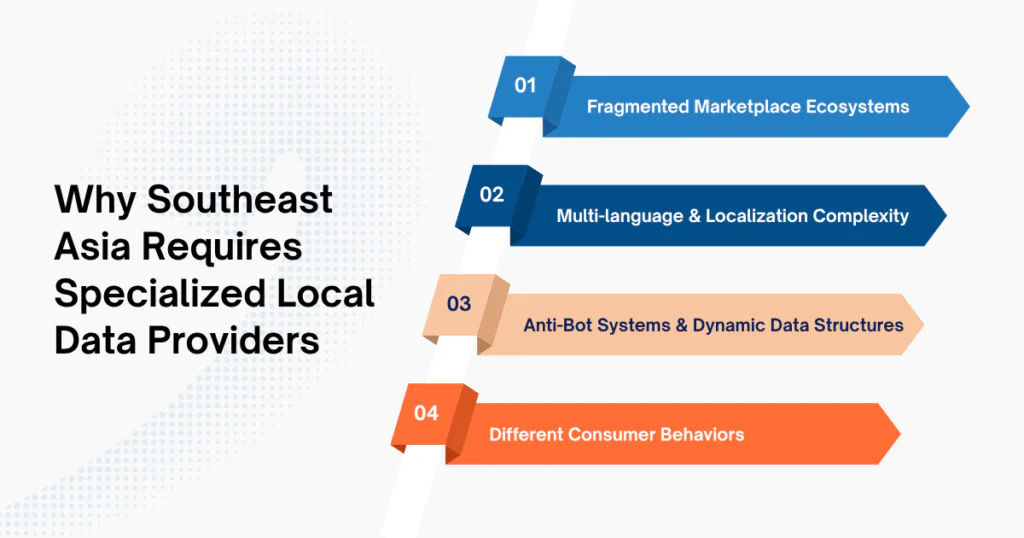
Fragmented Marketplace Ecosystems
Unlike the US or Europe where Amazon dominates ecommerce, Southeast Asia is highly fragmented across Shopee, Lazada, TikTok Shop, and Tokopedia. Each platform operates with different marketplace logic, data structures, and shopping behaviors.
Multi-language & Localization Complexity
Southeast Asia is an extremely localized market. The way users search for the same product in Vietnam, Indonesia, or Thailand can vary dramatically.
Beyond language differences, marketplace data in SEA is often highly messy due to inconsistent seller naming conventions. If an international ecommerce data provider relies only on standardized keyword scanning, their systems can miss up to 40% of market data because they fail to understand local naming variations.
Anti-Bot Systems & Dynamic Data Structures
This is the ‘graveyard’ of major international data-scraping tools. E-commerce platforms in Southeast Asia (particularly Shopee) possess highly sophisticated anti-bot systems (combining Cloudflare, Akamai, and AI-based behavioral detection). They constantly alter their web display structure (dynamic rendering) on an hourly basis and deploy dense layers of CAPTCHA barriers.
One of the biggest challenges in Southeast Asia is that anti-bot systems on Shopee, TikTok Shop, and Lazada evolve continuously. Beyond complex web rendering, most ecommerce activity in SEA happens through mobile apps, while critical datasets such as SKU mapping, inventory signals, or livestream pricing are often not fully exposed on web versions.
As a result, many businesses today no longer need basic web scraping alone. They require ecommerce data providers capable of handling mobile app data extraction, dynamic APIs, and large-scale anti-bot bypassing.
Learn more about app scraping – an advanced method for extracting data that goes beyond web scraping
Different Consumer Behaviors Across SEA
Shopping culture in Southeast Asia is highly unique, especially around flash sales and livestream events. Consumer purchasing behavior is heavily mobile-first and concentrated around specific “golden hours”.
In many categories, pricing, voucher strategies, and product visibility can change within minutes. If data updates are delayed, businesses can barely track marketplace movement accurately or react quickly to competitor strategies.
From Easy Data’s experience monitoring ecommerce campaigns across SEA, many brands now prioritize real-time marketplace data over traditional monthly reports, especially in highly competitive sectors such as beauty, FMCG, and electronics.
Practical Tips for Choosing the Right Ecommerce Data Provider
To choose the right ecommerce data provider for Southeast Asia, businesses should typically evaluate the following five factors:
- Evaluate data accuracy & stability: Request a test run on a specific product group or category. Check for duplicate data, the ability to filter fake orders, and the actual missing-data rate.
- Assess scalability for large data volumes: When a business scales from a few thousand to hundreds of thousands of SKUs across multiple SEA marketplaces, can the infrastructure remain stable? This is where many systems begin to fail during mega-sale events.
- Check API/Webhook reliability: If marketplace data needs to sync into ERP systems, BI tools, or internal pricing engines, businesses should carefully evaluate API uptime, retry mechanisms, and delivery stability under heavy load.
- Compare cost efficiency at scale: DIY scraping may appear inexpensive initially. However, once proxy costs, anti-bot handling, and data engineering maintenance are included, long-term costs are often significantly higher than managed data services.
- Prioritize providers with local marketplace expertise: Platforms like Shopee and TikTok Shop continuously change their data structures and anti-bot systems. Providers with local operational experience usually maintain better data stability within Southeast Asia.
Conclusion
Choosing the right ecommerce data provider is not simply about purchasing a software tool. It is about building a stable data foundation that supports long-term business operations and growth.
In a fragmented and fast-changing market like Southeast Asian ecommerce, the advantage often belongs to businesses that select the proper ecommerce data provider based on their actual use case, operational scale, and required level of data depth.
Leave a Reply