


Introduction
Web scraping freelance work involves agreeing on a data-collection scope, building an extractor and delivering output a client can check. This guide covers the skills, portfolio evidence and project terms to consider when starting out or hiring a freelancer. The original 2025 guide was reviewed on October 3, 2026; the examples below are planning illustrations, not evidence of typical earnings or current Easy Data vacancies.
What is Web Scraping?
Web scraping is the process of extracting data from websites using automated scripts or software. This data can be used for various purposes, such as price monitoring, competitor analysis, market research, and lead generation.
Common Use Cases of Web Scraping
- E-commerce: Tracking competitor prices and analyzing market trends.
- SEO & Digital Marketing: Gathering data for keyword research and content strategies.
- Real Estate & Job Market: Aggregating listings for real estate platforms or job boards.
- Academic & Business Research: Collecting large datasets for analysis.
Why Choose Freelancing in Web Scraping?
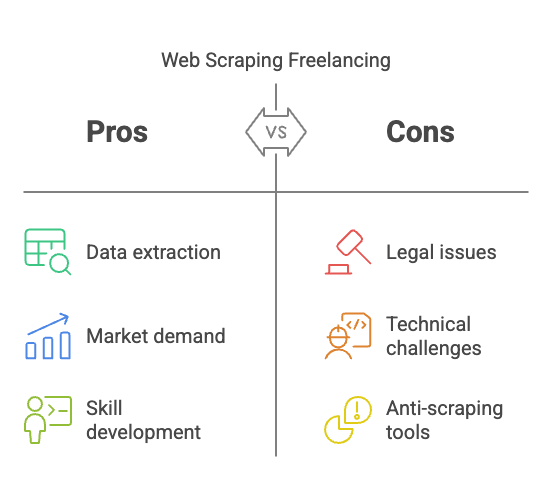
Benefits of Becoming a Web Scraping Freelancer
- Useful specialization: Collection, validation and maintenance can be offered as defined services. Listings on a marketplace demonstrate available briefs, not a guarantee of sustained demand or paid work for an individual.
- Flexible arrangements: Some projects can be delivered remotely, but agree on meeting times, deadlines and support hours before accepting work.
- Project-based income: Evaluate the fee against discovery, development, testing, client communication and maintenance time. Unpaid proposal work, expenses, platform fees and taxes affect what you retain; a quoted project price is not take-home pay.
- Diverse applications: Projects can involve different industries and data formats. Build expertise in a defined source type and validation problem before promising broad coverage.
Challenges of Web Scraping Freelancing
- Access and reuse: Confirm the permitted source and intended use with the client. Their request alone does not establish permission to collect or redistribute the data.
- Maintenance and uncertainty: JavaScript rendering, changed layouts and missing fields can affect both delivery and future upkeep. Separate the initial build from ongoing monitoring and repairs in the quote.
- Access restrictions: Authentication, rate limits and CAPTCHA can interrupt collection. Define stop and escalation conditions; do not promise that every source can be collected continuously.
How to Become a Web Scraping Freelancer in 2025
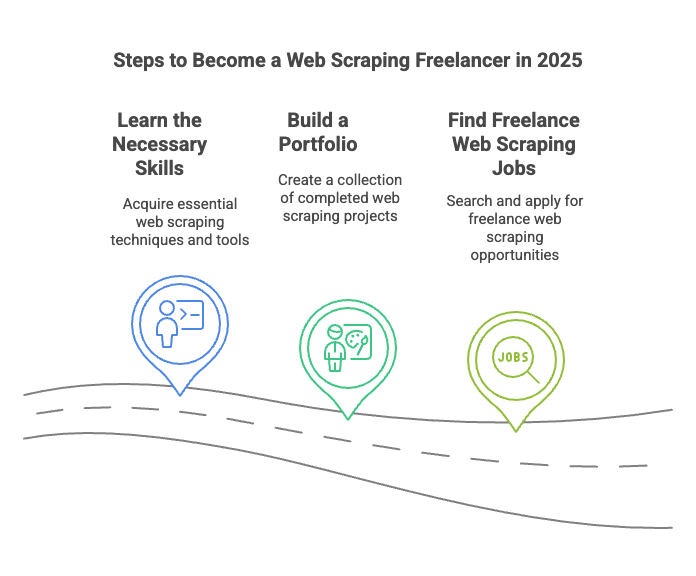
1. Learn the Necessary Skills
Build a small, reproducible project before offering a large collection job. Core skills include:
- Programming and parsing: Learn a language such as Python or JavaScript, then choose the right parser or automation library. Beautiful Soup and Scrapy are Python tools; Puppeteer is a JavaScript library. Selenium provides browser automation with bindings for multiple languages.
- APIs & Data Extraction: Handle documented APIs, pagination, JSON/XML and HTML structure. Record source identifiers and observation times, and distinguish a missing value from zero.
- Data Storage & Processing: Define field types, currency and time zones, stable row identity, missing-value rules and deduplication. Choose CSV, JSON or a database according to the agreed output rather than using a complex stack by default.
- Reliable operation: Implement logging, bounded retries, request limits and explicit failure reports. Use browser automation when rendering is necessary and authorized; access restrictions require review, not an assumption that bypass tools solve the project.
2. Build a Portfolio
A portfolio should let a reviewer understand what you collected, how you checked it and what is excluded:
- Personal projects: Use your own test site, a permitted training target or an appropriately licensed source. Include a small sample with field definitions, collection date, coverage and known gaps.
- GitHub repositories: Publish only code and data you have permission to share. Include setup instructions, dependency versions, sample inputs and validation checks; exclude credentials, private client data and session cookies.
- Blog writing: Explain a specific parsing or quality problem, your approach and its limitations. Label synthetic examples and get client permission before publishing their work. Our dataset preparation guide explains row identity and validation.
3. Find Freelance Web Scraping Jobs
The following are places to investigate, not a ranking or a promise of work. Check current listings, eligibility, fees and platform rules before applying:
- Upwork has a web-scraping jobs category. Evaluate each brief for scope, access and realistic delivery requirements. If a project involves Upwork’s own listings, review our Upwork access and job-data analysis guide before agreeing to collect them.
- Freelancer lists web-scraping projects. Review the client, deliverables and payment terms for the specific project.
- Toptal offers a screened developer network. It is a different engagement route from an open job board; investigate its current application requirements.
- PeoplePerHour is another marketplace to research. Verify that a suitable, current brief exists rather than assuming a scraping opportunity is available.
For examples of managed collection projects, see the Easy Data services overview. A service page is not a job advertisement; this guide does not establish that Easy Data is recruiting.
How to Hire a Web Scraping Freelancer
Key Factors to Consider
If you’re looking to hire a web scraping freelancer, consider the following:
| Brief item | What to specify |
|---|---|
| Source and access | Exact source URLs or API, authorized access method, allowed scope and stop conditions. |
| Output | Fields and types, currency, time zone, row identity, format and delivery location. |
| Coverage and timing | Expected IDs or pages, observation window, refresh schedule and treatment of unavailable records. |
| Acceptance | Sample size, required-field checks, duplicate rules and reconciliation of missing records. |
| Handover | Code and data rights, instructions, credentials transfer, retention and maintenance scope. |
Fictional quote example: suppose a freelancer estimates 4 hours for discovery, 8 for development, 5 for testing and 3 for documentation and handover. That is 20 hours. At an assumed USD 30 per hour, labor is USD 600; adding an assumed USD 40 of agreed project expenses gives USD 640 before platform fees and taxes. If a layout change adds 6 hours without an agreed price change, the labor portion becomes USD 600/26 ≈ USD 23.08 per hour, before fees and taxes. These invented figures are not market rates or an Easy Data quote. Define included revisions and ongoing maintenance before work starts.
For a separate example of checking a delivered file against expected IDs and required fields, read our web scraping service guide. Agree on acceptance criteria before the pilot rather than relying on row count alone.
- Experience & Portfolio: Request a relevant, permitted sample and an explanation of missing values, duplicates and source changes. A screenshot alone does not demonstrate a maintainable collector.
- Technical Skills: Ask the freelancer to explain the proposed collection method, validation checks, failure handling and handover. Match the tools to the source and deliverable.
- Access and data responsibilities: Agree on permitted sources, collection and reuse scope, personal-data handling, retention and who resolves access uncertainty. Generic claims of compliance are not project-specific evidence.
- Communication & Reliability: Agree on a pilot, milestones, status reporting, acceptance checks, rework and maintenance. Decide what happens if the source changes or access is withdrawn.
Where to Find Freelancers
- Freelance Marketplaces: Upwork, Freelancer, and Fiverr.
- Managed providers: A service provider may handle collection and maintenance as an ongoing engagement. Compare the written scope and support responsibilities with a freelancer’s proposal; see Easy Data services for the relevant service options.
- Professional profiles and portfolios: Review relevant work and use the person’s stated contact route. A public profile is not consent to collect personal details or send bulk outreach.
Best Web Scraping Tools for Freelancers
Choose tools by the job they perform. A parser, browser-automation library and storage system solve different problems; none guarantees access, accuracy or a successful freelance business. See our web scraping libraries guide for a broader comparison.
Open-Source Libraries
- Beautiful Soup: Parses HTML/XML for navigation and extraction. It does not itself fetch pages or run browser JavaScript.
- Scrapy: A Python crawling framework with extraction and export facilities. Configure request limits and review logs; scale depends on the target and project constraints.
- Selenium: Automates browsers, useful when a permitted workflow requires rendering or interaction. It is not inherently the best choice for every JavaScript page.
- Puppeteer: A JavaScript library for controlling Chrome or Firefox. Headless describes a browser mode, not a guarantee that automation is undetectable or authorized.
Access Restrictions and Request Handling
- Check the access route: Prefer an authorized API, export or agreed collection route when available. A proxy service does not confer permission to retrieve or redistribute a source’s data.
- Bound requests and retries: Apply a per-source request budget and log failures. HTTP 429 indicates rate limiting and may include Retry-After; honor applicable limits rather than increasing aggregate load through more IPs.
- Escalate blocked access: If authentication or CAPTCHA prevents an agreed workflow, pause and resolve it with the source or client. Do not quote guaranteed continuous collection from a source you cannot reliably and appropriately access.
Data Storage & Processing Tools
- MongoDB: A document database option when the project benefits from that data model. Define indexes, validation, access and retention; a database does not fix poor source coverage.
- PostgreSQL: A relational database option for structured records and queries. A small one-off delivery may only require an agreed CSV or JSON file.
- AWS S3 & Google Cloud Storage: Object-storage options for delivered files. Agree on storage costs, permissions, retention and deletion with the client; do not publish private output by default.
A dependable handover includes the agreed output, field dictionary, run instructions, validation results and a list of unresolved records. Keep access decisions and ongoing support explicit; a collection tool alone does not deliver those responsibilities.
Legal and Ethical Considerations
Review technical access, terms, reuse and personal-data obligations separately. Requirements depend on the source, use and jurisdiction; obtain qualified advice where the project is uncertain.
Understanding Legal Risks
- Terms and reuse: Review current source terms, API conditions and any written permission. Confirm whether the proposed collection, storage and redistribution fit that scope.
- Robots.txt: Honor applicable crawler directives. RFC 9309 distinguishes these rules from access authorization; an allow rule is not a license or blanket permission.
- Personal data: Public availability does not remove privacy obligations. The privacy regulators’ joint statement addresses publicly accessible personal information. Determine applicable law, lawful grounds, necessary fields, retention and individual rights; consent is not the only possible legal basis in every regime.
Ethical Web Scraping Practices
- Document the scope: Retain the agreed source list, access conditions, reuse rights and instructions for handling changes or denied access.
- Limit load: Use conservative concurrency, caching where appropriate and bounded retries. Measure total requests to a source; proxy rotation alone does not reduce that total.
- Check official APIs: An API can provide a documented route, but its terms, authorization scope, rate limits and intended reuse still apply. Availability alone does not guarantee lawful use.
Conclusion
A useful freelance engagement starts with a permitted source, a clear output specification and a small pilot whose results can be checked. Build a portfolio around reproducible work, quote the full delivery effort and agree on maintenance and access changes. Clients comparing a managed option can use the Easy Data services overview and bring a source list and sample output to the existing demo inquiry below.
Leave a Reply