


Monitoring product prices by list price alone is one of the most common mistakes beauty brands make on e-commerce platforms. The price shown on a product page is rarely the final price a customer actually pays. Shop vouchers, platform vouchers, coin cashback, gifts with purchase, or Flash Sales can all shift the net effective price a buyer ends up paying, sometimes significantly.
That’s why top beauty brands don’t judge competitors on list price alone. They analyze the entire pricing mechanism behind every promotion to understand whether a competitor is competing on price, on added value, or on some other strategy. In this article, Easy Data reveals the techniques many leading brands use to monitor beauty product prices on Shopee, TikTok Shop, and Lazada.
Why the List Price Isn’t the Real Price: Finding the Net Effective Price
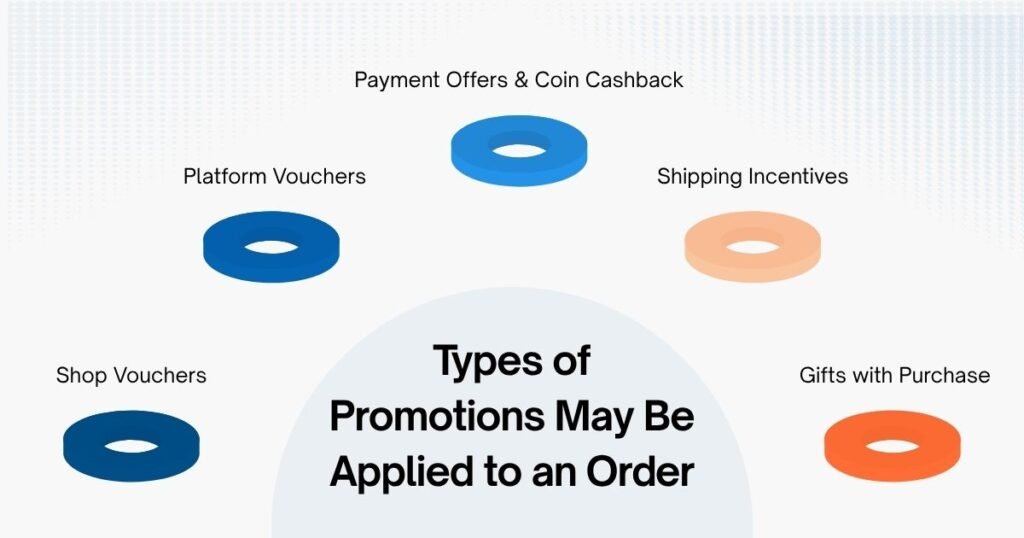
To pinpoint the net effective price, you need to account for every offer stacked onto an order. A single order is typically affected by several layers of offers applied at once: shop vouchers, platform vouchers, payment offers or coin cashback, shipping incentives and gift with purchase programs.
Example:
| Item | Value |
| List price | 450,000 VND |
| Shop voucher | 10% off |
| Platform voucher | 20% off |
| Gift | Mini skincare set worth 150,000 VND |
Net effective price ≈ 315,000 VND (not including the perceived value of the gift). If you only look at the 450,000 VND list price, it becomes very difficult to gauge how competitive a rival’s pricing really is accurately.
One more thing worth noting: don’t default to counting the full retail price of a gift as an equivalent discount. In practice, customers rarely value a gift the same way they’d value cash. Here’s a conversion range you can use as a reference:
- Samples or mini versions: 40–60% of retail price
- Tote bags, boxes, and non-beauty gifts: 10–20% of retail price
Once you’ve worked out the net effective price, the next step is to reduce different versions or variants of the same product to a single comparable unit. Depending on the category, that unit could be price per volume or weight (ml, gram), price per item within a set, or price per use. Once you’ve stripped out the differences in packaging format, you can more accurately assess how a competitor allocates price across versions within the same product line.
Common signals to watch for:
- If a brand keeps prices relatively high on trial or small-volume versions but discounts full-size, jumbo, or multi-pack versions significantly, they’re usually encouraging customers to trade up to a higher order value, while also boosting repeat purchase rates.
- Conversely, if the entry-level or trial size is the most competitively priced version, that’s typically a strategy to lower the barrier to trial and attract new customers, accepting thinner margins on the first order to maximize customer lifetime value over the long run.
Cracking Open Combo & Bundle Pricing
Combos and bundles are one of the most common ways brands mask the real discount on their hero product. Instead of cutting the price of the hero product directly, they pair it with other products in a set. Buyers then tend to evaluate the value of the whole combo rather than each individual item, making the offer feel more attractive without denting the perceived value of the hero product too much.
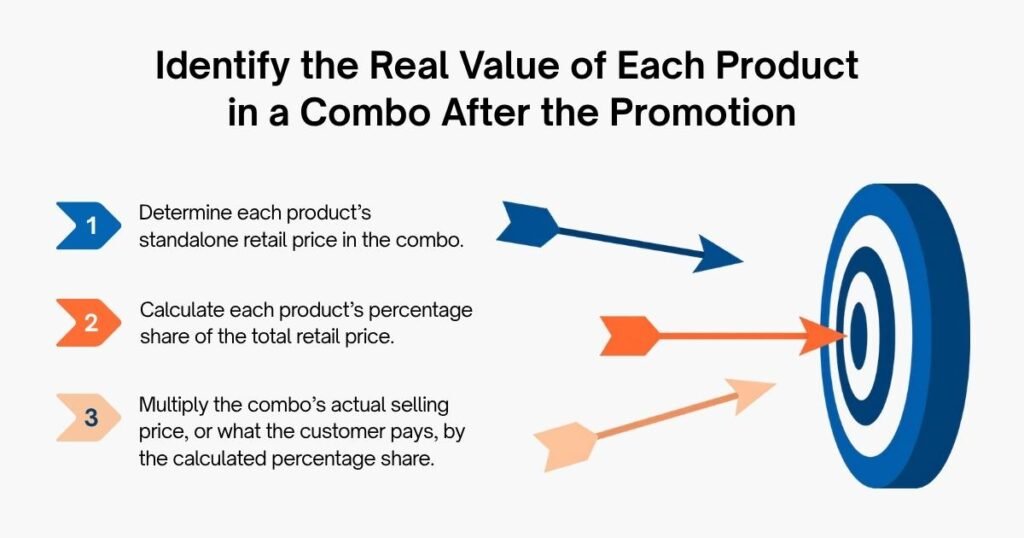
To find out how much of a discount a competitor is really giving on the hero product, you need to allocate the combo’s selling price according to each product’s retail price weight. Here’s how:
- Take the standalone retail price of each product in the combo (if available).
- Calculate what share of the total retail price each product represents.
- Allocate the combo’s actual selling price according to that same share.
What you get is the real value of each product in the combo after the promotion.
Example:
| Component | Retail price |
| Hero serum | 1,200,000 VND |
| Cleanser | 600,000 VND |
| Eye cream | 360,000 VND |
| Total retail price | 2,160,000 VND |
| Combo price | 1,440,000 VND |
In this example, the serum accounts for roughly 55.6% of the set’s total value. That means the value allocated to the serum within the combo works out to about 800,000 VND (55.6% × 1,440,000 VND).
The important thing is that you shouldn’t judge the hero product by the combo’s overall discount rate. A combo might be advertised as 33% off, but the discount landing on the flagship product simply reflects that product’s value share within the set, it doesn’t mean the brand is slashing the price of the hero product itself.
If a product in the combo isn’t sold on its own (a mini version or limited edition, for instance), you can still estimate its value in one of two ways:
- Compare it against a similar product from other brands on the market.
- Work backward from the known prices of the other products in the combo to figure out the remaining value.
Penetration Pricing or Inventory Clearance? Reading a Competitor’s Price Signals
Not every discount campaign is a sign that a competitor is struggling. When a brand cuts prices sharply, the goal is usually either market penetration or inventory clearance. Correctly telling these two apart will help you decide whether or not to react.
| Criteria | Market Penetration | Inventory Clearance |
| Product targeted | Hero product, bestseller, or new launch | Near-expiry SKUs, discontinued colors/models, past-season products |
| Remaining shelf life | Long (typically 18+ months) | Short (typically under 12 months) |
| Promotion style | Heavy on gifts and stacked vouchers, brand-building in nature | Deep direct discounts, few gifts, often bundled with slow-moving stock |
| Timing | Synced with major sale campaigns | Scattered throughout the year, not tied to a fixed sale calendar |
| Sell-through speed | Controlled, typically restocked quickly | Sold off once, not restocked |
| Margin sacrifice | Temporary, traded for high-value new customers | Margin loss accepted to recover working capital |
Example:
- If a bestseller goes on sale right during a major sale season, comes with plenty of vouchers and gifts, and stock keeps getting replenished, this is most likely a market penetration play, not a sign the brand is struggling.
- Conversely, if a lower-profile product is deeply discounted for weeks outside of sale season and never gets restocked, that’s usually a sign of an inventory clearance program aimed at freeing up stuck stock.
How Top Brands Defend Share Without Starting a Price War
When a competitor cuts prices, the most common reaction is to cut prices too. But in beauty, where gross margins tend to run high, a price race rarely pays off in the long run. Constantly discounting doesn’t just squeeze margin, it also chips away at a brand’s positioning and perceived value. That’s why leading beauty brands typically favor non-price levers before deciding to touch their price.
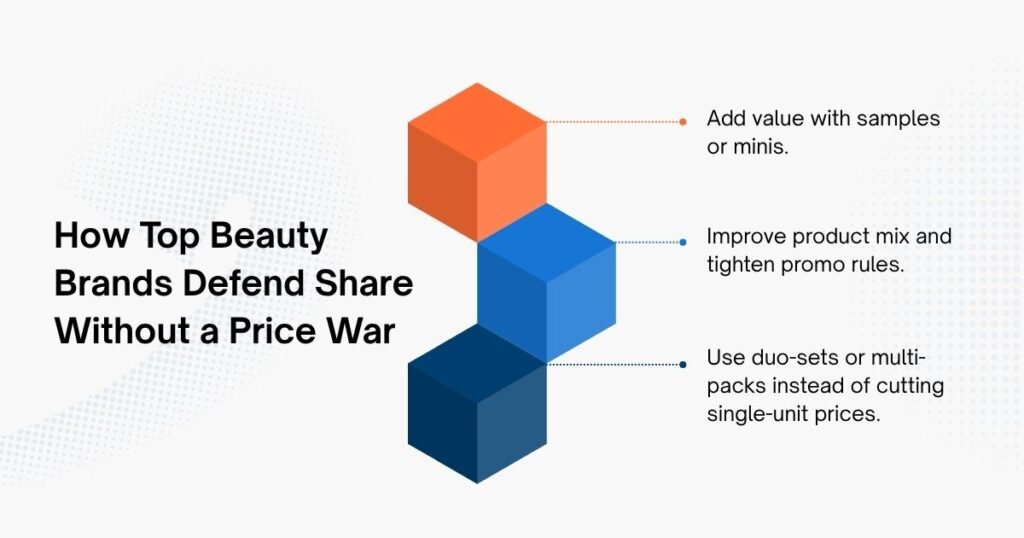
Step 1: Raise perceived value
Instead of cutting the list price, a brand can add an exclusive sample or mini version as a bonus. In beauty, where gross margins typically run 60–80%, the cost of a gift is usually far lower than the value a customer perceives in it. This makes the offer more appealing without ever touching the sticker price.
Step 2: Optimize the product mix and promotion rules
If competitive pressure keeps up, a brand can shift ad and search budget toward product lines with better margins instead of continuing to compete head-on over the same product. At the same time, it’s worth reviewing voucher stacking rules to prevent customers from combining more discount codes than intended, and setting an appropriate minimum order value to offset the discount given.
Step 3: Change the format, not the single-unit price
When a price response is genuinely needed, prioritize building a duo-set or multi-pack over cutting the price of a single item directly. This lowers the price per unit enough to appeal to price-sensitive shoppers, while the list price of the standalone retail version stays untouched, protecting the brand’s long-term value.
Setting Your Price Floor So You’re Not Guessing
Pricing based purely on what a competitor is doing (the “see what they charge, then price a bit lower” approach) can leave a brand unknowingly selling below the margin it actually needs. The reason is that a lot of the variable costs of selling on e-commerce platforms never get fully accounted for.
A more rigorous approach is to define your price floor (the lowest acceptable selling price) based on your target margin and the full set of costs involved.
Basic formula: Minimum selling price = (Production/sourcing cost + Fulfillment cost) ÷ (1 − % target margin − % platform fee − % payment fee − % expected return rate)
The hard part isn’t the formula itself, it’s pinning down the right cost ratios for your specific category and business model.
| Item | Skincare | Makeup | Fragrance |
| Production/sourcing cost (% of revenue) | 15–22% | 10–18% | 5–12% |
| Reference gross margin | 65–80% | 55–70% | 75–88% |
| Platform fee (Shopee/TikTok Shop/Lazada) | 5–12% | 5–12% | 5–12% |
| Payment fee | 2.5–3.5% | 2.5–3.5% | 2.5–3.5% |
| Marketing budget/CAC | 20–35% | 25–40% | 30–45% |
| Return/damage rate | 3–5% | 5–8% | 2–4% |
Example: A bottle of serum has:
| Production cost | 80,000 VND |
| Fulfillment cost | 15,000 VND |
| Target contribution margin | 20% |
| Platform fee | 8% |
| Payment fee | 3% |
| Expected return rate | 4% |
Applying the formula: Minimum selling price = (80,000 + 15,000) ÷ (1 − 20% − 8% − 3% − 4%) ≈ 146,000 VND
That means selling below 146,000 VND puts the brand genuinely below breakeven. So no matter how deep a competitor’s discount goes, matching it could cost you margin rather than buying you any lasting competitive edge.
Conclusion
Monitoring beauty product prices isn’t as simple as checking whether the number on a product page has changed. Top brands dig deeper: they strip out each layer of vouchers to find the net effective price, assess whether a discount campaign is a market penetration play or just inventory clearance, and look for ways to defend market share without joining a discount race that erodes everyone’s profit.
Once a brand understands how to read these pricing signals, it can respond appropriately and on time, instead of reacting on instinct every time a competitor adjusts a price.
Leave a Reply