

By 2025, Shopee app scraping is becoming the go-to approach when Shopee web scraping starts to hit its limits. Instead of relying on rendered pages, it taps directly into Shopee’s API to deliver cleaner, faster, and more scalable data, if you know how to handle the complexity behind it.
Shopee app scraping is an advanced method of extracting data directly from Shopee’s mobile app by intercepting and replicating API requests, instead of relying on HTML like web scraping.
It becomes the preferred approach when:
- Web scraping becomes unstable or unreliable
- You need large-scale or near real-time data
- Clean, structured JSON data is required
However, it requires:
- Understanding API structures
- Handling authentication (tokens, sessions)
- Managing rate limits and anti-blocking mechanisms
In short: Web scraping helps you get started → App scraping helps you scale.
What is Shopee App Scraping?
Shopee app scraping is the process of collecting data directly from the Shopee mobile application by intercepting and replicating the API requests it sends to its servers, allowing access to structured data without relying on the user interface.
Every time you open the app (search or click on a product, etc.), Shopee sends a request to the server to retrieve data for display. Shopee app scraping involves “intercepting” these requests and resending them to retrieve the data. This process typically consists of 3 steps:
- Intercept the requests sent by the app
- Examine the contents (API, parameters, headers)
- Resend the request to retrieve the data
Simply put: Instead of just scraping what you see on the screen, you’re directly retrieving the raw data from Shopee’s system.
Why is Shopee App Scraping an upgrade from Shopee Web Scraping?
If you’re not tech-savvy and are just starting to get into scraping Shopee, web scraping is usually the most reasonable choice. It’s easy to implement and sufficient for basic tasks like price tracking, competitor analysis, or testing a few products. But as you start to scale up, these issues become very apparent:
- Data is inconsistent
- Crawling is slow or unstable
- Increasing volume makes you prone to being blocked
And this isn’t a rare edge case; almost every team hits this point sooner or later. The problem isn’t with the code; it lies in how the Shopee website operates. Shopee isn’t a “static” website. Most of the data isn’t available in the HTML from the start but is rendered via JavaScript after the page loads. This leads to several limitations:
- The initial HTML contains almost no data
- Selectors can change based on the UI
- You must rely on a browser or headless mode to render
- And the more you crawl → the more likely you are to get blocked
This is also why many teams are starting to explore alternative approaches.
Instead of loading the page and then “rendering the data”, Shopee app scraping goes straight to the data source:
- Sends requests directly to the API
- Receives JSON data from the server
- Then displays it on the interface
As a result, the data you receive is much “neater” and more stable:
- Not dependent on the UI → less prone to breaking when Shopee changes the layout
- Clear JSON format → ready to use immediately
- Easier to scale when handling large volumes
However, the trade-off is that you need to understand how requests work, handle tokens and sessions, and the setup is more complex than web scraping.
| Criteria | Shopee Web Scraping | Shopee App Scraping |
| Data Source | HTML | API |
| Stability | Medium | Higher |
| Data Format | Unstructured | JSON |
| Scalability | Difficult | Better |
| Complexity | Medium | High |
When Do You Need Shopee App Scraping?
Shopee app scraping does indeed produce better results. However, the technical costs and complexity are also significantly higher. Therefore, in practice, teams usually don’t choose this method from the start; they only switch to it when they begin to encounter “clear limitations” in their data processing.
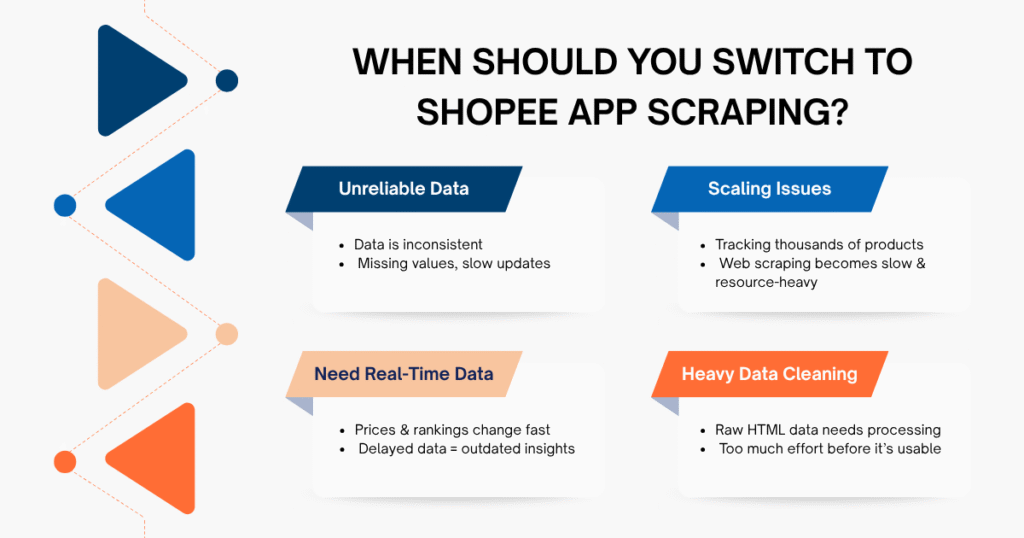
- Data is no longer reliable: You can still crawl and get output, but the data is sometimes missing, sometimes incorrect, and prices update slowly
- Scaling data: When tracking thousands of products or multiple categories simultaneously, the HTML-based Shopee data collection method becomes slower and consumes more resources than necessary
- Need near-real-time data: Shopee changes very quickly (prices, flash sales, rankings, etc.). If your data is a few minutes behind, the insights you derive are already outdated.
- Too much effort required to clean the data: Data from the web often needs significant processing before it can be used. In contrast, Shopee app scraping returns well-structured JSON that’s almost ready to use.
How does Shopee App Scraping work?
Shopee app scraping essentially follows the data flow that the app uses within the system. The entire process can be simply broken down into 5 steps:
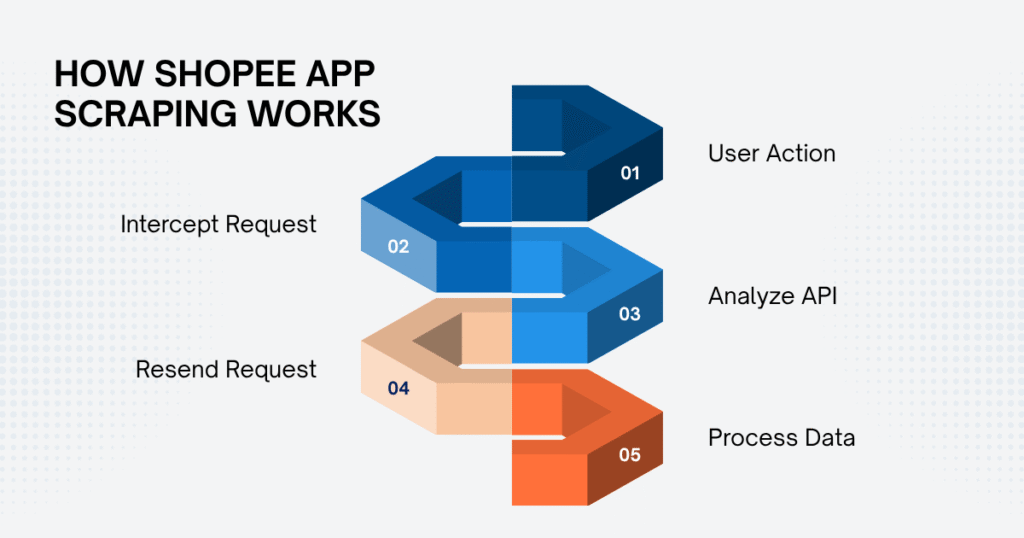
Step 1 – The app sends a request to the Shopee system
When you perform actions within the app (search for products, view listings, filter by price, etc.), the app automatically sends a request to the server to retrieve the corresponding data. For example, you type “diapers” → the app sends a request containing that keyword to the Shopee system.
Step 2 – Intercept the request from the app
The essence of this step is to precisely identify what the app is asking the server. To do this, you must use tools like Charles Proxy, Mitmproxy, or an Android emulator.
When intercepting the request, you’ll clearly see three key groups of information:
- Endpoint: Which API the app is calling
- Params: Keyword, page, filter, sort…
- Headers: Token, device info, session
Step 3 – Analyze the API
This is the most critical and also the most challenging step. Analyzing the API isn’t just about seeing what’s in the request; it’s about understanding:
- Where this data comes from (search, recommendations, rankings, etc.)
- Which fields are core (price, sales, rating, etc)
- Which fields are context-dependent (session, user state…)
- Are there any security mechanisms involved (token, signature, encryption…)
To complete this step, you must understand the core logic behind how Shopee generates its data.
Step 4 – Resend the request to retrieve data
Once you understand the API, you can recreate the request:
- Send it directly to the endpoint
- Pass the correct parameters and headers
- Retrieve the data without opening the app
Step 5 – Process the JSON data
Data returned from the API is typically in JSON format (i.e., pre-structured data). Your task is to:
- Select the fields you need (price, title, rating…)
- Standardize the format (currency, null values, duplicates…)
The goal is to transform the data from a “technical response” into data that supports decision-making (pricing, tracking, analysis, etc.).
The Real-World Challenges of Shopee App Scraping
When performing Shopee app scraping, the deeper you delve into the underlying system, the more complex things become. Here are some issues you’ll frequently encounter:
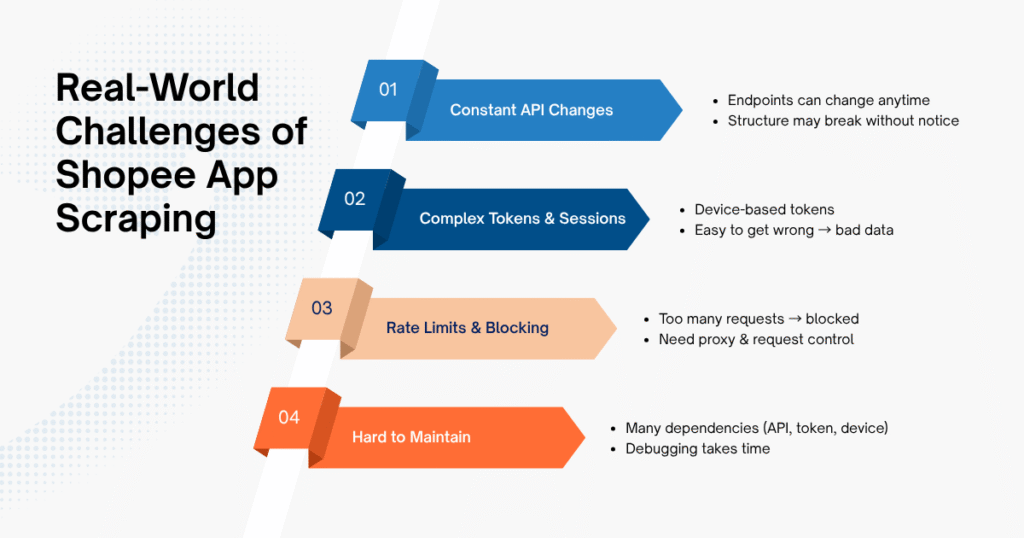
- Constant API changes: Shopee may update endpoints or request structures at any time. This can cause a system that was working fine to “break” without you immediately realizing it.
- Complex authentication & tokens: Many requests require device-specific tokens or sessions. If you handle them incorrectly or miss even a small step, the request may still run, but the returned data could be incomplete or corrupted.
- Rate limits & request blocking: Even when using APIs, you can’t “scale freely.” Sending too many requests can still trigger rate limits or IP blocks, so you still need to implement delays, use proxies, and control the rate.
- Difficult to maintain long-term: The biggest challenge isn’t the initial build, but keeping the system stable. Because there are many interdependent layers (API, tokens, devices, etc.), debugging when errors occur often takes significantly longer than with web scraping.
Legal Aspects of Shopee App Scraping
From a legal standpoint, Shopee API-based data collection is not significantly different from web scraping. However, since you are working directly with the API and the data flow “within” the system, the risks are slightly higher if done incorrectly.
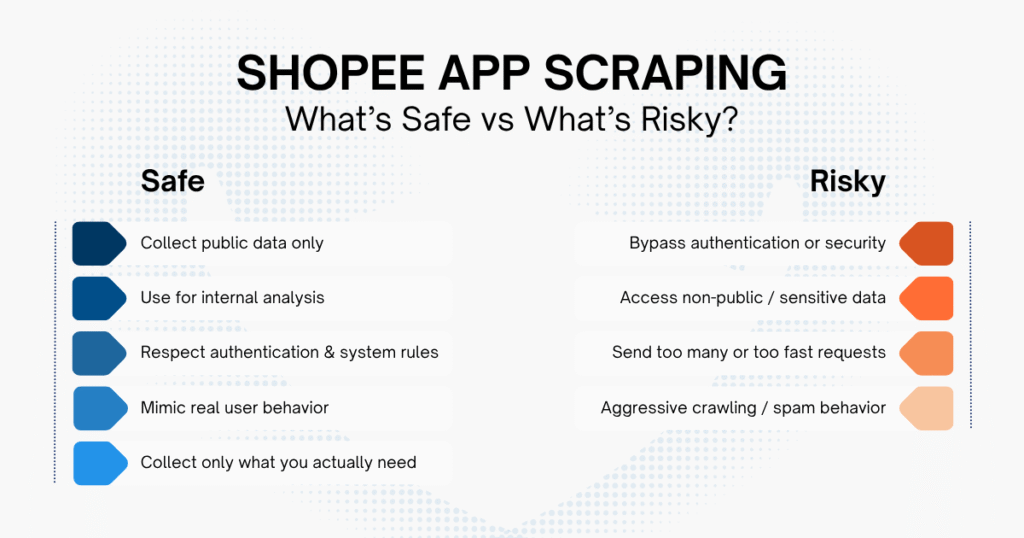
Generally, Shopee app scraping is still considered fairly safe if you:
- Only collect public data
- Use it for internal purposes such as pricing, tracking, or research
- Do not interfere with the system’s authentication or security mechanisms
Conversely, risks begin to arise when you:
- Attempt to bypass authentication or security mechanisms
- Access non-public data
- Send requests too quickly or in excessive quantities (aggressive crawling)
At that point, the issue is no longer about “whether scraping is possible,” but rather about policy and compliance.
Based on practical implementation experience with numerous e-commerce teams across Southeast Asia, Easy Data has identified a safer and more sustainable approach:
- Crawl in a manner that mimics real user behavior, avoiding spam requests
- Retrieve only the data you need, avoiding excessive collection
- Avoid accessing sensitive or non-public data
- Adhere to general principles such as PDPA or GDPR where applicable
What If You Don’t Want to Build a Scraping System from Scratch?
Whether you choose web scraping or app scraping, as you start scaling up, you’re almost certain to encounter technical issues. A scraping system that runs stably over the long term requires more than just the initial code; it demands:
- Sufficient technical expertise
- Time to continuously monitor and resolve issues
- Infrastructure costs (proxies, servers, monitoring, etc.)
Meanwhile, not every team has the resources to maintain these tasks daily.
Easy Data takes care of the “hardest” part for you
Instead of having your team manage the entire pipeline on their own, Easy Data acts as a backend layer, handling all the technical aspects:
- Designing the appropriate data collection method (web, app, or hybrid)
- Handling proxies, anti-blocking, and request strategies
- Monitoring and adapting to changes in Shopee’s UI or API
- Ensuring data is consistently updated on schedule and remains stable
So what does this actually change for your team?
When using Easy Data’s Shopee data scraping service, what you receive is ready-to-use data:
- Data that has been collected and cleaned
- Formatted for analysis
- Customizable to meet specific needs (products, prices, keywords, search queries)
More importantly, your team no longer has to spend time “keeping the system running” and can instead focus on using the data to make informed decisions.
Final Thoughts
Although the ultimate goal of Shopee scraping is to obtain data that is high-quality and reliable enough to inform decision-making, in practice, each team will choose a different approach:
- Some teams start with Shopee web scraping, then gradually transition to Shopee app scraping when they need to scale and achieve greater stability
- And some teams opt for a more convenient approach: using pre-processed data from third-party sources
Once you clearly understand your needs and the extent of your resources, you’ll naturally know which approach is the most suitable, one that’s both effective and sustainable in the long run.
Is Shopee app scraping better than web scraping?
Shopee app scraping is generally more stable and scalable than web scraping, but it is also more complex to implement and maintain.
What data can be extracted using Shopee app scraping?
You can extract product data, prices, seller information, ratings, reviews, rankings, and search results in structured JSON format.
Do you need coding skills for Shopee app scraping?
Yes. Compared to web scraping, app scraping requires a deeper understanding of APIs, request structures, and system behavior.
Can you scrape Shopee API directly?
Yes. By intercepting API requests from the Shopee app and replicating them, you can retrieve data directly from Shopee’s backend systems.
Is Shopee app scraping legal?
It depends on how it is implemented. Collecting publicly available data for internal use is generally considered low-risk, while accessing private data or bypassing authentication mechanisms may violate platform policies.
When should you switch from web scraping to app scraping?
You should consider switching when:
- Web scraping becomes unstable
- You need to scale data collection
- You require near real-time updates
- Data cleaning becomes too time-consuming
Leave a Reply