

Data-driven ecommerce gets talked about a lot, but it’s often misunderstood. Many businesses assume they’re already there, but when it’s time to make real decisions, gut feeling still tends to take over.
The issue isn’t a lack of data. It’s knowing how to actually use that data to guide decisions. And that usually starts with something more foundational: having a data system that helps teams look past surface-level metrics and truly understand what’s going on in the market.
- Why do most data-driven ecommerce strategies fail?
- The biggest gaps in data-driven ecommerce
- What high-performing data-driven ecommerce teams do differently
- How to fix a broken data-driven ecommerce system
What Data-Driven Ecommerce Actually Means
What people call “data-driven ecommerce” often gets boiled down to having a bunch of tools or dashboards. But that’s not really the point. In practice, it’s both simpler and more demanding than that.
At its core, being data-driven ecommerce just means this: your important decisions are guided by ecommerce data (not guesswork), and you consistently check those decisions against real outcomes.
To make that work, you need more than scattered bits of information. You need a system that actually connects the dots. Usually, that starts with a solid ecommerce dataset that brings together different signals (customer behavior, pricing, demand) into something you can actually use. From there, everything runs in a continuous loop:
Data → Insight → Decision → Action → Feedback
Each step flows into the next. You collect data, turn it into insights, use those insights to make decisions, act on them, and then measure what happens so you can improve the next round.
The problem is, most businesses never really complete this loop. They generate reports, but nothing changes. Or they make decisions, but don’t track the results closely enough to learn from them. Over time, data turns into something you just look at, instead of something you actively use to run the business.
When it’s done right, though, a data-driven ecommerce setup is very tangible. You can see it in how the business operates day to day:
- You spot demand before it peaks
- Your pricing adjusts based on competitor movements, not gut feeling
- You track category shifts almost in real time
Where Most Data-Driven Ecommerce Strategies Break Down
Across different growth stages, many ecommerce teams run into the same recurring issue: their systems aren’t actually built to use data in a practical, actionable way. And that’s exactly where so-called data-driven ecommerce strategies start to break down.
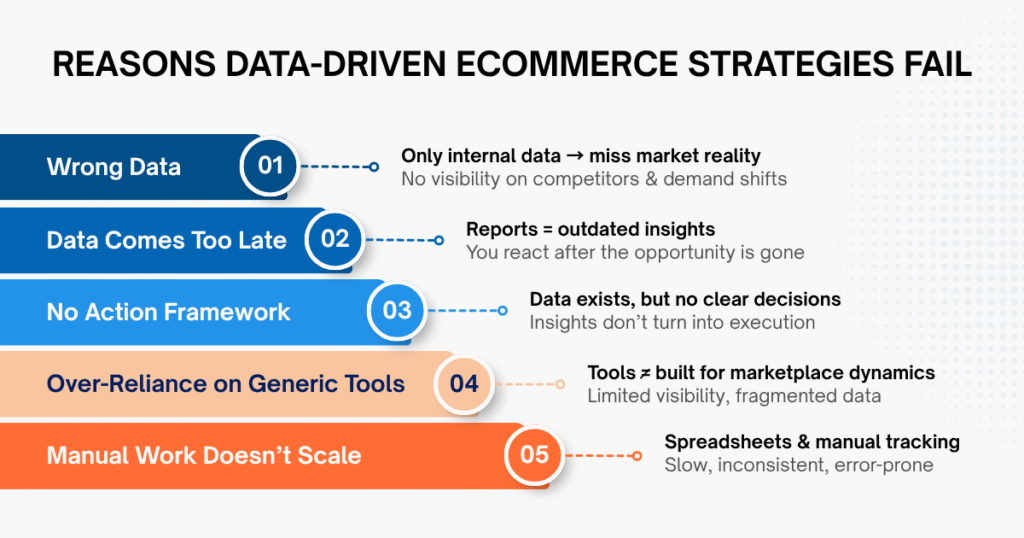
1. Not Having Access to the Right Data
One of the most common patterns is teams relying almost entirely on internal data: conversion rates, ad performance, and on-site behavior. They keep optimizing ads and landing pages. On paper, everything looks fine. Conversion rates are stable. Campaigns are performing. But revenue isn’t growing.
When you dig deeper, the problem usually isn’t inside the funnel; it’s outside of it. Competitors start dropping prices on key products. New sellers enter the market with aggressive promotions. None of this shows up in internal dashboards. This is a classic blind spot: many data-driven ecommerce systems only reflect what’s happening internally, while the real competition is happening externally.
When teams can’t see competitor pricing changes, which products are actually winning in the market, and shifts in category demand, they end up making decisions in a vacuum. Over time, this creates the illusion of optimization, when in reality, they’re just missing half the picture.
2. Data That Comes Too Late (or Incomplete)
Another common issue is timing. In ecommerce, data loses value much faster than most teams expect. You’ll often see:
- Pricing reports updated weekly
- Product performance reviewed monthly
- Trend analysis based on outdated snapshots
The problem isn’t accuracy; it’s that the data is already outdated by the time it’s used.
For example, a seller might spot a trending category in a monthly report. But by the time they increase inventory and launch campaigns, the market is already saturated, and margins drop almost immediately.
That’s the hidden cost of delayed data: you’re reacting to what already happened, instead of what’s happening now. Most of these delays come from:
- Manual data collection
- Tools that don’t sync in real time
- Fragmented data that takes time to consolidate
So even if the system looks “data-driven ecommerce” it behaves like a reactive one.
3. No Clear Path from Data → Decision
Even when teams have good data, there’s often another bottleneck: they don’t have a consistent way to act on it. You’ll see this play out in meetings all the time. People review dashboards, point out trends, agree that something should change… and then nothing concrete happens.
The core issue is simple: there’s no clear bridge between signal and decision. In a strong data-driven ecommerce setup, that bridge is clearly defined. For example:
- If a competitor drops price by more than 10% → review pricing within 24 hours
- If search demand increases for 3 consecutive days → increase inventory
Without rules like these, data stays “open to interpretation”: everyone draws different conclusions, decisions get delayed, and execution slows down. Over time, data becomes something teams “look at”, not something they actually operate on.
4. Over-Reliance on Generic Tools
Most teams start with standard data analytics tools, and that’s completely reasonable. But as the business grows, those tools start to show their limits. They’re typically built around:
- Website tracking
- Simplified customer journeys
- Aggregated reporting
That works early on. But it becomes a problem when your business depends on marketplaces, constant price competition, and fast-changing product trends.
Some teams try to patch the gaps manually: exporting data, combining sources, and building complex spreadsheets. Others just ignore the missing pieces. Neither approach holds up long-term.
You either spend too much time managing data or make decisions without full visibility. And neither supports a scalable data-driven ecommerce strategy.
5. Manual Work That Doesn’t Scale
Almost every ecommerce team starts with manual workflows:
- Tracking competitors in spreadsheets
- Checking listings by hand
- Pulling reports when needed
At a small scale, this feels manageable, even flexible. But as the business grows, it starts to break down.
If your team relies on one person to update all data, spends hours (or days) compiling reports, and sees conflicting numbers across different sources. Then the issue is no longer just efficiency, it’s reliability.
Manual processes lead to slower decisions, inconsistent data, and a higher risk of human error. And most importantly, they make real-time response almost impossible.
The Data System Behind Growing Ecommerce Businesses
When you look at ecommerce businesses that grow steadily over time, the real difference isn’t that they have access to more data. It’s that they’ve built systems that actually turn data into action. They don’t just review numbers; they rely on data as part of the core infrastructure that drives their decisions.
It usually starts with collecting data in real time, not only from internal operations but also from the market itself, things like product listings, price changes, and category trends. But raw data on its own doesn’t do much. It has to be cleaned up, organized, and standardized so it can be properly compared and analyzed.
From there, the mindset shifts. Instead of focusing on “what happened,” growing teams ask a more useful question: “What should we do next?” That shift is what turns data from something passive into something actionable.
Decisions also aren’t left open to interpretation. Clear rules are set: what triggers an action, who’s responsible for it, and how quickly it needs to happen. Over time, this creates a feedback loop where each action helps improve the next one.
How Data-Driven Ecommerce Works in Practice
It’s much easier to understand this idea when you see how it actually plays out. Instead of spending hours manually checking competitors, teams now track pricing automatically and adjust it on the fly. Rather than guessing which products might sell, they look at real marketplace signals to validate demand before putting money into inventory.
They’re also not waiting around for monthly reports anymore. They keep a constant eye on demand, search trends, and product performance, which helps them spot opportunities and react faster than everyone else.
And across all of this, one thing becomes clear: data only matters if you can turn it into action quickly. Otherwise, you’re just reacting too late to keep up.
How to Build a Scalable Data-Driven Ecommerce System for Growth
If you want a truly data-driven ecommerce system that actually holds up as you scale, it helps to start thinking in layers.
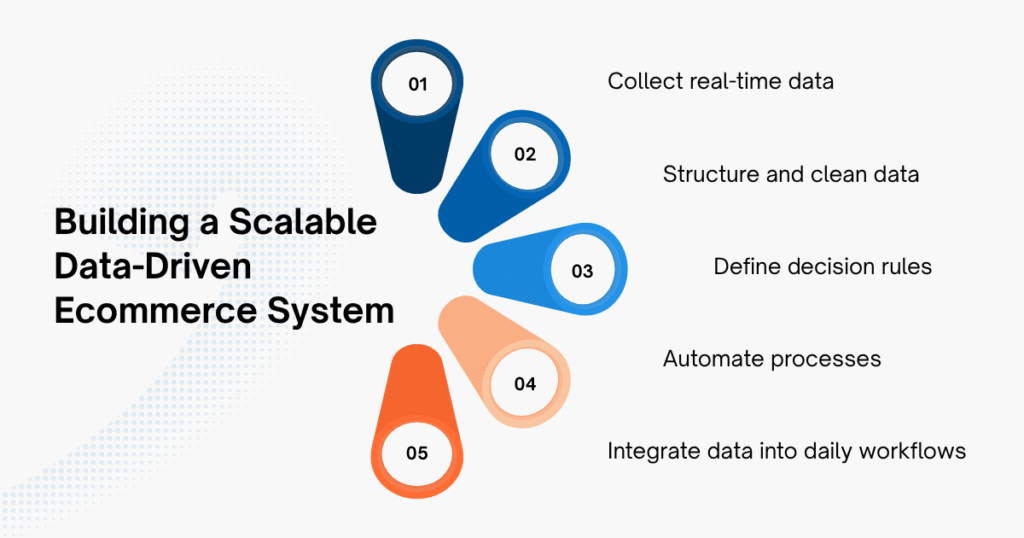
- Data Collection (Internal + External): Combine internal analytics with external signals like competitor pricing, product trends, and market demand.
- Data Structuring (Make It Usable): Clean, standardize, and organize data so it can be compared and analyzed consistently. Without this, even good data becomes unreliable.
- Insight → Decision Mapping: Define what signals matter and what actions follow. For example, when pricing drops beyond a threshold → trigger a pricing adjustment within a fixed timeframe.
- Execution & Automation at Scale: As volume grows, you’ll need to automate repetitive tasks, whether that’s updating prices, tracking competitors, or generating reports.
- Integration into Business Workflow: Plugging your data into the tools and workflows your team already relies on, such as dashboards, internal systems, and reporting processes.
Why Building a Scalable Data-Driven Ecommerce System In-House Is Harder Than It Looks
On paper, building a scalable data-driven ecommerce system sounds pretty straightforward. But in practice, most teams only realize the complexity once they’re already deep into building it. Where things get tricky:
- Collecting data at scale isn’t simple: Scraping marketplace data reliably takes more than just writing a crawler. You need solid infrastructure, constant monitoring, and frequent adjustments as platforms change.
- The data gets messy – fast: Without proper structuring and cleaning, your dataset quickly becomes inconsistent. And once that happens, any insights you generate are questionable at best.
- Real-time data is harder than expected: Keeping everything updated in near real-time is a constant challenge. Even small delays can disrupt decision-making and reduce the value of the system.
- Integration is often underestimated: Getting data into dashboards, internal tools, or workflows takes time. It’s rarely a plug-and-play process, especially when multiple teams are involved.
- Maintenance never really ends: Marketplaces evolve, APIs break, formats change. What worked last month might stop working tomorrow. Keeping the data-driven ecommerce system running becomes an ongoing effort.
Overall, the biggest challenge businesses face is that the costs and long-term effort required to maintain a scalable data-driven ecommerce system become unsustainably high.
How Easy Data Helps You Get There Faster
Instead of building a data-driven ecommerce system from scratch, more ecommerce teams are choosing to plug into existing data infrastructure from third-party providers like Easy Data. Our ecommerce data scraping services act more like a data backbone that supports your entire workflow:
- Continuous data scraping from marketplaces like Shopee, Lazada, and TikTok Shop
- Clean, structured datasets ready for use (via CSV, API, or dashboards)
- Reliable updates so your data stays fresh and usable
- Less dependence on manual processes
This means that by partnering with Easy Data, teams can access: competitor pricing, product performance signals, category-level demand …without having to build and maintain complex pipelines internally.
Conclusion
Most businesses fail at being data-driven ecommerce because their data never fully connects to action. The shift happens when data stops being something you review and becomes something you operate with.
When real signals consistently drive decisions, when feedback loops are built into execution, and when speed becomes part of the system, data stops being a report and becomes a competitive advantage. Because ultimately, the difference isn’t about who has more data. It’s about who can turn it into faster and clearer decisions than everyone else.
What is data-driven ecommerce in simple terms?
Data-driven ecommerce means using real data (such as pricing, demand, and customer behavior, …) to guide decisions instead of relying on guesswork. The key is not just collecting data, but consistently using it to improve actions and outcomes over time.
Why do most ecommerce businesses struggle to be data-driven?
Most businesses struggle because their data is incomplete, delayed, or disconnected from decision-making. Even when data exists, there’s often no clear system that turns insights into actions, so teams end up reacting slowly or relying on intuition.
What kind of data is needed for data-driven ecommerce?
A strong setup combines both internal and external data. Internal data includes website analytics, conversions, and ad performance. External data covers competitor pricing, marketplace trends, and product demand. Without external data, you’re only seeing part of the picture.
How do high-performing ecommerce businesses use data differently?
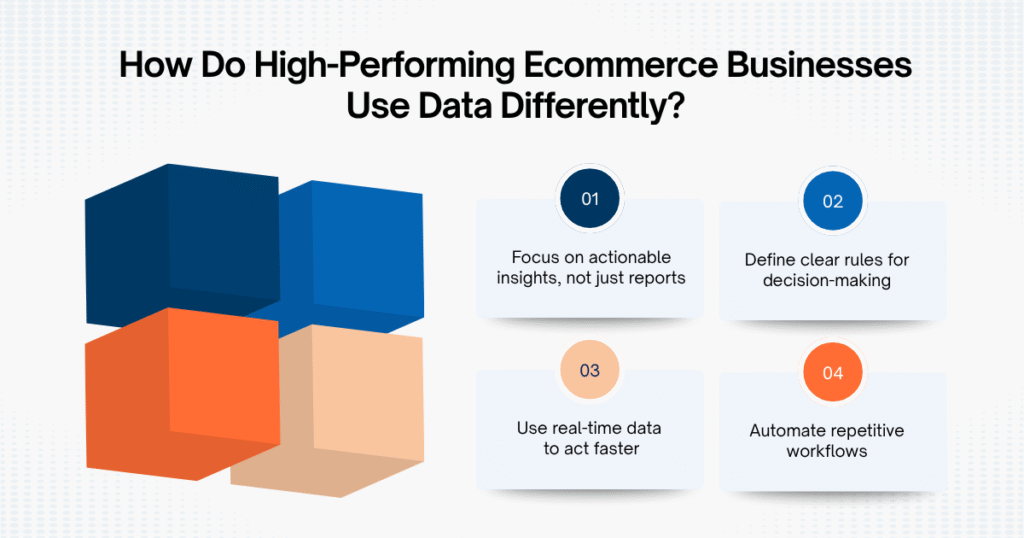
They focus on execution. Instead of just reviewing reports, they define clear decision rules, act on real-time data, and automate repetitive processes. Their advantage comes from speed and consistency, not just access to data.
How can businesses build a scalable data-driven ecommerce system?
They need to move from manual processes to structured systems: collect real-time data, clean and organize it, define decision rules, automate execution, and integrate everything into daily workflows. Scalability depends on reducing manual effort.
How does Easy Data support data-driven ecommerce?
Easy Data provides real-time marketplace data, structured datasets (via CSV or API), and automated data collection at scale. This helps businesses access reliable data without building complex infrastructure internally, making it easier to act quickly and accurately.
Leave a Reply