


Understanding ecommerce search trends is no longer just a “nice-to-have” for marketers, it’s becoming a key way to predict what will sell before it appears in sales reports. In 2026, the brands that succeed won’t be reacting to demand; they’ll be anticipating it by leveraging real-time marketplace signals built from a reliable ecommerce dataset.
What Are Ecommerce Search Trends
Ecommerce search trends are patterns in how users search for products over time, revealing emerging demand before it becomes visible in sales data.
Most people understand ecommerce search trends at a surface level: they see them simply as a reflection of what users are searching for on platforms. But when you look closer, they reveal something much more valuable: real-time buying intent as it forms and evolves.
Unlike sales data, which tells you what has already happened, search data gives you a preview of what customers are about to do. When someone searches for a product, they are rarely browsing without purpose. In most cases, they already recognize a need, are comparing options, and are moving closer to making a purchase.
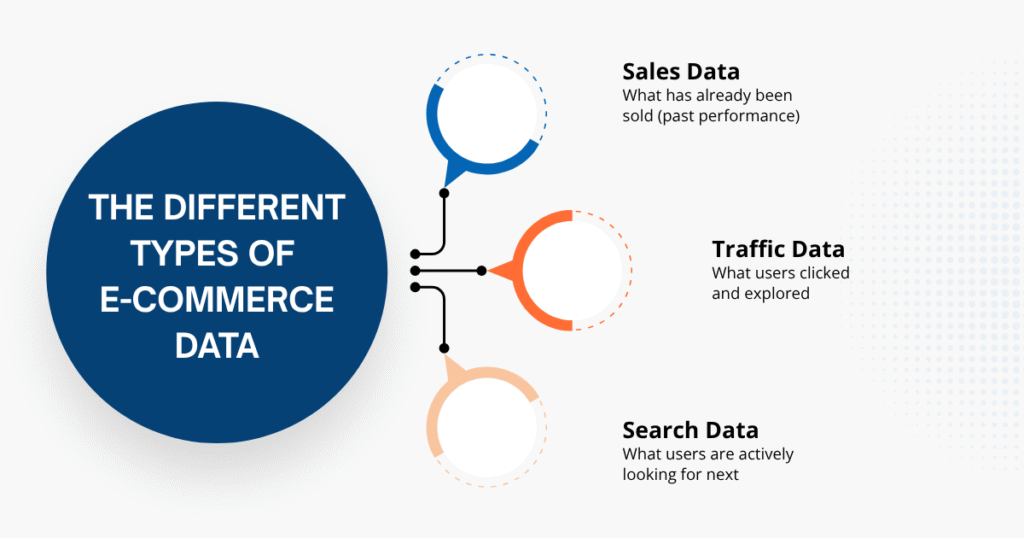
A simple way to look at the difference:
- Sales data reflects what has already been sold
- Traffic data shows what users clicked on
- Search data reveals what users are actively looking for next
This difference may seem subtle, but it completely changes how you interpret the market. If you rely only on past sales, you’re always reacting to demand after it happens. But when you start working with ecommerce search trends, you begin to see demand forming early, sometimes days or even weeks before it translates into revenue..
Ecommerce Search Trends 2026: What’s Actually Changing
Search behavior hasn’t just “evolved”, it has fundamentally changed in how it reflects demand. Many teams still analyze ecommerce search trends using outdated assumptions, which leads to missed opportunities or late decisions. To make sense of 2026, it helps to look at how search behavior is shifting in practice.
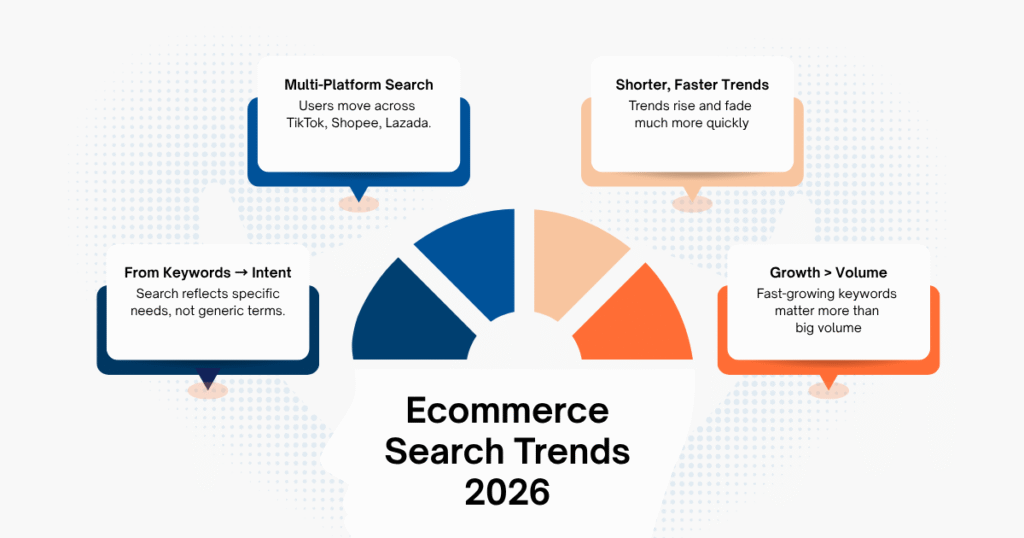
Search is shifting from keywords to intent clusters
A few years ago, users searched in short, generic terms. Today, searches are more specific and layered with context.
Instead of typing something broad like “wireless earbuds,” users now search in ways that reflect their exact situation, such as “best wireless earbuds for running under $50” or “noise-cancelling earbuds for office calls.”
This shift means you’re no longer analyzing isolated keywords. You’re analyzing clusters of intent – groups of related searches that reveal what customers actually care about, from price range to usage context.
Search no longer happens on a single platform
Another major shift is how users move across platforms during their buying journey. Someone might first discover a product on TikTok, then search for it on Shopee to compare options, and finally check Lazada for pricing or delivery. What looks like fragmented behavior is actually a connected flow of intent.
For businesses, this means ecommerce search trends are no longer contained within one platform. If you only track a single source, you’re seeing an incomplete picture of demand.
Trends are becoming shorter and more volatile
In the past, product trends built slowly and lasted longer. Today, many trends are driven by social content and can rise (and fade) within weeks.
For example, a product featured in a viral TikTok video can suddenly generate thousands of searches overnight. But that spike may not last unless it’s supported by real demand. This makes timing more critical than ever. Being early matters far more than being right in the long run.
Growth speed matters more than search volume
Perhaps the most important shift is how we evaluate opportunities. High search volume used to be the main signal. Now, it’s often misleading. A keyword with stable, high volume is usually already saturated. In contrast, a smaller keyword that is growing quickly often signals an emerging opportunity.
For example, a product going from 1,000 to 5,000 searches in two weeks can be far more valuable than a product sitting at 30,000 searches with no growth
How to Analyze Ecommerce Search Trends to Predict Winning Products
Predicting winning products from ecommerce search trends isn’t about spotting a single keyword; it’s about understanding how demand builds, accelerates, and converts. The difference between guessing and predicting lies in having a clear process behind your analysis.
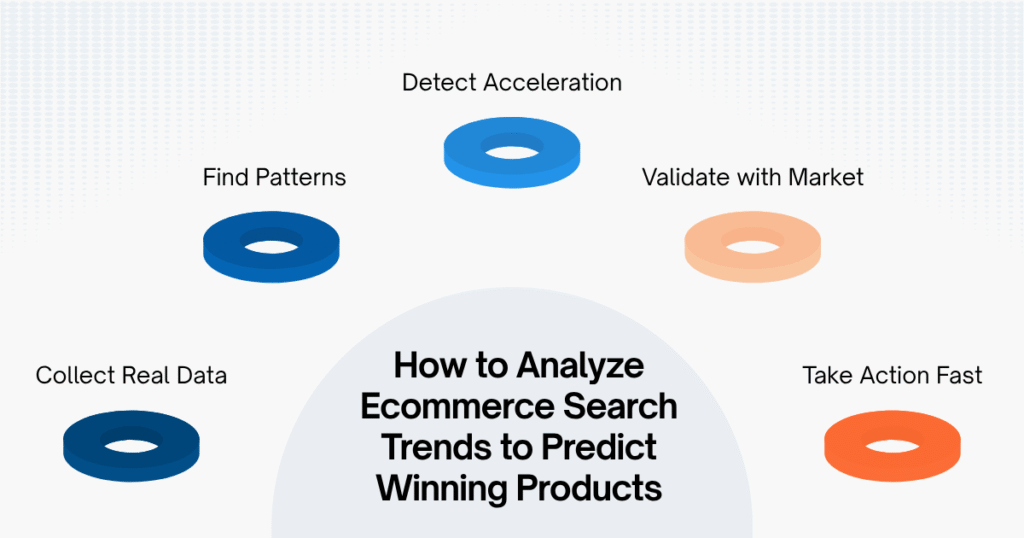
Step 1: Collect Real Marketplace Search Data
Everything starts with the quality of your data. If the source is too broad or disconnected from actual transactions, the insights you get will always feel vague.
Many teams rely on tools like Google Trends or generic keyword platforms. While useful for macro signals, they don’t reflect what’s happening inside marketplaces where purchases actually occur.
To understand real demand, you need search data from platforms like Shopee, Lazada, or TikTok Shop, … where users are not just browsing, but actively preparing to buy. If your data doesn’t come from the transaction layer, your understanding of demand will always be one step removed from reality.
Step 2: Identify Emerging Search Patterns
Once you have the data, the goal is not to isolate individual keywords but to observe how they evolve together.
You might notice that a simple keyword like “mini fan” gradually expands into more specific variations such as “portable USB fan” or “handheld rechargeable fan.” This progression reflects how user expectations are changing.
Instead of treating these as separate keywords, it’s more useful to see them as a single pattern, one that tells you how a product category is developing.
Looking at these queries as a group allows you to see the direction a product category is moving toward, rather than treating each keyword as an isolated signal.
Step 3: Detect Demand Acceleration Before It Peaks
One of the most common mistakes is focusing only on total search volume. It feels logical, but it often leads to entering markets too late. What really matters is how fast a search trend is growing.
When a keyword jumps from 1,000 to 5,000 searches in a short period, it signals accelerating interest. That acceleration often happens before competition fully enters the market. In contrast, a keyword with consistently high volume but no growth usually indicates a mature and highly competitive space.
Recognizing acceleration early is what allows businesses to enter at the right moment.
Step 4: Validate Trends with Market Signals
Search data is powerful, but it doesn’t tell the whole story on its own. To avoid chasing false trends, it’s important to cross-check what you see in search behavior with what’s happening in the market. For example:
- If search demand is rising but the number of product listings remains low, it often signals an early opportunity.
- If both search demand and listings are increasing, competition is already entering.
- If search stays flat but sales improve, the change may come from better conversion rather than demand growth.
The strongest signals appear when search data aligns with real marketplace activity.
Step 5: Turn Search Trends into Product Opportunities
Once a trend is validated, the real value comes from how quickly you act on it. This might involve launching new product variations, adjusting pricing strategies, and refining your ecommerce product listing to better match emerging demand. At the same time, teams may reallocate marketing budgets to capture momentum while the trend is still growing.
At this stage, ecommerce search trends are no longer just insights; they directly influence business decisions.
How Ecommerce Search Trends Reveal Winning Products
Ecommerce search trends function like an early warning system for product opportunities; they show signals before the market becomes crowded.
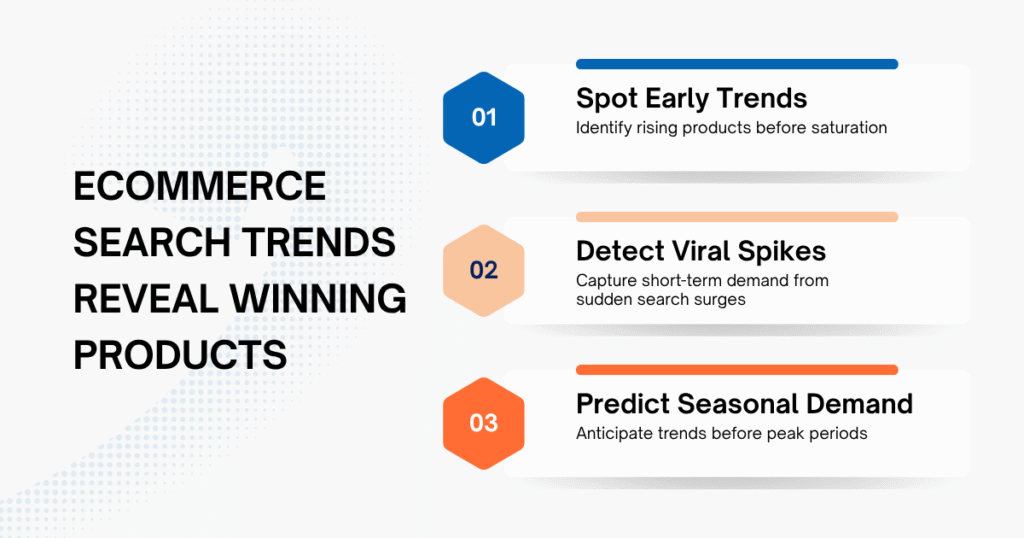
Spotting a Rising Product Before It Becomes Saturated
Early-stage trends rarely look impressive at first. They often appear as small, niche keywords with modest search volume. But what makes them valuable is not their size, it’s their direction.
When those keywords consistently grow, they indicate emerging demand that hasn’t yet been fully captured by sellers. Entering at this stage gives you a significant advantage: less competition, better margins, and more room to position your product effectively.
Detecting Viral Products from Search Spikes
Not all trends grow gradually. Some are triggered by external factors (most commonly social media).
A product featured in a viral video can generate a sudden surge in searches across multiple variations. These spikes are often short-lived, but they create immediate opportunities for businesses that can react quickly. The key is not assuming every spike is sustainable, but recognizing when to capture short-term demand.
Predicting Seasonal Winners Using Search Patterns
Some trends repeat every year, but their timing and intensity can vary. Search data makes these patterns visible. You can often see demand building weeks before peak season (whether it’s cooling products in summer or decorations during holidays).
Businesses that track these patterns don’t just react to seasonal demand; they prepare for it in advance, adjusting inventory, pricing, and campaigns accordingly.
Common Mistakes When Using Ecommerce Search Trends
Even with access to ecommerce search trends, many teams fail to extract meaningful value: not because the data is wrong, but because the approach is. Some of the most common pitfalls include:
- Focusing only on high-volume keywords and ignoring emerging trends with lower (but growing) demand
- Relying on global tools instead of marketplace-specific data, especially in regions like Southeast Asia
- Treating search trends as static instead of continuously evolving signals
- Stopping at analysis without translating insights into concrete actions
The real gap is not access to data, it’s the ability to interpret it correctly and act on it fast enough.
Scaling Ecommerce Search Trend Analysis with Real-Time Data
Manual tracking may work in the early stages, but it quickly becomes unsustainable as the business grows.
As product lines expand and competition increases, high-performing teams move toward systems that continuously collect and analyze data in real time. This typically involves automated data collection, structured datasets, and dashboards that allow teams to monitor changes as they happen.
Partnering with providers like Easy Data makes this transition much more practical. Instead of relying on fragmented tools, Easy Data’s data scraping service for Shopee, Lazada, and TikTok Shop provides businesses with stable access to marketplace-level data, making it easier to track search behavior, monitor product trends, and integrate insights into internal workflows.
What this changes is not just efficiency; it changes how quickly a business can respond. When insights are updated continuously, decisions are no longer delayed by outdated reports. Teams can act while opportunities are still emerging, not after they have already peaked.
Conclusion
In 2026, understanding ecommerce search trends is less about tracking keywords and more about reading how demand forms in real time.
Businesses that rely only on historical data will always be reacting to the market. Those who learn to interpret search behavior early can move ahead of it: launching products sooner, adapting faster, and making more confident decisions with less guesswork.
Ultimately, the advantage doesn’t come from having more data. It comes from being able to act on the right signals at the right time.
Leave a Reply