

Introduction
The main types of e-commerce describe who sells and who buys: business-to-consumer (B2C), business-to-business (B2B), consumer-to-consumer (C2C) and the commonly used consumer-to-business (C2B) label. Direct-to-consumer (D2C) describes a brand selling to the end customer. Social channels, subscriptions and payment methods are additional dimensions that can overlap with those relationships.
The 2025 OECD definition focuses on how an order is placed over a computer network, rather than requiring online payment or delivery. An online order collected in a store can therefore qualify. A social advertisement alone is not an order. This guide explains common business labels and practical questions for comparing them; it is not an exhaustive statistical classification. Definitions and examples were reviewed October 2, 2026.
For help defining the source, coverage and refresh schedule of a market-data project, visit Easy Data. Confirm the available evidence before treating any dataset as current or market-wide.
- Introduction
- 1. Business-to-Consumer (B2C) E-Commerce
- 2. Business-to-Business (B2B) E-Commerce
- 3. Consumer-to-Consumer (C2C) E-Commerce
- 4. Consumer-to-Business (C2B) E-Commerce
- 5. Direct-to-Consumer (D2C) E-Commerce
- 6. Channels, Payments and Revenue Arrangements
- Evaluating E-Commerce Technology Choices
- Conclusion
1. Business-to-Consumer (B2C) E-Commerce
What is B2C E-Commerce?
B2C describes an online sale by a business to an individual for personal use. The business may manufacture the product or resell another brand. A platform name alone does not establish the transaction type: identify the seller and buyer in the particular order.
Examples of B2C E-Commerce:
- Amazon, Shopee and Lazada illustrate marketplace channels: a business merchant selling to a household makes a B2C sale. Do not infer every seller or order has the same classification.
- Nike, Apple and Samsung illustrate brand-owned stores. A brand selling its product directly to a consumer is both B2C and D2C.
- ASOS, Zalora and Sephora illustrate retail channels for fashion or beauty. The product brand and the merchant taking the order may be different businesses.
Benefits of B2C E-Commerce:
- Broader potential reach: An online catalogue can be available outside store hours, but shipping areas, service hours and local requirements still limit where an order can be fulfilled.
- A different cost structure: Online sales may reduce some shop-floor costs while adding payment, platform, fulfilment, return and acquisition costs. Lower total cost is not automatic.
- Customer insight: Appropriately collected order data can inform product and service decisions; personalization requires testing and suitable privacy controls.
Challenges:
- High competition and customer acquisition costs.
- Logistics and order fulfillment complexities.
- Fraud risks and cybersecurity concerns.
2. Business-to-Business (B2B) E-Commerce
What is B2B E-Commerce?
B2B describes an online sale between businesses. It includes a wholesaler supplying a retailer, a manufacturer buying components or a company ordering software. Bulk quantity, international trade and negotiated pricing are possible features, not requirements for every B2B order.
Examples of B2B E-Commerce:
- Alibaba & GlobalSources – International B2B marketplaces.
- Salesforce & HubSpot – Cloud-based SaaS providers.
- Uline & Grainger – Industrial and office supply businesses.
Benefits of B2B E-Commerce:
- Repeat purchasing potential: Replenishment or service contracts may support recurring orders; order value and retention must be measured for the actual customer group.
- Process improvement: Integrating orders with stock and invoicing can reduce manual steps, provided product records, permissions and exception handling are reliable.
- Focused selling: A defined business audience may help targeting, but account acquisition, sales staff, onboarding and support can be expensive. Compare measured cost per acquired account.
Challenges:
- Complex negotiations and longer sales cycles.
- Order requirements: Check minimum quantities, approvals, payment terms and service commitments; digital services and small business orders need not involve bulk fulfilment.
- Applicable requirements: Cross-border transactions add trade and jurisdictional considerations; domestic B2B orders have their own contractual and operational requirements.
3. Consumer-to-Consumer (C2C) E-Commerce
What is C2C E-Commerce?
C2C commonly describes a private individual selling to another individual, such as a used item sold through a marketplace. A professional merchant on the same platform may instead make B2C sales. For example, eBay supports individual and business seller registration; a platform is not exclusively C2C simply because it permits peer-to-peer resale.
Examples:
- eBay and Facebook Marketplace: A private person selling a used possession to another consumer illustrates C2C. Check the actual seller rather than assigning one category to the whole platform.
- Etsy and Depop: Handmade, vintage or resale descriptions do not establish C2C status. An independent seller operating a business may be making B2C sales.
- Carousell and Poshmark: Private resale can illustrate C2C; professional selling should be distinguished in any market analysis.
Benefits:
- A small-scale starting point: Selling an owned item may need little initial inventory investment, but fees, shipping and the seller’s time still count.
- Wide range of products and price flexibility.
- Reuse: Resale can extend a product’s use. Its overall environmental effect depends on replacement purchases, transport and other factors; resale alone does not prove a sustainability claim.
Challenges:
- Payment security risks in peer-to-peer transactions.
- Limited scalability for individual sellers.
- Challenges with dispute resolution and product authenticity.
4. Consumer-to-Business (C2B) E-Commerce
What is C2B E-Commerce?
C2B is commonly used for an individual providing work, content or rights to a business. It is a useful description of the commercial relationship, not proof that the supplier is legally a consumer. A freelancer operating a business may be treated as a business supplier; distinguish that status when building reports or contracts.
Examples:
- Upwork & Fiverr – Freelance platforms where individuals offer services to companies.
- Shutterstock and Adobe Stock: Creator contributions illustrate content licensing. Identify the contributor, licensee and platform’s role rather than assuming a direct sale of copyright to a business.
- Influencer Marketing Networks – Brands hiring social media influencers for promotions.
Benefits:
- Offer design: Individuals may define a service or license, subject to platform rules, negotiated terms and buyer requirements.
- Capacity choices: Repeatable deliverables or licenses can support additional sales, but available hours, fees, demand and rights restrictions limit earnings.
- Direct collaboration between brands and creators.
Challenges:
- Competitive market with pricing inconsistencies.
- Trust issues in contract fulfillment and payment security.
- Saturation of freelance services leading to price undercutting.
5. Direct-to-Consumer (D2C) E-Commerce
What is D2C E-Commerce?
D2C, also written DTC, means a brand or manufacturer sells directly to an end consumer without a separate retailer reselling that order. It is a form of B2C, not a mutually exclusive buyer category. Payment providers, software and logistics partners may still participate. A brand can operate D2C and wholesale channels at the same time.
Examples:
- Tesla – Direct vehicle sales model.
- Warby Parker and Glossier: Brand-direct purchases illustrate D2C; the brand need not sell exclusively through that route. Glossier’s help centre lists its own channels and wholesale retail partners, demonstrating why orders should be classified by channel.
- Dollar Shave Club – Subscription-based direct sales.
Benefits:
- Control over the retail offer: Keeping the retail sale can avoid a reseller’s share, but the brand then bears acquisition, fulfilment, returns and support costs. Compare contribution after these costs instead of assuming higher profit.
- Direct customer feedback: Handling customer interactions can improve learning; loyalty still depends on the product and service experience.
- First-party measurement: Direct orders can provide useful operational data. Consent and other applicable privacy requirements still govern how it is used.
Challenges:
- Higher marketing and customer acquisition costs.
- Handling logistics, warehousing, and direct customer service.
- Capacity trade-offs: Direct growth depends on acquisition and operational capacity; retail partnerships offer a different route with their own costs and constraints.
Fictional D2C comparison, not a company result: The figures below describe one unit in the same currency, excluding tax. The selected variable costs are assumptions for this example, not industry benchmarks.
| Per-unit item | Direct sale | Wholesale sale |
|---|---|---|
| Seller revenue | 100 | 65 |
| Product cost | 40 | 40 |
| Selected selling costs | 35 | 5 |
| Contribution | 25 | 20 |
Direct contribution is 100 − 40 − 35 = 25; wholesale contribution is 65 − 40 − 5 = 20. If direct selling costs rise to 45, direct contribution falls to 15, below the wholesale example. These figures exclude fixed overhead and financing, so they are not net profit. Include payment fees, acquisition, packing, delivery, expected returns and support consistently when comparing real channels.
6. Channels, Payments and Revenue Arrangements
The following describe channels, ordering interfaces, payment choices or revenue arrangements. They can apply to several buyer-seller relationships and should not be counted as mutually exclusive transaction types:
- Social commerce: A discovery or selling channel. A business sale to a consumer remains B2C; distinguish an advertisement, a message enquiry and a completed structured order.
- Voice commerce: An ordering interface, where supported. Voice-assisted product discovery does not by itself establish that a purchase was completed.
- Cryptocurrency payment: A payment choice, not a buyer-seller category or a guarantee of transaction security. Check settlement, refund and operational requirements before adopting a method.
- Subscription commerce: A recurring billing or delivery arrangement that can serve consumers or businesses. Track renewals, cancellations and service obligations; a subscription is not necessarily monthly.
| Question | Example classification |
|---|---|
| Who sells to whom? | A brand to a household: B2C. |
| Does the brand sell directly? | Its own checkout without a reseller: D2C. |
| Where was the order placed? | Brand website; social content may have referred the customer. |
| How is it billed? | A recurring subscription. |
| How is it paid and delivered? | Card payment and home delivery; separate operational fields. |
Evaluating E-Commerce Technology Choices
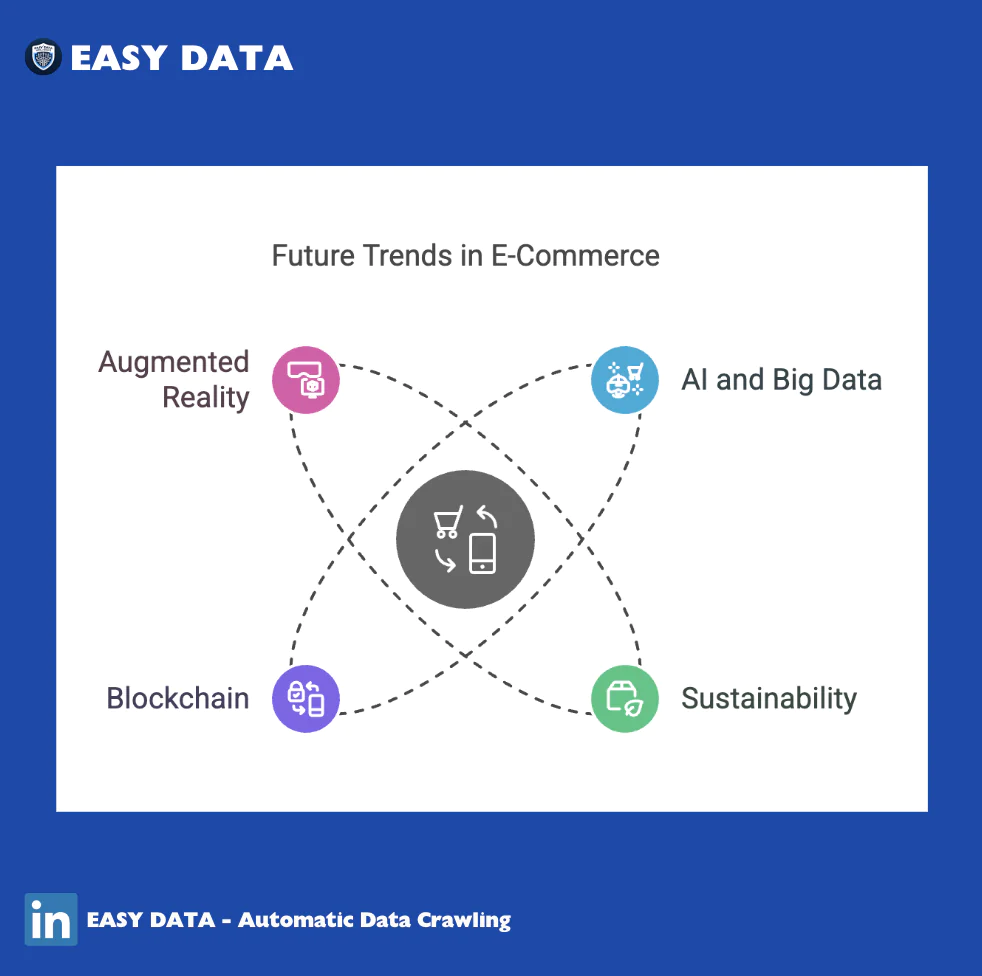
The original 2025 trend list should be treated as ideas to evaluate, not predictions proven by the passage of time. Define a customer problem, baseline and measurable pilot before adopting a technology:
- AI and analytics: Test a defined use case against a baseline; measure errors, business results, data quality and operating cost.
- Logistics impact: Compare packaging, deliveries and returns within a stated measurement boundary rather than assuming a digital channel is more sustainable.
- Shared records: Establish who can write, verify and correct records. A ledger does not establish that off-chain product claims are true or eliminate payment and account risks.
- Augmented reality: Test whether the experience helps a specific product decision and changes completion or returns; include asset production, device support and accessibility costs.
Conclusion
Classify the seller and buyer first, then record channel, payment, billing and fulfilment separately. The same brand can make B2B wholesale sales and B2C sales, with a D2C subset. A subscription ordered through a social channel should not be counted as several separate orders. For the costs and fulfillment trade-offs of online and physical channels, see our ecommerce versus traditional retail comparison.
For a comparison framework, see our e-commerce market analysis guide. When using regional totals, compare the reporting period, transaction scope and geography described in our growth statistics guide. Easy Data can help scope the source and fields for a research project.
Further reading: Shopify’s business-model explanation provides a commercial framework; the OECD definition and interpretation guide explains statistical ordering boundaries. Keep their purposes distinct when comparing reports.
Leave a Reply