


Introduction: What House-Price Scraping Can and Cannot Show
Web scraping house prices can build a dated record of advertised property prices, listing details and changes. An asking price is not a completed sale price, and a portal sample is not the whole housing market. This guide explains how to define fields, choose a permitted source, validate repeated observations and avoid misleading trend comparisons. It includes an explicitly fictional example; no live property dataset or investment return is claimed. Sources were checked on October 3, 2026.
What is Web Scraping House Prices?
Web scraping house prices means extracting published property information into a structured record. A useful record identifies the source listing, observation time, price type, currency, property characteristics and status as shown by the source. Keep sale listings separate from rents, and asking prices separate from completed-sale records. Missing fields should remain missing rather than becoming zero.
Check whether an official download, licensed feed or permitted API already answers the question before building a page scraper. For example, HM Land Registry’s Price Paid Data guidance describes registered sales in England and Wales, including price and transfer date. It has defined coverage and registration timing; it is not a live feed of every listing or a dataset for another country. Choose a source that matches your geography and price definition.
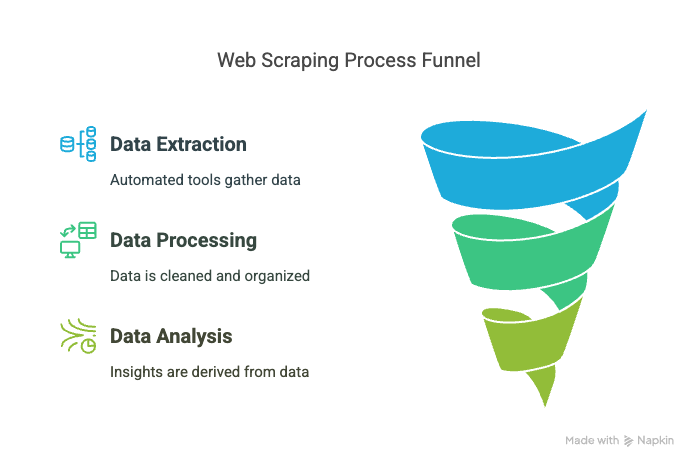
Key Benefits of Web Scraping House Prices
-
Track observed listing changes
Repeated snapshots can show how advertised prices change between collection times. Record the collection schedule and any missed runs. Daily observations cannot establish the exact time of an intraday change, and a recently collected page may still contain an old listing.
Practical check: retain both the observation timestamp and any separately displayed listing-update date. Label a dashboard with its last successful collection time and coverage; do not describe scheduled snapshots as real-time transactions.
-
Compare similar listings
Group observations by location, property type, size, tenure and condition where those fields are available. An apartment and a detached house are not interchangeable comparisons. Deduplicate repeated advertisements and flag uncertain property matches before summarising prices.
Practical check: report the number of eligible listings, missing fields and exclusions beside a median or mean. A different mix of properties can move the average even when no individual property becomes more expensive.
-
Support research questions
Listing observations can help identify areas or property types for further investigation. They do not establish market value, investment profitability, rental occupancy or demand by themselves. Treat price, rent, completed transactions and operating costs as distinct evidence sources.
Practical check: do not infer a sale because a listing disappears or is marked unavailable. It may have expired, been withdrawn, moved to a different URL or become inaccessible to the collector. Verify the source’s status definition and use an appropriate transaction record when a completed sale matters.
-
Review pricing with context
Use observed changes to flag listings for human review, rather than automatically matching the lowest competitor price. Differences in condition, lease terms, location and included charges can explain price gaps. Keep the original displayed offer alongside your normalised value.
Practical check: a collection process does not prove that repricing will increase revenue or reduce time on market. Document the decision, its evidence and later outcome separately from the scraped observations.
-
Make collection repeatable
Automation can reduce repetitive copying once the source and extraction rules are validated. It also requires maintenance when markup, pagination, permissions or field definitions change. Measure successful coverage and review effort, not just the number of rows exported.
Practical check: preserve an approved sample, extraction version and run log. Investigate sudden row-count drops, duplicate spikes and blank price fields before replacing the previous usable dataset.
How to Scrape House Prices Effectively
Use a small, permitted pilot to test the workflow before increasing coverage. Define what one row represents and what result would make the run unacceptable.
1. Choose the Right Web Scraping Tool
Choose tools around the source format, permitted access, validation needs and maintenance capacity. These are different components or products, not a ranking or a promise that a given property portal supports collection:
- Scrapy: a Python crawling framework with configurable delays, concurrency and robots handling. Set and verify those controls for the permitted source; installing a framework does not establish permission or data quality.
- Beautiful Soup: parses HTML or XML supplied to it. It does not itself fetch pages or run browser JavaScript. Test selectors on saved, authorised examples; our offline parsing and validation exercise demonstrates that separation.
- Octoparse: offers scheduled extraction workflows. Confirm current plan limits, execution environment and the exact pages your configured task can handle before relying on unattended runs.
- ParseHub: provides visual extraction and advertises support for dynamic pages and scheduled runs. Validate the intended interaction and export with a small sample; product capabilities do not guarantee complete coverage of every site.
2. Define Your Data Collection Goals
Write a field specification before collecting. For each field, record its source, meaning, required status and validation rule. At minimum, decide how you will represent:
- Advertised amount, currency and price type; keep sale prices, monthly rents, weekly rents and price ranges separate.
- Property type, bedrooms, bathrooms and area, retaining the original area unit and distinguishing floor area from land area.
- The geographic detail needed for the analysis, such as locality or postcode; avoid collecting occupant or contact details without a defined lawful purpose.
- The source listing identifier, URL, observed status and observation timestamp; a portal’s “sold” label is not automatically a verified completion price.
Use a data dictionary and keep raw values beside normalised fields. For example, a “price on application” entry is not zero, and a weekly rent must not enter a monthly-rent comparison without an explicit conversion rule. Flag ambiguous currencies, area units and duplicate identities for review.
3. Set Up Scraping Parameters
Configure a bounded run with an allowed URL scope, pagination limit, collection interval, conservative request rate and output schema. Retain enough provenance to reproduce an observation without collecting unnecessary personal information.
- Target sources: record the permitted feed, API or pages, geographic coverage and exclusions. Do not bypass authentication, access restrictions or blocks; ask for an authorised route when needed.
- Frequency and load: choose an interval supported by your use case and the source’s limits. Handle errors and rate limits with backoff or stopping; faster retries are not evidence of fresher data.
- Output and identity: export CSV, a workbook or a database with explicit types. Use source plus listing ID plus observation time for snapshot identity; maintain a separate reviewed property-match key if combining portals or relistings.
4. Run the Scraper
Run a small pilot and compare a sample of extracted values against the source at the same observation time. Check pagination, duplicate IDs, currency, area units, missing prices and status labels. Log failed pages separately from valid pages with no matching listings. Keep historical snapshots rather than overwriting every prior price; stop or quarantine a run when the agreed checks fail.
5. Analyze and Use the Data
Start analysis with a documented eligible cohort. Report counts, missingness and exclusions, then compare similar property groups and matched listings across dates. Keep asking-price changes distinct from transaction-price trends. FHFA’s US House Price Index FAQ explains a repeat-sales method using repeat transactions on the same properties, with defined mortgage-data coverage. A simple average of portal listings is not equivalent to that index.
Worked example — fictional asking prices: the two snapshots below use the same invented currency and property definition. A dash means the listing was not observed in that snapshot, not that its price was zero or that it sold. These are teaching records, not market data.
| Listing | Snapshot 1 | Snapshot 2 |
|---|---|---|
| A | 100,000 | 90,000 |
| B | 200,000 | 190,000 |
| C | 300,000 | — |
| D | — | 500,000 |
The all-listing mean rises from (100,000 + 200,000 + 300,000) / 3 = 200,000 to (90,000 + 190,000 + 500,000) / 3 = 260,000, an increase of 30%. But the same two listings, A and B, fall from a mean of 150,000 to 140,000, or approximately 6.67%. The sample changed: a more expensive listing appeared while C was no longer observed.
Neither comparison establishes market appreciation. The matched sample is tiny and selected, asking prices are not completed transactions, and property condition or listing details may have changed. Publish both denominators, identify entries and exits, and investigate missing observations before drawing conclusions. For a broader worked comparison of normalised offers, see our price-validation example.
Legal and Ethical Considerations in Web Scraping House Prices
Source access, data rights and privacy require separate checks for the actual jurisdiction and intended use. This operational checklist does not provide legal clearance for a specific collection project:
- Terms and permission: review the source’s licence, terms, access rules and permitted reuse. Prefer authorised APIs or downloads where appropriate, and resolve uncertainty with the rights holder or qualified advice before collecting or republishing.
- Robots instructions: honour applicable crawl rules, but do not treat them as a licence. RFC 9309 explicitly distinguishes robots rules from access authorisation. A missing disallow rule does not settle contractual, copyright or privacy questions.
- Personal information: minimise collection and define access, retention and deletion rules. Public visibility does not remove privacy obligations. The ICO’s joint-statement update stresses lawful, contractually controlled scraping. Assess the rules applicable to your project rather than assuming one country’s guidance covers every market.
| Check | Record |
|---|---|
| Access | Permitted source, request limits and contact for unresolved restrictions. |
| Reuse | Licence, attribution, redistribution and retention conditions. |
| Privacy | Necessary fields, applicable obligations, access controls and deletion process. |
Conclusion: Build a Verifiable House-Price Monitor
A useful house-price monitor records what was observed, where, when and under which definitions. Begin with a permitted source and a small validated sample, keep historical observations, and explain how the eligible property mix changes. Use the result to investigate questions; do not present asking-price averages as completed-sale values, market-wide appreciation or guaranteed investment returns.
To scope a collection project, contact Easy Data with the geography, source, permitted access, required fields, observation schedule and validation criteria. Confirm coverage and a sample before agreeing ongoing delivery.
Further practical reading
- Web scraping examples and a worked price comparison — applies the same principle of comparing equivalent offers.
- Offline web-scraping exercise — practise extraction and validation without collecting live property data.
Leave a Reply