


Shopee has become one of the most important ecommerce platforms in Southeast Asia. As its scale and complexity increase, interest in web scraper Shopee solutions has grown rapidly. By 2025, however, scraping Shopee is no longer a simple technical question of extraction. It has become a strategic decision shaped by sustainability, data quality, and long-term analytical value.
Instead of explaining how to scrape, this article focuses on how to use a Shopee web scraper responsibly and effectively within a broader data strategy.
Web Scraper Shopee in 2025: Market Context and Data Challenges
Using a web scraper Shopee today is fundamentally different from several years ago. Platform defenses, rendering logic, and data volatility have evolved significantly.Shopee now operates with:
- Advanced anti-bot and detection mechanisms
- Highly dynamic, JavaScript-driven interfaces
- Frequent structural and layout changes
- Aggressive rate-limiting behavior
As a result, scraping may still be technically possible, but maintaining stable, accurate, and scalable datasets has become the real challenge. In 2025, best practices are less about optimization tricks and more about discipline, restraint, and data design.
Understanding What a Shopee Web Scraper Can and Cannot Do
Before applying best practices, it is critical to understand the realistic role of a Shopee scraper within an analytics stack. Much of the risk around scraping comes not from technical limitations, but from mismatched expectations about what scraping can reliably deliver.
What a Shopee Web Scraper Is Designed For
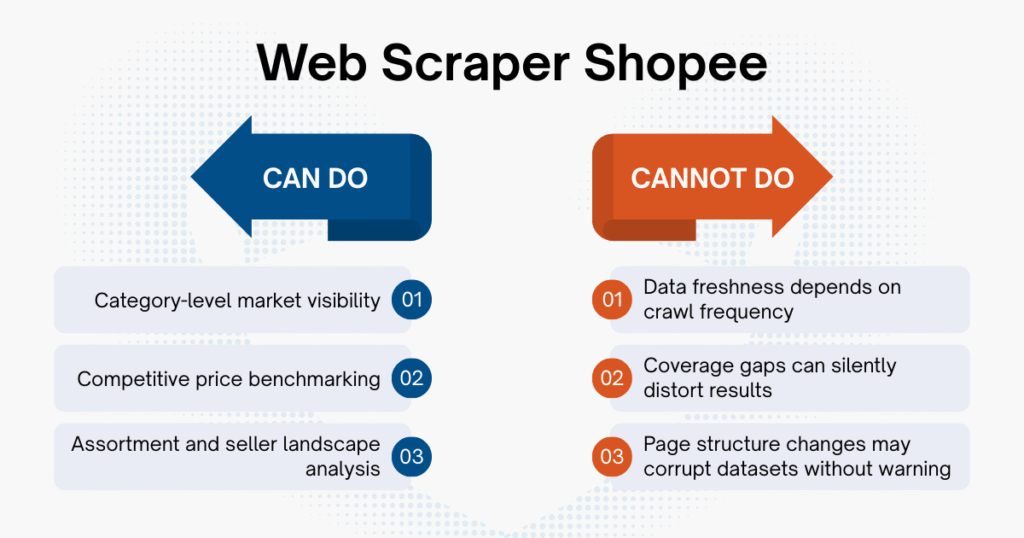
At its core, a web scraper Shopee is a mechanism for collecting publicly accessible marketplace data. When aligned with appropriate objectives, it can support:
- Category-level market visibility
- Competitive price benchmarking
- Assortment and seller landscape analysis
These use cases focus on aggregated market patterns, not operational control.
Structural Limitations of Shopee Scraping
Even the most advanced Shopee crawler faces inherent constraints:
- Data freshness depends on crawl frequency
- Coverage gaps can silently distort results
- Page structure changes may corrupt datasets without warning
Shopee web scraper is not a data source by itself. It is only one component within a broader data pipeline that requires validation, normalization, and monitoring.
Use Cases That Actually Make Sense for a Shopee Web Scraper
In 2025, the value of a web scraper Shopee depends less on what can be extracted, and more on which questions are being asked. Some use cases align naturally with scraping, while others introduce hidden risk and distortion.
Use cases that align well with scraping include:
- Category-level market sizing
- Competitive landscape mapping
- Historical price and promotion tracking
- Seller distribution and assortment depth analysis
Use cases that are structurally misaligned include:
- Real-time inventory monitoring
- Individual user behavior analysis
These limitations are not technical failures. They reflect misunderstandings about what scraping can reliably deliver.
Is Using a Shopee Web Scraper Legal in 2025?
Beyond technical considerations, Shopee data scraping operates within a legal and compliance framework that cannot be ignored. Understanding these boundaries is essential for teams that intend to use scraping as a repeatable data input rather than a one-off experiment.
Shopee Terms of Service: What You Should Know
Like most large marketplaces, Shopee defines how its data may be accessed and used. While interpretations may vary by jurisdiction, several principles are commonly relevant when teams use a web scraper Shopee.
- Public data vs. private data: Product listings, prices, and category information are generally considered public-facing. User accounts, personal identifiers, and private transactions are not.
- Rate limits and access rules: Excessive request volume, automated abuse, or activities that degrade platform performance may violate platform policies, even when accessing publicly visible pages.
Understanding these boundaries helps organizations reduce unnecessary legal and operational risk when scraping Shopee data at scale.
Ethical and Compliance Considerations
Compliance is not limited to written terms. As scraping operations scale, ethical considerations increasingly influence platform tolerance, enforcement risk, and long-term viability:
- Respecting robots.txt directives and maintaining reasonable request frequency
- Avoiding the collection of personal or sensitive user data
- Using scraped data for analysis and insight generation rather than platform manipulation
Treat Shopee data scraping as an analytical activity, not an exploitative one. Responsible usage minimizes disruption to the platform and reduces the likelihood of enforcement actions.
Shopee Web Scraper vs API Access vs Pre-Collected Datasets
Accessing Shopee data is ultimately a question of trade-offs rather than right or wrong choices. Different approaches reflect different assumptions about flexibility, stability, and long-term analytical needs.
| Criteria | Web Scraper | Shopee Scraper API | Pre-Collected Dataset |
|---|---|---|---|
| Flexibility | High | Medium | Low–Medium |
| Stability | Low–Medium | Medium | High |
| Hidden operational cost | High | Medium | Low |
| Long-term analytical fit | Medium | Medium | High |
A web scraper Shopee offers flexibility, but that flexibility often comes with operational complexity. APIs reduce technical burden but still impose constraints, while curated datasets trade flexibility for consistency.
Best Practices for Using a Web Scraper Shopee in 2025
In 2025, effective Shopee scraping is less about clever extraction techniques and more about disciplined system design. Best practices focus on how scraping is governed, maintained, and integrated into broader data workflows over time.
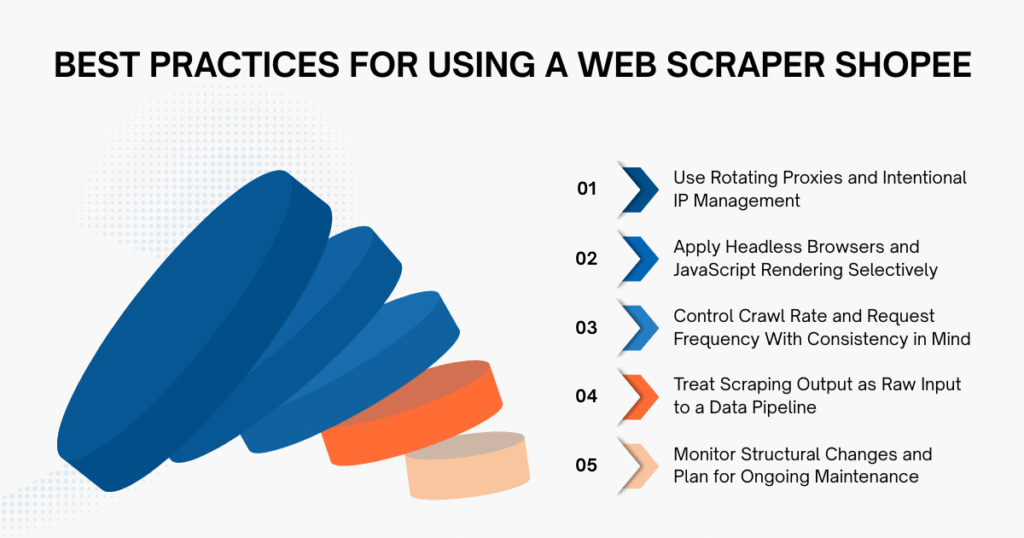
These principles reflect how experienced data teams approach Shopee scraping when accuracy, scalability, and long-term usability matter more than short-term speed.
1. Use Rotating Proxies and Intentional IP Management
IP strategy is foundational to sustainable Shopee scraping. At scale, unstable or poorly managed IP usage is one of the most common causes of data gaps and silent failures. Effective Shopee scraping typically involves:
- Residential proxies to reduce behavioral detection risk
- Datacenter proxies for controlled, lower-risk workloads
- Geo-targeted IP pools to ensure market-specific accuracy (for example, differentiating Shopee SG, MY, or TH)
Rather than maximizing request volume, mature teams focus on maintaining consistent access patterns that resemble normal browsing behavior. In practice, conservative IP rotation and traffic pacing produce far more reliable datasets than aggressive throughput optimization.
2. Apply Headless Browsers and JavaScript Rendering Selectively
Shopee’s interface relies heavily on client-side rendering, but not every page requires browser-based scraping. Overusing headless browsers increases cost, latency, and operational complexity without improving data quality. Best practice involves:
- Using headless browsers for pages with dynamic filters, pagination, or interactive elements
- Avoiding full browser rendering for static or semi-static endpoints when structured requests suffice
- Standardizing user-agent strings and interaction flows to minimize fingerprint variability
Teams that selectively apply JavaScript rendering tend to achieve better stability while keeping infrastructure costs predictable.
3. Control Crawl Rate and Request Frequency With Consistency in Mind
High request volume is one of the fastest ways to trigger blocking or throttling on Shopee. In 2025, consistency matters more than speed. Experienced scraping operations typically:
- Mimic human navigation patterns rather than batch-style crawling
- Avoid sharp traffic spikes within short time windows
- Schedule scraping cycles to align with realistic market update intervals
From a data perspective, a slower but repeatable crawl produces far more analytical value than an incomplete high-speed scrape that cannot be replicated reliably.
4. Treat Scraping Output as Raw Input to a Data Pipeline
Scraping itself does not produce analysis-ready data. Best practice requires treating scraped Shopee data as raw input to a structured pipeline.This usually includes:
- Deduplicating products that appear across multiple categories or seller pages
- Validating critical attributes such as price, availability, and variant structure
- Implementing retry logic and error handling for partial or transient failures
Teams that delay normalization until after analysis often discover that inconsistencies are too deeply embedded to correct reliably.
5. Monitor Structural Changes and Plan for Ongoing Maintenance
Shopee’s frontend and backend structures evolve continuously. Without active monitoring, scraping logic can degrade silently, producing incomplete or misleading datasets. Operational best practices include:
- Alerts for HTML or DOM structure changes
- Monitoring data volume and field distributions to detect anomalies
- Regularly reviewing selectors and extraction logic
Maintenance is not an exception scenario. It is an inherent cost of using a web scraper Shopee as a long-term data source.
Key Challenges When Scraping Shopee Data
Scraping Shopee in 2025 presents challenges that extend well beyond simple HTML extraction.
Anti-Bot and CAPTCHA Systems
Shopee employs multiple layers of protection, including:
- IP blocking and reputation-based filtering
- JavaScript-heavy rendering
- Behavioral detection that flags non-human interaction patterns
These mechanisms, commonly referred to as bot detection systems, require scrapers to behave more like real users rather than static scripts.
Data Quality and Structural Issues
Even when access remains stable, data consistency is difficult to maintain:
- HTML structures change frequently
- Product variants, SKUs, and bundles are often nested or dynamically loaded
- Category paths may overlap or evolve over time
Without careful handling, scraped data can quickly become fragmented or misleading.
Scaling Problems
What works for hundreds of products may fail at scale:
- Millions of listings across categories
- Rapid price and availability updates
- Continuous monitoring requirements
Scaling scraping efforts introduces infrastructure, cost, and maintenance challenges that many teams underestimate.
Where Managed Data Collection Fits In
As scraping efforts mature, data collection often becomes an operational responsibility rather than a technical experiment.
Some organizations continue to manage scraping internally using best practices like those outlined above. Others complement internal workflows with external data providers that specialize in maintaining stable Shopee data pipelines at scale.
In these cases, providers such as Easy Data operate less as tool replacements and more as infrastructure partners, handling the complexity of continuous Shopee data scraping while internal teams focus on analysis, modeling, and decision-making.
Conclusion
A web scraper Shopee remains a powerful way to access ecommerce data in 2025, but only when used thoughtfully. Following best practices helps reduce risk, improve data quality, and control long-term maintenance costs. Ultimately, effective scraping is less about scale or speed, and more about building reliable data foundations that support meaningful market intelligence over time.
Leave a Reply