
Introduction: Understanding the Uses of Web Scraping
The uses of web scraping are expanding rapidly across industries. Businesses, marketers, and researchers rely on data extraction to gather real-time insights, track competitors, and optimize operations.
- Introduction: Understanding the Uses of Web Scraping
- 1. E-Commerce Price Monitoring & Competitor Analysis
- 2. Lead Generation & B2B Sales Prospecting
- 3. SEO & Digital Marketing Insights
- 4. Social Media Sentiment Analysis
- 5. Dropshipping & E-Commerce Automation
- 6. Financial & Stock Market Data Extraction
- 7. Job Market & Recruitment Data
- 8. Travel & Hotel Price Aggregation
- 9. Real Estate Market Insights
- 10. Scientific Research & Academic Studies
- Final Thoughts: Why Web Scraping is a Game-Changer
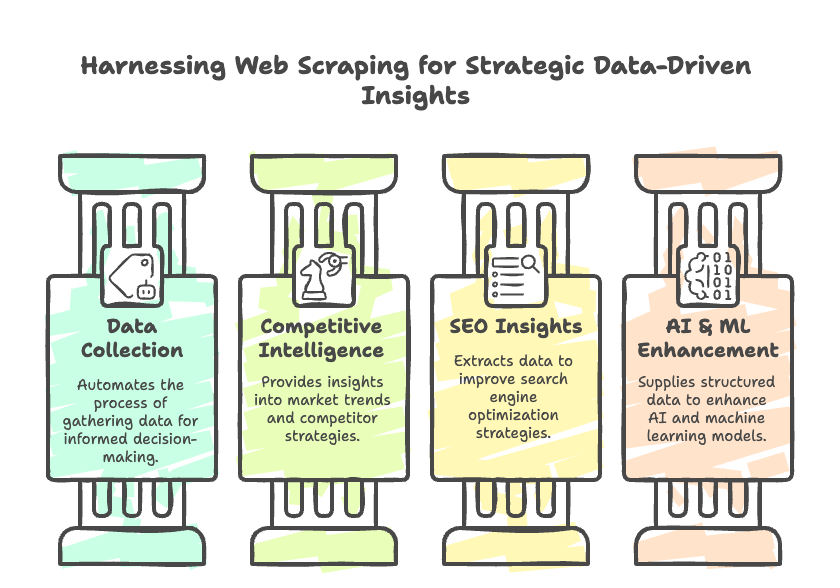
Why Web Scraping is Essential?
✔ Automates data collection for better decision-making
✔ Provides competitive intelligence for e-commerce & finance
✔ Extracts SEO insights for digital marketing
✔ Enhances AI & machine learning models with structured data
Let’s explore the top 10 uses of web scraping and how companies benefit from it.
1. E-Commerce Price Monitoring & Competitor Analysis
📌 Industry: E-Commerce, Retail, Travel
Businesses use web scraping to monitor competitor pricing, discounts, and stock availability.
How It Works:
- Scrape Amazon, eBay, Shopee, and Walmart to track real-time prices.
- Automate price adjustments for dynamic pricing strategies.
- Extract product details, customer reviews, and shipping costs.
📖 Further Reading: How Web Scraping Helps E-Commerce Businesses
2. Lead Generation & B2B Sales Prospecting
📌 Industry: Sales, Marketing, Real Estate
Companies scrape business directories, LinkedIn, and online databases to generate leads.
How It Works:
- Extract company names, emails, and phone numbers.
- Automate outreach for cold emailing & digital marketing.
- Identify potential customers for B2B sales pipelines.
📖 Further Reading: Automating Lead Generation with Web Scraping
3. SEO & Digital Marketing Insights
📌 Industry: SEO, Digital Marketing, Content Strategy
Marketers use web scraping to track search engine rankings, backlinks, and competitor keywords.
How It Works:
- Scrape Google search results to analyze top-ranking keywords.
- Monitor competitor backlink strategies.
- Extract content from top-performing websites for SEO optimization.
📖 Further Reading: SEO Keyword Tracking with Web Scraping
4. Social Media Sentiment Analysis
📌 Industry: Brand Management, Consumer Research
Businesses scrape social media platforms like Twitter, Instagram, and Reddit to monitor public sentiment.
How It Works:
- Collect hashtags, mentions, and reviews related to a brand.
- Use Natural Language Processing (NLP) to analyze sentiment trends.
- Track customer perception and engagement levels.
📖 Further Reading: AI-Powered Social Media Sentiment Analysis
5. Dropshipping & E-Commerce Automation
📌 Industry: E-Commerce, Dropshipping
Dropshippers scrape supplier data to track product availability, pricing, and shipping times.
How It Works:
- Scrape AliExpress, Alibaba, and Oberlo to track inventory.
- Monitor competitor best-sellers and trending products.
- Automate product listing updates on Amazon, eBay, and Shopify.
📖 Further Reading: How Automation is Changing Dropshipping
6. Financial & Stock Market Data Extraction
📌 Industry: Finance, Investment, Cryptocurrency
Traders and financial analysts scrape stock prices, earnings reports, and financial news for market insights.
How It Works:
- Scrape real-time stock prices and cryptocurrency values.
- Monitor economic news & investor sentiment.
- Track company earnings reports & SEC filings.
📖 Further Reading: AI & Big Data in Financial Trading
7. Job Market & Recruitment Data
📌 Industry: HR, Recruitment
HR teams scrape job boards and LinkedIn to track hiring trends and find potential candidates.
How It Works:
- Extract job listings from Indeed, Glassdoor, and LinkedIn.
- Analyze salary trends and hiring demand.
- Automate candidate sourcing for recruitment firms.
📖 Further Reading: How Data Analytics is Transforming Hiring
8. Travel & Hotel Price Aggregation
📌 Industry: Travel, Hospitality
Travel agencies scrape hotel and flight prices to offer the best deals to customers.
How It Works:
- Scrape flight prices from Expedia, Skyscanner, and Kayak.
- Monitor hotel discounts on Booking.com and Airbnb.
- Track seasonal price fluctuations.
📖 Further Reading: How Travel Tech Uses Web Scraping
9. Real Estate Market Insights
📌 Industry: Real Estate, Property Investment
Investors scrape property listing websites to analyze housing market trends.
How It Works:
- Extract rental prices, home values, and location data.
- Compare historical price trends for investment insights.
- Track foreclosures and new developments.
📖 Further Reading: Real Estate Data Analytics Trends
10. Scientific Research & Academic Studies
📌 Industry: Academia, Research Institutions
Researchers scrape public datasets, academic papers, and government databases for studies.
How It Works:
- Scrape Google Scholar, PubMed, and ResearchGate for research papers.
- Analyze scientific trends and citation networks.
- Extract data from open government sources.
📖 Further Reading: Data Science in Academic Research
Final Thoughts: Why Web Scraping is a Game-Changer
The uses of web scraping continue to expand, helping businesses and researchers automate data collection, gain market insights, and enhance AI-driven analytics.
📩 Need a web scraping solution? Contact Easy Data for expert data extraction services.
Leave a Reply