

Shopee Product Scraping is often perceived as a purely technical data collection activity. From a market perspective, however, product-level data reveals how categories are structured, how competition evolves, and where strategic opportunities emerge. When analyzed over time, Shopee Product Scraping becomes a powerful source of market intelligence, far beyond simple data extraction.
What Is Shopee Product Scraping?
In practice, scraping Shopee is often treated as a technical task focused on extracting product listings, prices, and seller information. From a market perspective, however, Shopee Product Scraping represents a systematic way to observe how product categories are structured, how competition evolves, and how sellers position themselves over time. When collected consistently, product-level data becomes more than a static snapshot, it forms a dynamic view of market behavior.
Shopee Product Scraping Defined (Market Perspective)
At its core, Shopee Product Scraping refers to the large-scale collection of product-level data from Shopee over time. This data typically includes:
- Product titles and descriptions
- Category and sub-category placement
- Seller and brand associations
- Pricing and promotional indicators
- Availability and stock status
When observed continuously, this data forms a time-series view of the marketplace, allowing analysts to move from isolated product snapshots to broader market signals.
Why Shopee Product Scraping Is Often Misunderstood
Shopee Product Scraping is frequently reduced to a technical exercise: crawling product pages and storing listings in a database. This narrow interpretation overlooks its strategic value.
Common misconceptions include:
- Treating product data as static lists rather than evolving market signals
- Focusing on individual SKUs instead of category-level patterns
- Ignoring historical depth and time-based changes
Without context, product data remains fragmented. With structure and continuity, the same data becomes a lens into how markets form, grow, and compete.
From Product Data to Market Intelligence
Raw product data only becomes valuable when it helps explain how the market behaves – a core principle of market intelligence. Shopee Product Scraping enables this shift by revealing patterns that are invisible at the individual product level.
How Product-Level Data Reveals Market Structure
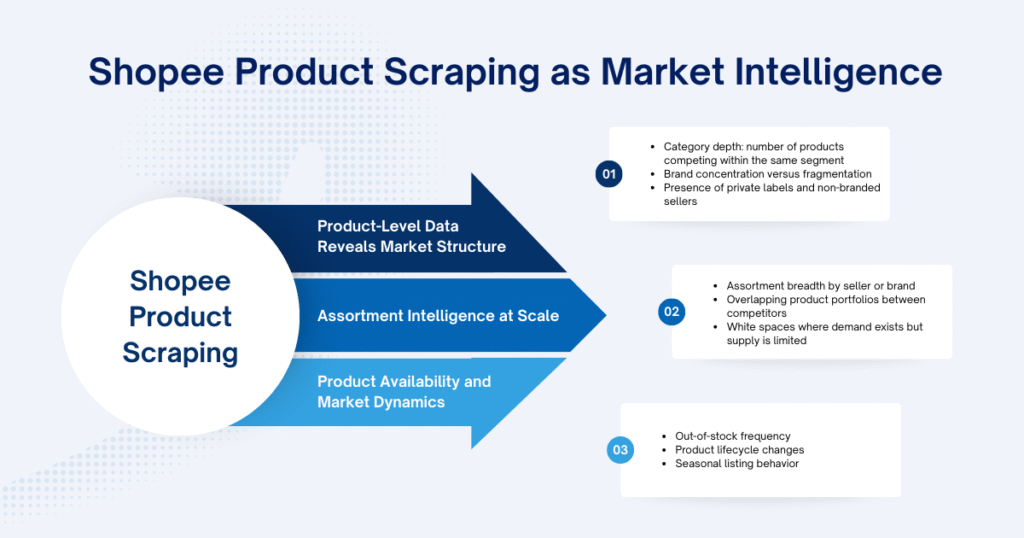
At scale, product data shows how categories are built and competed within. By analyzing scraped product listings, businesses can observe:
- Category depth: number of products competing within the same segment
- Brand concentration versus fragmentation
- Presence of private labels and non-branded sellers
These structural signals help explain why certain categories experience intense price competition while others remain more stable.
Assortment Intelligence at Scale
Shopee Product Scraping also enables assortment intelligence, understanding who sells what, and how complete or differentiated their offerings are.
Key insights include:
- Assortment breadth by seller or brand
- Overlapping product portfolios between competitors
- White spaces where demand exists but supply is limited
Over time, these patterns highlight strategic positioning rather than isolated listing decisions.
Product Availability and Market Dynamics
Availability data adds another dimension to market intelligence. Product scraping captures:
- Out-of-stock frequency
- Product lifecycle changes
- Seasonal listing behavior
Together, these signals help explain demand volatility, category maturity, and seller responsiveness.
Key Market Insights Enabled by Shopee Product Scraping
When product data is aggregated and analyzed consistently, Shopee Product Scraping supports a range of market-level insights that extend far beyond individual listings.
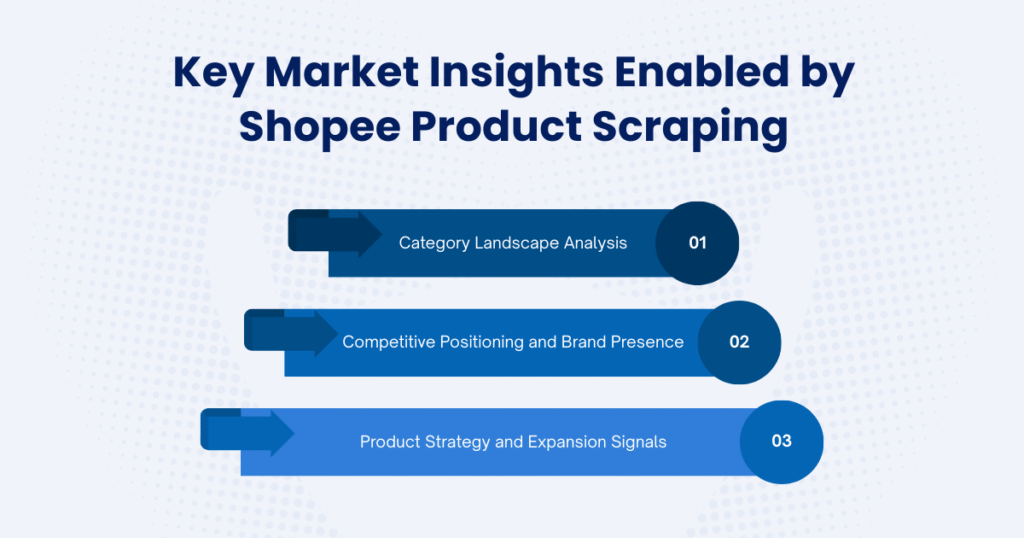
Category Landscape Analysis
Product scraping makes it possible to evaluate categories at scale, including:
- Category saturation levels
- Entry barriers for new sellers
- Competitive density across sub-categories
This type of analysis helps explain why some categories favor volume-driven strategies while others reward specialization.
Competitive Positioning and Brand Presence
By mapping products to sellers and brands, Shopee Product Scraping reveals how competitive positions are formed:
- Brand dominance versus long-tail competition
- Concentration of hero products
- Shifts in brand visibility over time
These patterns are essential for understanding how brands defend or lose market share in dynamic marketplaces.
Product Strategy and Expansion Signals
Tracking new listings and category entry provides early indicators of strategic moves, such as:
- New product launches
- Cross-category expansion
- Testing of adjacent market segments
Over time, these signals reflect how sellers adapt to market pressure and emerging demand.
Shopee Product Scraping vs Simple Product Lists
Not all product data delivers the same value. The difference between basic product lists and market intelligence becomes clear when viewed side by side.
| Simple Product Lists | Shopee Product Scraping as Market Intelligence |
| Static snapshots | Continuous time-series data |
| SKU-focused | Category and market-focused |
| Limited context | Competitive and structural context |
| Short-term visibility | Long-term market understanding |
In practice, market intelligence emerges only when product data is collected, structured, and observed over time. Without this continuity, analysis remains descriptive rather than strategic.
Challenges of Using Product Data for Market Intelligence
Shopee Product Scraping introduces complexity that goes beyond basic data access. At scale, several challenges influence how reliable market insights can be.
- Data Freshness and Coverage: Shopee listings change frequently. Without consistent updates, product data quickly loses relevance, distorting market analysis.
- Product Normalization Across Sellers: The same product may appear under different titles, categories, or attributes. Normalizing these variations is critical for accurate aggregation.
- Category Mapping at Scale: Category structures evolve over time, requiring continuous alignment to ensure historical comparisons remain valid.
Why Raw Product Data Matters More Than Pre-built Insights
Market intelligence depends on flexibility. As markets evolve, pre-built dashboards and fixed metrics often limit how product data can be explored, reinterpreted, and reused for new questions.
Raw Shopee product data provides a different level of control. With direct access to raw datasets, teams are able to:
- Define their own analytical logic
- Re-segment categories as markets evolve
- Integrate product data with pricing, promotion, and demand signals
In this context, raw data is not a technical preference, it becomes a strategic requirement for long-term market understanding.
This is where the role of a raw e-commerce data provider becomes relevant. Rather than offering opinions or closed analytics, providers like Easy Data focus on delivering structured, large-scale Shopee product data generated through Shopee data scraping, designed to be directly integrated into existing BI systems, data warehouses, or custom analytical models.
By working with raw datasets instead of pre-processed insights, organizations retain ownership over how market intelligence is built, validated, and adapted. In practice, this approach supports long-term analysis, cross-functional use cases, and evolving business questions, without being constrained by a fixed reporting layer.
Shopee Product Scraping in a Broader Market Intelligence Context
Shopee Product Scraping becomes significantly more powerful when viewed as part of a broader market intelligence effort. When combined with product data from other marketplaces such as Lazada or TikTok Shop, it supports cross-platform comparisons and industry-level analysis.
Rather than answering isolated questions, this broader view helps organizations understand how product strategies differ across platforms and how market structures evolve at the ecosystem level.
Final Thoughts
Shopee Product Scraping is not simply about collecting more product listings. When structured and analyzed correctly, it becomes a way to read the market, revealing how categories form, how competition intensifies, and how strategies shift over time.
Seen through this lens, product scraping is less about data volume and more about perspective. Market intelligence begins where product data is allowed to speak beyond individual SKUs.
Leave a Reply