

Shopee insights reveal far more than simple performance numbers. Every new product listing, price change, and customer review contains signals about market demand and competitive dynamics. When businesses fully leverage Shopee Business Insights and combine it with broader Shopee data sources, they can transform these signals into deeper market intelligence that drives smarter ecommerce strategies.
What Is Shopee Business Insights?
Shopee Business Insights (Shopee BI) refers to the analytics features provided within the Shopee ecosystem, mainly through seller dashboards and analytics tools designed to help merchants understand marketplace performance. These dashboards aggregate metrics such as:
• Product views
• Sales performance
• Traffic sources
• Conversion rates
• Product-level performance indicators
For sellers operating on the platform, Shopee BI provides the first layer of Shopee insights. It shows what is happening inside a store and across individual product listings, allowing businesses to monitor sales performance in near real time.
However, Shopee BI should be viewed as an entry point rather than a complete analytics system. The dashboard reveals important signals but only covers a limited portion of marketplace activity. To generate deeper Shopee insights for market analysis, analysts typically expand beyond BI data and combine multiple marketplace datasets.
How to Read Shopee Business Insights for Market Analysis
Understanding Shopee BI dashboards requires interpreting several key metrics rather than looking at raw numbers in isolation. Each metric provides a different signal about marketplace behavior.
Traffic Metrics
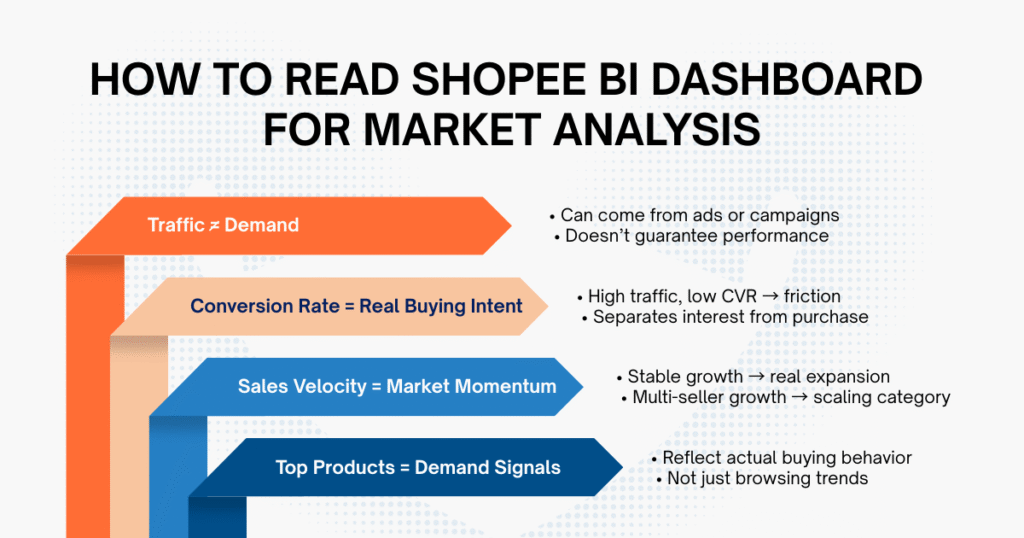
Traffic data shows how many users are visiting product pages or stores. A sudden spike in traffic may indicate rising demand, a successful promotion, or increased visibility in search results. However, traffic alone does not necessarily indicate strong business performance.
Conversion Rates
Conversion rate measures how effectively product views translate into purchases. A product receiving large amounts of traffic but producing few sales may signal pricing issues, weak product descriptions, or stronger competing listings.
Revenue and Sales Velocity
Sales velocity provides insight into how quickly products are moving through the marketplace. Consistent sales growth across multiple sellers often indicates that a category is expanding.
Product Performance
Shopee BI dashboards also highlight top-performing products and trending listings. These indicators provide valuable Shopee insights that help analysts understand marketplace demand and identify what customers are actively purchasing.
What Insights Can Shopee Business Insights Reveal?
When analyzed correctly, Shopee BI data can reveal several strategic insights about ecommerce markets.
Product Demand Patterns
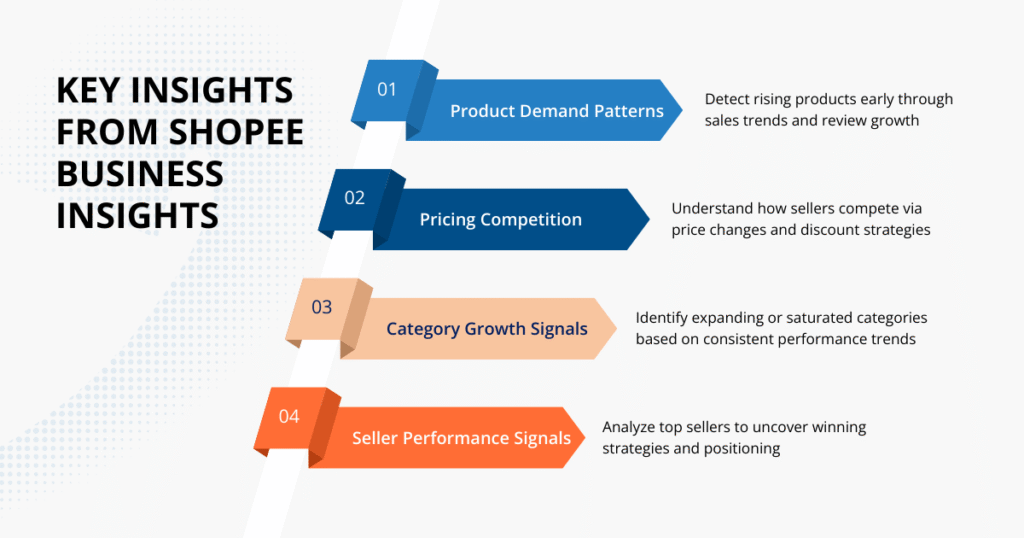
Sales performance and product analytics within Shopee BI can highlight which products are gaining traction within a category. By observing sales trends, review activity, and product performance signals, analysts can identify emerging trends before they become mainstream.
For example, if a product category shows rising sales velocity and increasing review volumes, it often signals expanding consumer demand.
Pricing Competition
Price fluctuations across sellers reveal how competitive a product segment is. Monitoring pricing trends allows brands to determine whether to compete on price, differentiate on product features, or offer bundled packages.
Pricing intelligence is one of the most valuable analytical insights Shopee provides that ecommerce teams are always looking to leverage.
Category Growth
Category performance metrics in Shopee BI can reveal early signals of growth or decline within specific product segments. When multiple products within a category show consistent increases in sales and traffic, it may indicate expanding demand within that segment.
For businesses evaluating market entry, these Shopee insights provide early signals of category saturation or growth potential.
Seller Performance Signals
By examining seller performance signals, review patterns, and product portfolios, businesses can better understand how competitors operate on the platform. High-performing sellers often reveal successful pricing strategies and listing optimization techniques.
Data Sources That Power Shopee Market Insights
While Shopee BI provides useful analytics, the insights themselves are powered by multiple layers of marketplace data. Understanding these data sources helps analysts interpret Shopee BI signals more accurately and extract deeper insights from Shopee.
| Data Source | What It Reveals |
| Product data | Listings, pricing, attributes, stock levels |
| Seller data | Store performance, ranking, portfolio size |
| Search data | Keyword demand and trending queries |
| Review data | Customer sentiment and product quality signals |
| Pricing data | Competitive positioning and discount patterns |
Each dataset provides a different analytical perspective. For instance, product data explains what is currently being sold, while search data reveals what customers are actively looking for. Review data highlights customer sentiment and product satisfaction levels.
The most valuable Shopee insights typically emerge when these datasets are integrated and analyzed together rather than examined individually.
Examples of Shopee Insights for Market Analysis
To understand the practical value of Shopee insight, it helps to examine how marketplace data translates into real business insights.
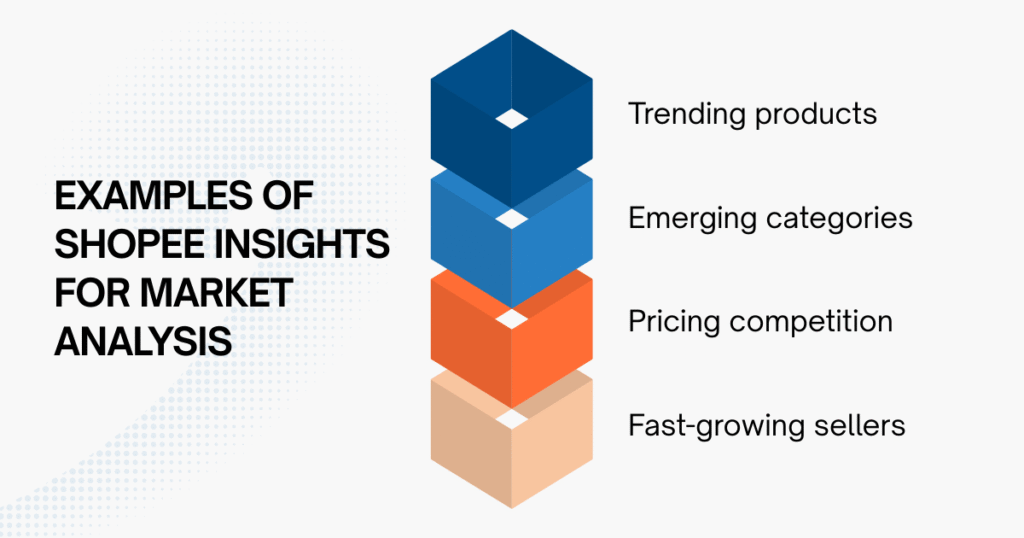
- Trending products: Rapid increases in sales velocity and review counts often signal that a product is trending. Identifying these signals early allows sellers to capture emerging demand before competitors enter the market.
- Emerging categories: When new product segments begin appearing across multiple sellers, it may indicate a growing category trend. These insights allow brands to position themselves early in expanding markets.
- Pricing competition: Monitoring price changes among competing sellers can reveal aggressive discounting or premium pricing trends within a category.
- Fast-growing sellers: Tracking seller rankings over time helps identify stores that are rapidly gaining market share. Studying these sellers often reveals effective marketing or pricing strategies.
Each of these examples illustrates how different Shopee data sources can be translated into actionable market intelligence. By interpreting patterns in listings, reviews, pricing activity, and seller rankings, businesses can uncover meaningful Shopee insights that support data-driven ecommerce decisions (from product launches to pricing strategies).
How Businesses Extract Shopee Insights for Market Analysis
Companies that rely heavily on marketplace intelligence typically move beyond basic Shopee BI dashboards to analyze broader Shopee data sources. By collecting and processing marketplace datasets, businesses can transform raw Shopee data into deeper market insights.
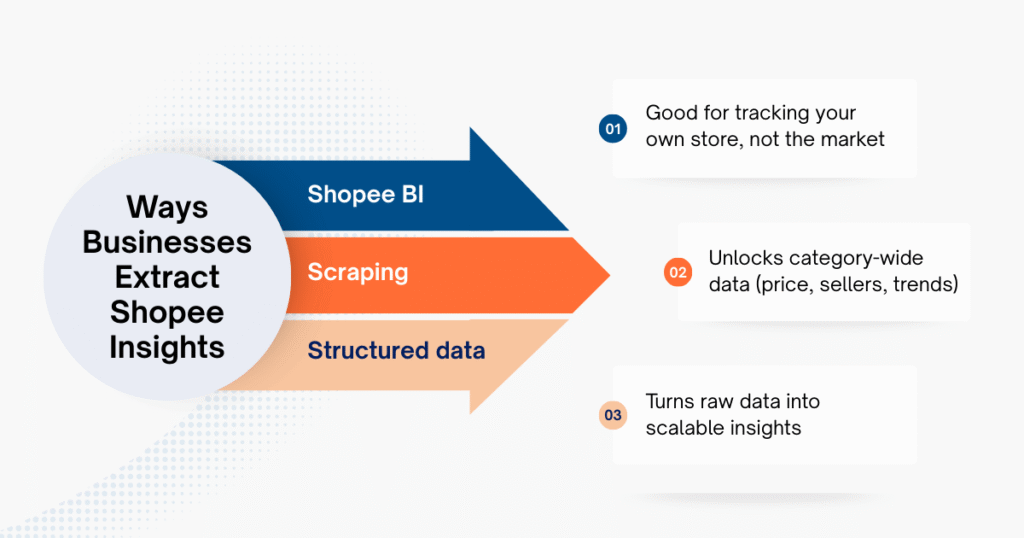
Manual Analysis from Shopee BI
Many sellers begin by analyzing the analytics features available within the Shopee seller dashboard. This approach works well for monitoring store performance and tracking product sales trends. However, this method becomes limited when businesses want to analyze the entire marketplace rather than a single store.
Marketplace Scraping
Some ecommerce analysts collect marketplace data through web scraping techniques. This approach allows businesses to gather large volumes of information, such as:
• Product listings
• Seller rankings
• Price changes
• Review activity
With this data, analysts can build custom dashboards and generate deeper Shopee insights across entire product categories.
Structured Shopee Datasets
Another increasingly common approach is to work with structured datasets generated from marketplace data.
These datasets provide analytics-ready information that can be imported directly into BI tools or data analysis platforms. By combining multiple Shopee datasets, analysts can build advanced Shopee insight models such as demand forecasting or competitor benchmarking.
Using External Shopee Data for Deeper Market Insights
Although Shopee Business Insights provides useful analytics for individual stores and product listings, it does not provide a complete view of the overall marketplace. Because of these limitations of Shopee Business Insights, businesses often find it difficult to analyze competitor product portfolios, category-wide pricing trends, or cross-seller performance when relying solely on the platform’s built-in analytics tools.
For this reason, many e-commerce companies combine Shopee dashboards with external marketplace datasets to generate deeper Shopee insights. External data enables broader analysis across product categories and seller ecosystems. Businesses can extract insights related to:
• Competitor intelligence
• Product trend detection
• Demand forecasting
• Pricing optimization
When these external datasets are integrated with analytics tools, analysts gain a much clearer picture of how the Shopee ecosystem evolves. These deeper layers of Shopee insight allow companies to move beyond descriptive analytics and begin identifying predictive trends.
Generating Shopee Insights with Easy Data
Platforms like Easy Data provide analytics-ready datasets derived from Shopee marketplace activity. Instead of manually collecting and cleaning raw data, analysts can work directly with structured information designed for market intelligence workflows. For example, Easy Data supports businesses that require:
• Large-scale Shopee data scraping service for product and pricing intelligence
• Structured Shopee datasets for analytics and forecasting
• Competitive intelligence across multiple sellers and categories
These datasets enable ecommerce teams to generate deeper Shopee insights than what standard dashboards provide, resulting in faster analysis and more accurate market positioning.
Conclusion
Shopee Business Insights provides the foundation for understanding marketplace performance. However, the most valuable Shopee insights emerge when BI metrics are combined with broader marketplace data. By transforming raw Shopee data into market insights, businesses can uncover strategic signals that guide smarter ecommerce decisions.
Leave a Reply