


Shopee trends aren’t just about products that sell well for a few days. They reflect how search behavior, competition, and pricing evolve over time. If you understand Shopee trends correctly, you can enter earlier, avoid crowded markets, and make better decisions. This guide breaks down how to actually read Shopee trends: how to find them, interpret them, and turn them into actions.
What Are Shopee Trends?
Shopee trends are recurring patterns in user search behavior, listing expansion, price fluctuations, and demand over time, not just short-term spikes.
A common mistake is assuming any fast-selling product is a trend. In reality, many products “blow up” for a few days, then disappear → that’s a fad, not a trend.
Take the Labubu blind box trend (before 2024 – early 2025):
- The keyword “labubu” grew steadily over time
- Sellers increased gradually
- Prices started high (due to scarcity), then stabilized
This is a real Shopee trend because it has a lifecycle and is driven by real demand, not campaigns.
Compare that with something like a $2 mini juicer during flash sales:
- Sales spike due to discounts
- Search doesn’t grow
- Listings don’t expand
That’s not a Shopee trend, it’s price-driven demand. Misreading this is why many sellers enter too late or at the wrong time.
Latest Shopee Trends in 2026
Shopee trends in 2026 show a clear shift: users are no longer just looking for cheap products, they’re looking for products that fit their lifestyle.
Trending Product Categories
Home & lifestyle optimization
Products like foldable laptop stands or mini vacuum cleaners … are growing steadily:
- They sell without heavy discounts
- Reviews increase consistently
- Listings grow without intense price competition
These are sustainable Shopee trending products driven by real demand.
Health & personal care devices
In the Southeast Asian market, social media content about neck massagers, mini facial toners, and at-home skincare tools… is on the rise.
On Shopee:
- Search demand for these products is rising first
- Sellers are joining in later
This underscores an important observation: Shopee trends often originate from user behavior, not from the platform itself.
Affordable tech accessories
Items like cooling fans or budget gaming gear … still perform well, but:
- Listings scale quickly
- Prices drop fast
- Margins get tighter
These Shopee trends are profitable, but highly competitive.
Emerging Product-Level Trends
Some of the best opportunities come from smaller trends:
- Mini wearable fans (weather-driven)
- LED room lights (TikTok-driven aesthetics)
- Interactive pet toys
These Shopee trending products usually start with search demand, while listings are still low. By the time they appear in “top products,” it’s often too late.
Keyword & Search Trends on Shopee
Keywords are often the earliest signal of Shopee trends. Recent Shopee search trends show patterns like:
- “mini”, “portable” → convenience-driven demand
- “setup”, “decor” → personalization needs
- “cheap”, “under $5” → ongoing price sensitivity
For example, the keyword “LED room decor lights” didn’t spike overnight, it grew steadily alongside TikTok content.
Most Shopee trends follow a similar path: Content → Search → Listing → Competition
How Shopee Trends Actually Form
If you feel like you’re always late to Shopee trends, the issue is usually how you track them, not how fast you move.
The Typical Trend Lifecycle
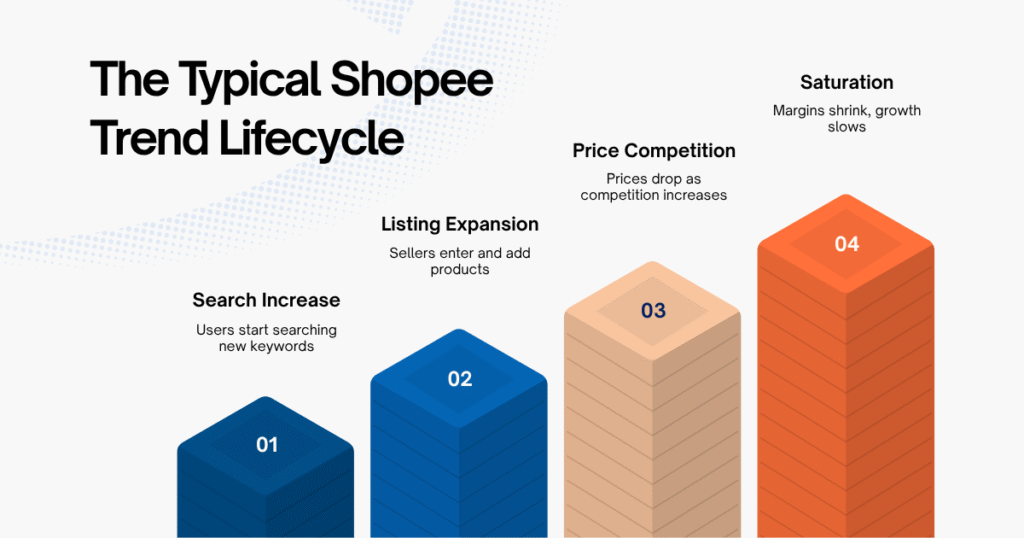
Most Shopee trends start quietly:
- A few keywords begin rising
- A small number of sellers test the market
Then more sellers enter, listings grow, and competition increases. By the time a product is everywhere, the trend is already halfway through.
Eventually:
- Prices drop
- Margins shrink
- Sellers exit
The most profitable stage is often the least visible.
Role of Campaigns
Campaigns can distort Shopee trends. For example:
- During flash sales: prices drop → orders surge
- After campaigns: orders decline → search remains flat
This isn’t real demand. Entering at this stage often leads to inventory risk.
Influence of Content (KOLs, Livestreams, …)
Content (KOLs, livestreams, … )makes Shopee trends harder to interpret. For example, a viral TikTok video may:
- Boost search briefly
- Not sustain listing growth
This is attention, not a real Shopee trend. Many sellers misread this by focusing only on sales volume.
How to Find Shopee Trends
Finding Shopee trends isn’t the hard part; interpreting them correctly is.
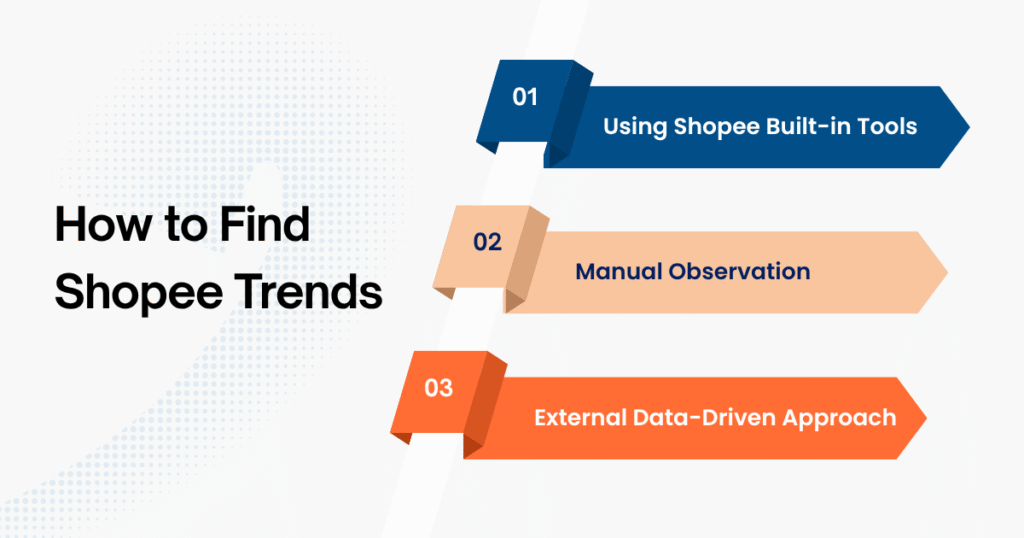
Using Built-In Shopee Tools
The modules of built-in Shopee analytics tools like Keyword Insight, Top Products, and Category Ranking help identify what’s selling. However:
- You don’t know when the trend started
- You can’t tell its lifecycle stage
- You lack post-campaign visibility
You’re seeing snapshots, while Shopee trends evolve over time.
Manual Observation
Manual tracking can help you:
- Spot rising listings
- Detect emerging products
- Observe price pressure
But it comes with bias:
- Algorithms prioritize ads
- Favor high-conversion listings
- Personalize results
You don’t see the entire market, only a filtered version tailored specifically for you. This method also cannot be widely applied across different categories.
External Data-Driven Approach
A data-driven approach gives a deeper view of Shopee trends:
- Is search growing consistently?
- Are listings increasing gradually?
- Are prices under pressure?
- Are reviews stable?
Instead of just seeing the “results,” you’re observing the entire trend-forming process on Shopee.
Since built-in tools have limitations and manual tracking is inefficient, many sellers rely on Shopee data providers to access real-time detailed insights:
- Track the entire market landscape
- Consistently compare product categories
- Filter out noise from campaigns
A Simple Framework to Evaluate Shopee Trends
To evaluate Shopee trends quickly and accurately, the following framework is the best approach:
| Signal | What to Look For | What It Means |
| Search growth | Steady keyword growth | Demand is emerging |
| Listing growth | More sellers are entering the market | Increasing competition |
| Price trend | Prices are falling | Margins are under pressure |
| Review growth | Reviews are increasing steadily | Genuine demand |
For example, the Labubu blind box trend.
Over a long period, the keyword “labubu” grew gradually (not in a sudden 1–2 day surge). Then, the number of shops selling it began to increase (but not too rapidly). Prices didn’t drop sharply, and reviews increased steadily over time.
Looking at these four signals together, you’ll see this is a fairly “clean” Shopee trend: genuine demand, natural growth, and a sufficiently long lifecycle.
In contrast, with products like the 39k mini blender:
Search volume only spikes during sales, prices drop sharply to drive orders, and reviews surge for a few days before leveling off. Listings hardly change because this isn’t a new product; it’s just being promoted through discounts.
If you only look at the number of orders, it’s easy to think this is a trend. But when you apply this framework, you’ll see clearly: this is just a short-term spike.
The key point here is: genuine Shopee trends are always the result of multiple signals moving in the same direction. As long as you maintain this perspective, you’ll avoid 80% of mistakes.
Common Mistakes When Following Shopee Trends
The biggest mistake isn’t that you don’t see Shopee trends, it’s that you see them but misinterpret the signals.
- Confusing spikes with trends: A short-term surge in sales cannot be considered a trend unless there is a corresponding increase in search volume and reviews.
- Entering too late: When you see “everyone is selling,” it means the market is already getting crowded, and the best opportunity to make money has passed.
- Ignoring competition: Even if a trend is big, profits will still be low if there are too many sellers.
- Over-relying on campaigns: The fact that a product only sells well when deeply discounted doesn’t mean it will sell well in the long run.
How Sellers Turn Trends into Strategy
The biggest difference between an average seller and a great seller isn’t that they spot different trends, but that they act differently.
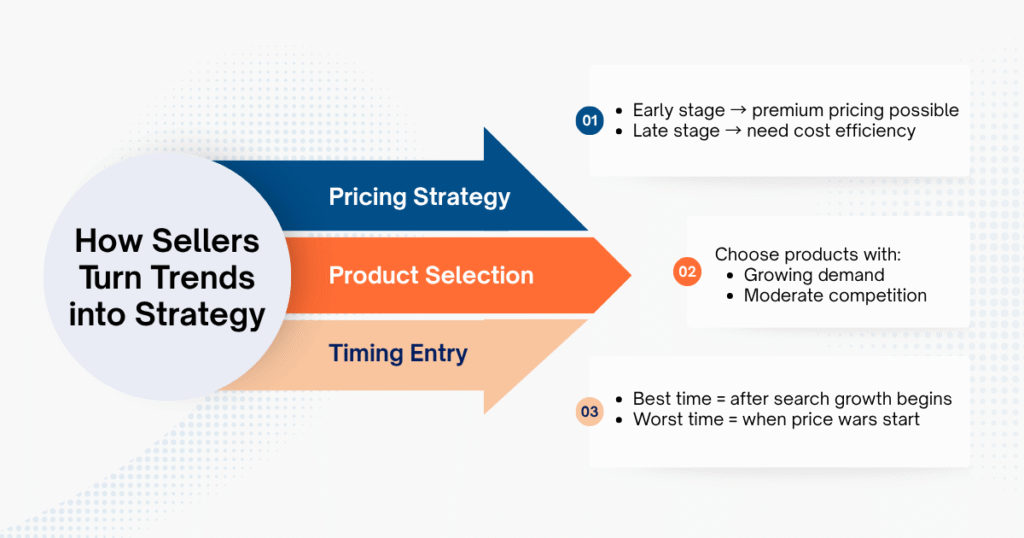
Pricing Strategy
In the early stages of Shopee trends, there are usually few sellers and little competition, so you don’t necessarily need to jump into a price war right away. Many experienced sellers take advantage of this phase to:
- Set prices slightly higher to test willingness-to-pay
- Observe market reactions rather than immediately optimizing volume
But as the trend becomes clearer, you’ll have to choose:
- Either optimize costs to maintain margins
- Or differentiate yourself (through bundles, branding, content, etc.)
Product Selection
Not every Shopee trend is worth jumping on, because in reality, trends that “everyone sees” are often already nearing saturation. Experienced sellers don’t look for the biggest trends; they look for trends that are “good enough”:
- Search volume is increasing
- But listings aren’t too saturated yet
- Prices haven’t been driven down too low.
Timing Entry
If you had to pick the single most critical factor when working with Shopee trends, it would be timing.
- Jump in too early → you risk entering a market where demand is still unclear.
- Jump in too late → you’ll almost certainly end up competing on price.
The “sweet spot” is usually in the middle:
- When search volume starts to rise noticeably
- But listings haven’t exploded yet
This is when the market begins to confirm demand, but there’s still enough room for you to join. And your challenge now is “how to spot this phase”.
Why Data Is Critical for Tracking Shopee Trends
Most sellers view Shopee trends as a “snapshot.” They see what’s trending, but don’t know when it started or where it’s headed. When you start tracking data over time, things become clearer:
- Keywords show a gradual increase over several weeks
- More sellers are joining the market
- Prices begin to drop as competition intensifies
Simply put, real-time data doesn’t just help you see “the trend as it unfolds,” but also reveals the entire formation process of the trend and helps you understand which stage it’s currently in.
However, collecting and maintaining data over a timeline on your own is far from simple.
- Shopee tools only provide snapshots
- Manual tracking is time-consuming and lacks accuracy
- Building your own crawler is prone to errors and difficult to maintain long-term
That’s exactly why providers like Easy Data exist. Instead of struggling with fragmented or unreliable data, teams can use a Shopee data scraping service that continuously collects and standardizes data over time based on their specific needs.
Think of it as having a reliable data pipeline always running in the background. With that, teams can track market movements more accurately and make decisions based on how trends actually evolve, not just how they look at a single moment.
Conclusion
Shopee trends aren’t something you have to chase; they’re something you need to master. Once you know how to leverage real-time data to understand the relationship between search trends, product listings, and pricing, Shopee trends become easier to predict. At that point, you’ll no longer just react to the market; instead, you’ll proactively make decisions before the market shifts.
What are Shopee trends?
Shopee trends are patterns in search demand, product listings, pricing, and reviews that develop over time. Unlike short-term sales spikes, real trends show consistent growth across multiple signals, indicating sustained demand rather than temporary campaign-driven activity.
How do to find trending products on Shopee?
You can identify trending products on Shopee by combining multiple methods:
- Checking Shopee tools like Keyword Insight and Top Products
- Observing listing growth and price changes
- Tracking search trends over time
The most reliable approach is analyzing data across these signals, not relying on a single snapshot.
Are Shopee trends reliable for making business decisions?
Shopee trends can be highly reliable if analyzed correctly. Instead of focusing only on sales volume, sellers should evaluate trends based on search growth, competition, pricing pressure, and review consistency to avoid misleading signals.
When is the best time to enter a Shopee trend?
The best time to enter a Shopee trend is when search demand is rising but competition is still relatively low. This phase typically offers the best balance between demand validation and profitability before the market becomes saturated.
Leave a Reply