

As competition in Vietnam’s diaper category on Shopee continues to intensify, performance is no longer determined by the sheer number of listings, but by how effectively each listing converts into actual sales. For brands and sellers, evaluating marketing effectiveness has therefore become a critical factor.
The Diaper Market Analytics – Shopee Vietnam (October 2025) report by Easy Data provides a clear, data-backed perspective on this issue, focusing on how listing-level marketing attributes translate into observable sales performance.
Defining Marketing Effectiveness Through Observable Data
In this report, marketing effectiveness is approached from an output-driven perspective, with the objective of assessing how listing-level marketing attributes convert into observable sales results on Shopee through the following key metrics:
- Total Revenue – reflecting total revenue contribution
- Active Listings – representing the level of market presence
- Average Units Sold per Listing – the core metric used to measure sales performance at the listing level
The dataset focuses on two listing-level marketing attributes:
- Video Presence – listings with or without video
- Shop Type – Shopee Mall or Normal shop
Throughout the report, Units Sold per Listing is used as the central metric to evaluate marketing effectiveness in order to:
- Minimize the impact of scale, enabling fair performance comparisons across listings
- Directly reflect operational quality and marketing effectiveness at the listing level, rather than aggregating at the shop level
- Establish a clear basis for comparison between listing groups with different marketing attributes
Within the same market context, a listing that sells an average of 400 units per month demonstrates higher sales efficiency per listing than one selling only 200 units, even if the latter belongs to a shop with higher total revenue due to a larger number of listings.
Video as a Measurable Driver of Sales Efficiency (+38%)
| Listing Group | Revenue | Units / Listing |
| With video | $8.8M | 286 |
| Without video | $7.0M | 207 |
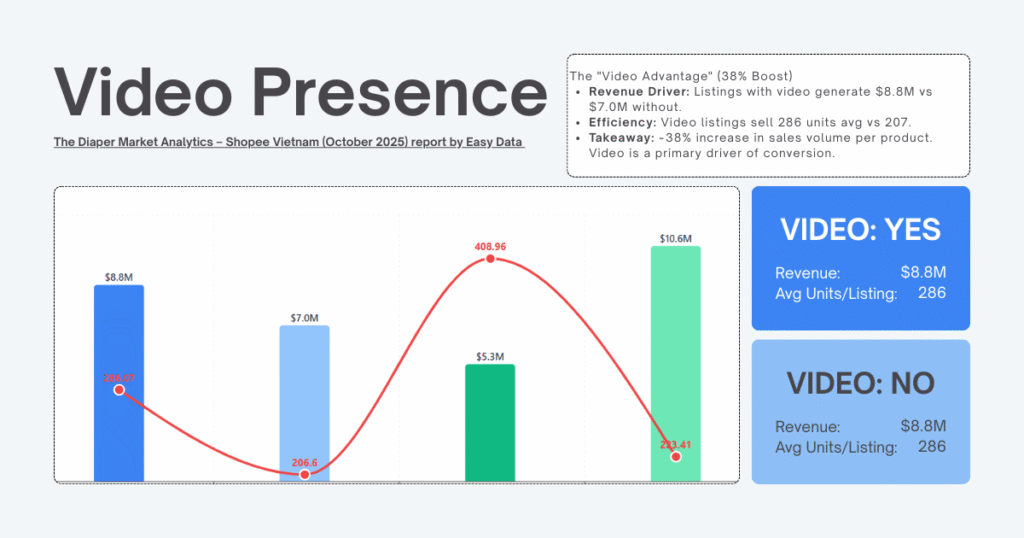
Under the same market conditions, listings with video record approximately 38% higher average units sold per listing compared to listings without video.
The data shows that video presence is consistently associated with higher sales performance at the listing level:
- Listings with video achieve consistently higher units sold per listing
- Video is a marketing attribute that can be clearly quantified using output data
- This performance gap creates a clear efficiency difference between the two listing groups, even without considering shop scale
Here, marketing effectiveness is no longer an abstract concept, but is quantified directly through units sold per listing.
Mall vs Normal Shops: The Efficiency–Scale Trade-Off
If video reflects differences in intrinsic listing performance, shop type reveals a structural trade-off that is highly characteristic of the diaper category.
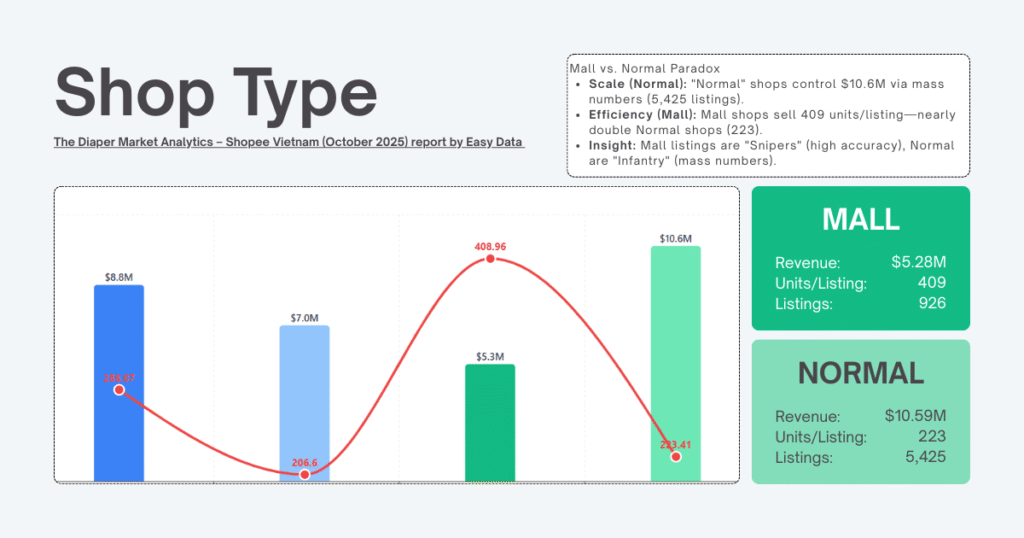
| Shop Type | Listings | Units / Listing | Revenue |
| Mall | 926 | 409 | $5.28M |
| Normal | 5,425 | 223 | $10.59M |
What the data reveals:
- Mall shops sell nearly twice as many units per listing compared to Normal shops
- Normal shops generate higher total revenue due to a significantly larger number of listings
The trade-off is clearly illustrated:
- Mall = High efficiency, low scale
- Normal = Low efficiency, high scale
When viewed purely through total revenue, Normal shops appear to “win.” However, when marketing effectiveness is measured by units per listing, Mall shops demonstrate a clear advantage.
This highlights that marketing effectiveness is not synonymous with high revenue, but rather lies in the efficiency of each individual selling unit.
Listing-Level Performance Patterns Revealed by the Data
From the data, two distinct marketing patterns can be identified:
Pattern 1: Fewer Listings – Higher Efficiency
- Representative: Mall shops
- Each listing receives heavier investment (content, visuals, video)
- Marketing effectiveness is directly reflected through high units sold per listing
Pattern 2: More Listings – Lower Efficiency
- Representative: Normal shops
- Growth driven by coverage and volume
- Lower listing-level marketing effectiveness, compensated by scale
The data indicates that marketing effectiveness does not automatically result from increasing the number of listings on the platform. Expanding coverage can help grow total revenue, but it does not inherently ensure that each listing performs more effectively. The real differentiation occurs at the listing-performance level, where the degree of investment in content and presentation directly determines conversion into sales.
In other words, within the same market environment, sales performance per listing (rather than the sheer number of listings) is the clearest indicator of the quality and effectiveness of a marketing strategy.
Marketing Implications Based on Observed Performance Patterns
1. Video as a Proven Marketing Efficiency Lever
The data from the Vietnam Shopee diaper category shows that the impact of video is no longer a hypothesis or a subjective marketing belief. The difference between listings with and without video is directly reflected in the gap in units sold per listing, and this gap is substantial enough to create a clear competitive advantage.
This indicates that video functions as a genuine efficiency lever, one that can be observed and measured through data. As a result, when optimizing marketing at the listing level, video should be treated as a top priority rather than an optional “nice-to-have” element.
2. Choosing Between Efficiency and Scale
Marketing effectiveness must be evaluated in relation to each brand’s strategic objectives. If the goal is to build brand equity and maximize performance per product, an efficiency-focused model (similar to how Mall shops operate) is more suitable. Conversely, for strategies centered on expanding coverage and capturing market share, accepting lower efficiency per listing in exchange for scale (as seen with Normal shops) can be a rational choice.
Therefore, marketing effectiveness should not be assessed solely through the lens of total revenue, but rather within the strategic context that a brand is pursuing.
Closing Thoughts
The greatest value of this analysis does not lie in uncovering overly complex findings, but in how data is used to answer the right core business questions. Rather than attempting to account for every possible variable, the data-driven approach applied here focuses on a small set of key metrics, just enough to surface meaningful differences in marketing performance at the listing level. This focus allows the data to “speak” clearly, turning familiar numbers into insights that can meaningfully guide decision-making.
As a result, the analysis highlights that the true power of data-driven marketing analysis is not determined by the complexity of the dataset, but by asking the right questions and measuring with the right metrics. When marketing effectiveness is viewed through the lens of observable sales performance, businesses can move beyond subjective assessments and concentrate on the levers that create real differentiation. This ultimately provides a solid foundation for marketing decisions that are both practical and sustainable in an increasingly competitive landscape.
Leave a Reply