

Introduction
Ecommerce growth in Malaysia is a useful starting point for market research, but a national growth figure cannot establish demand for your product or the profitability of a cross-border route. Separate the size of the digital economy from your category, target customer and fulfilment costs.
This guide explains dated official indicators, checks for selling into Malaysia and a practical market-entry worksheet. It distinguishes inbound selling from using Malaysia as an export base. Sources were reviewed on October 3, 2026; the worked margin example is fictional, not a Malaysian market benchmark.
For a data project, use the Easy Data service overview to define the platform, country, fields and collection frequency. Confirm coverage and a sample before treating any feed as real-time market intelligence.
The Current Landscape of Ecommerce Growth in Malaysia
Market Size & Growth Potential
DOSM’s Malaysia Digital Economy 2025 release reports 2024 ecommerce income of RM1,230.1 billion, up 3.9% in its quarterly series. This is an establishment ecommerce-income measure, not a consumer online-retail or cross-border market-size estimate. Do not compare it directly with a retail forecast in US dollars. For planning, keep these distinctions:
- Access is not purchasing: DOSM’s 2025 ICT survey statement, released April 23, 2026, reports 97.1% household Internet access and 98.3% individual Internet use. The denominators differ; neither figure measures ecommerce buyers.
- Mobile readiness needs testing: check product selection, address entry, payment and order confirmation on a phone. Mobile connections are not a count of unique shoppers.
- Category demand needs its own evidence: record the source, country, category, period and metric for every demand estimate. National digital-economy growth does not establish sales for a proposed SKU.
Marketplace Options to Assess
- Shopee Malaysia: consider it as a candidate channel, then verify seller eligibility, product restrictions, fees and the relevant fulfilment route. This guide does not assign it a transaction-market-share percentage.
- Lazada Malaysia: compare current onboarding and operating requirements with your own entity, product category and origin country.
- Specialist marketplaces: evaluate whether a fashion or beauty channel accepts your product and seller type before allocating catalogue or integration work.
- Own-store and other channels: compare the cost of acquiring customers, payments, support and delivery rather than assuming a marketplace is always the best route.
Assessing Malaysia for Cross-Border Ecommerce
1. Strategic Location for Regional Trade
Distinguish two decisions: selling imported products to Malaysian customers, and holding stock in Malaysia for export to other countries. A hub that fits one route may not fit another. Map the origin, warehouse, destination, delivery promise and return address for each proposed lane before choosing a base.
2. Strong Logistics & Fulfillment Infrastructure
Request comparable carrier or third-party logistics quotes for a fixed parcel size, weight and route. Compare Peninsular Malaysia, Sabah and Sarawak separately where relevant, and include handling, storage, remote-area surcharges, failed delivery and returns. A carrier’s presence does not establish that its service is cheapest or suitable for your goods.
3. Government Policies Encouraging Cross-Border Trade
Check who a support scheme is designed for. MATRADE’s August 2026 review of eTRADE 2.0 describes an export programme for Malaysian businesses that operated during 2021–2025. It is not evidence that a foreign seller importing into Malaysia automatically qualifies for a current grant. Before including support in a plan:
- Verify the current intake, eligible entity, qualifying expenditure and reimbursement conditions directly with the administering body.
- Keep a viable base case without a grant or tax incentive until eligibility and approval are confirmed.
- For any preferential trade treatment, confirm product classification, origin requirements and documentation for the specific shipment; do not assume a trade agreement makes every ecommerce parcel duty-free.
4. Testing Demand for International Brands
Treat demand for an international brand as a hypothesis to test. Build a small, dated sample for the intended category instead of assuming that fashion, beauty, electronics or supplements dominate all cross-border transactions:
- Compare like-for-like variants, pack sizes, displayed prices, seller location and delivery promises on the chosen channel.
- Record whether a payment option is actually available to the target customer and what fees or settlement conditions apply to the seller.
- Use authorised product information and a clear authenticity or warranty policy. Reviews and displayed sales counters have platform-specific meanings; they are not a complete market census.
Challenges of Cross-Border Ecommerce in Malaysia
1. Regulatory & Compliance Barriers
Build a category-specific checklist before launch. Resolve tax and product requirements for your own entity and goods with the relevant authority or a qualified adviser:
- Import and tax treatment: check classification, value, origin and responsibility for collection or payment. Consult the Royal Malaysian Customs low-value-goods portal where relevant; no universal tax rate or exemption is assumed here.
- Product requirements: do not apply one halal rule to every category. The Ministry of Health states that halal certification is not mandatory for cosmetics notification. This does not remove other obligations: check NPRA’s current cosmetics guidance, and assess food or other products separately.
- Customer information: confirm applicable requirements for seller details, product claims, displayed charges, delivery, complaints and returns before publishing the offer.
2. Logistics Costs & Delivery Delays
Measure delivery performance by route and promised service. Include these items in the pilot log:
- Dispatch, customs handover and delivery timestamps; distinguish seller handling time from carrier transit.
- Actual charged weight, surcharges, failed attempts and return-to-sender cost.
- Median and slower-delivery percentiles for each lane, together with the number of orders observed. A small pilot is not a nationwide service guarantee.
3. Competition from Regional & Global Giants
Competition analysis is most useful at product and offer level. Record comparable prices, pack sizes, shipping charges and delivery promises on a dated sample, then identify a proposition you can actually deliver. Our Shopee sales-data planning guide explains how to turn observations into testable decisions without treating displayed counters as complete market demand.
A market-entry worksheet
Complete this worksheet for one product family, one channel and one delivery route. Record an owner and review date for each answer. An unanswered requirement is a task to resolve, not an assumption to hide in a forecast.
| Decision | Evidence to collect before scaling |
|---|---|
| Customer and product | A dated sample with matching variants, currency, seller location and delivery charges; define what is outside the sample. |
| Channel eligibility | Current confirmation for the legal entity, origin country and category, plus the full fee schedule. |
| Product and import requirements | Category-specific approvals, classification, documents and responsibility for tax or duty; verify with the relevant authority. |
| Delivery and returns | A comparable quote and pilot log for the selected lane, including failed delivery, surcharges and a usable return address. |
| Order economics | Revenue less product, transport, fulfilment, selling, returns and acquisition costs; add verified taxes and fixed costs separately. |
| Go or revise | Written thresholds for service, errors and contribution, with a review date and a stop condition if they are missed. |
Fictional arithmetic example, not a market benchmark or tax quote: an order earns RM100. Product cost is RM40, transport RM15, fulfilment RM8, platform/payment charges RM12, expected returns cost RM5 and acquisition cost RM10. The residual is RM10 per order before any applicable taxes and fixed costs: 100 − 40 − 15 − 8 − 12 − 5 − 10 = 10. If transport rises by RM6, that residual falls to RM4. Replace every assumption with your own quote or measured data; do not label the residual net profit.
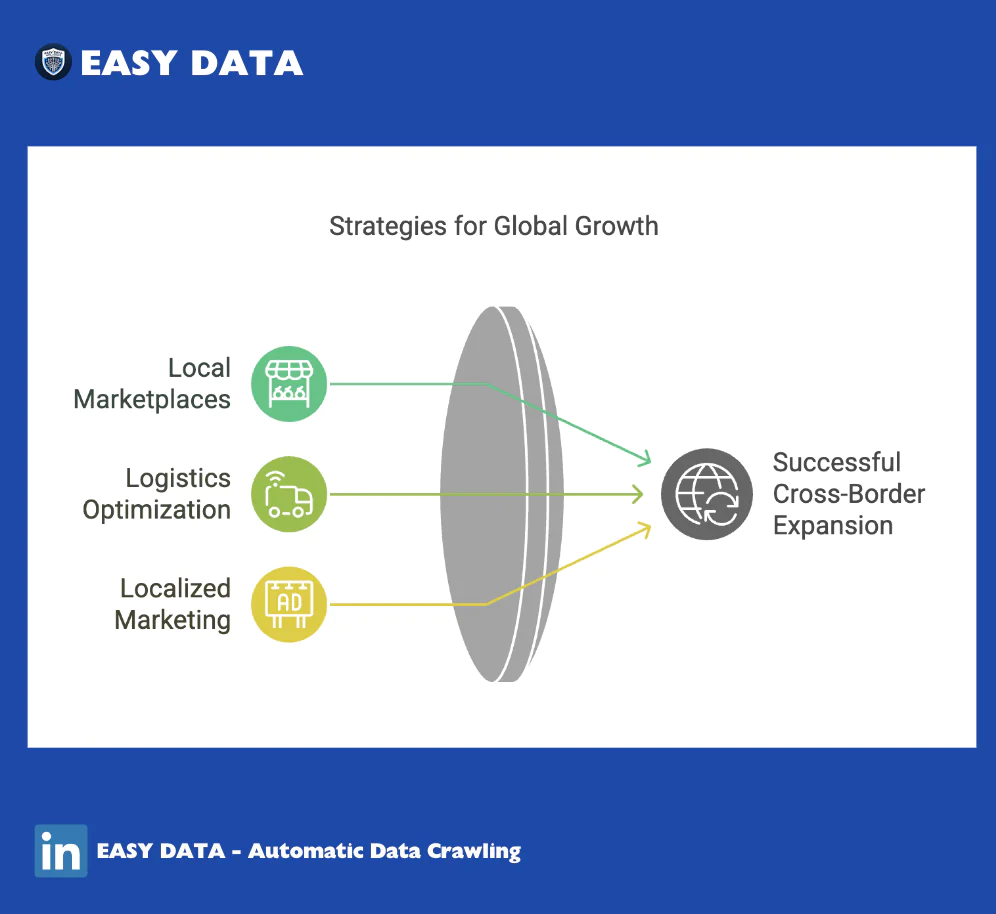
Strategies for Businesses Expanding via Cross-Border Ecommerce
1. Partnering with Local Marketplaces
Shortlist channels by the operating conditions you can meet. For each candidate, obtain current answers to:
- Eligibility: can your legal entity, origin country and product category use the intended local or cross-border programme?
- Costs and service: what are the commissions, payment charges, settlement timing, storage fees and delivery commitments?
- Operating responsibility: who handles import documentation, product approval, customer support, refunds and returns? Do not assume warehousing is included.
2. Optimizing Logistics & Fulfillment
Compare direct cross-border fulfilment with local stock using the same expected order volume and service level. A third-party logistics provider is an option to evaluate, not an automatic improvement:
- Include inbound replenishment, storage and slow-moving stock when evaluating a Malaysia-based warehouse.
- Compare total quoted cost and measured service on the same routes before choosing a carrier or aggregator.
- Model any shipping subsidy or free-shipping threshold against contribution per order. For definitions and a sample log, use our ecommerce shipping-data guide.
3. Adopting Localized Marketing Strategies
Localisation should improve clarity for the intended audience. Test a small number of changes with a defined outcome:
- Review Bahasa Malaysia and other relevant listing languages with a competent speaker; preserve accurate sizes, ingredients and product claims.
- Choose social or marketplace channels only after verifying current country, account and product eligibility. Measure completed orders and returns, not just views.
- State support hours, response expectations, payment choices and return instructions clearly; test the complete customer journey.
Experiments to Evaluate Before Scaling
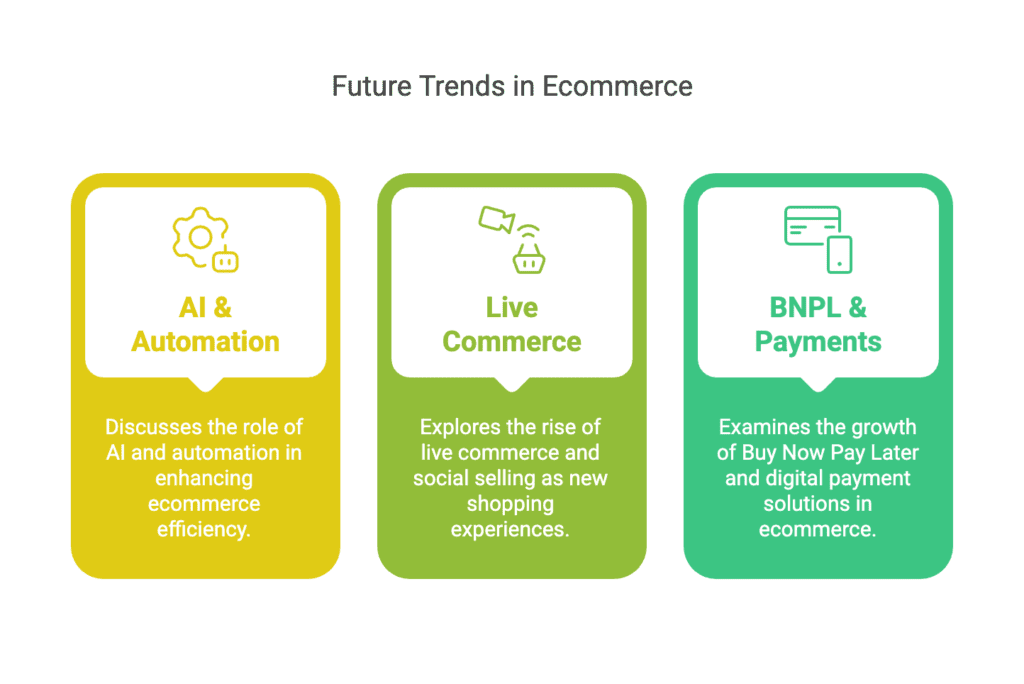
1. AI & Automation in Ecommerce
Evaluate automation on a bounded task such as classifying support requests or checking inventory exceptions. Compare error rate, human review time and operating cost before expansion. AI does not guarantee reliable fulfilment or growth.
2. Testing Live Commerce & Social Selling
Test a live demonstration or creator campaign with a fixed budget, clearly identified products and a measurable order window. Separate views, clicks, paid orders and refunds; a popular stream does not establish profitable incremental sales.
3. Evaluating BNPL & Digital Payments
For an available wallet or instalment option, verify provider eligibility, fees, settlement and refund handling. Compare checkout completion and net contribution in a controlled pilot. Do not assume that offering BNPL increases order value or profit.
Conclusion
Use national ecommerce indicators to frame research, then make the entry decision from category evidence, verified operating requirements and realistic order economics. Keep inbound sales and regional export plans separate so that costs and responsibilities are not mixed.
If you need a managed data sample, specify the target marketplace, Malaysia category, fields, collection date and acceptance checks before discussing ongoing delivery with Easy Data. A sample should document missing fields and coverage limits.
Expand only after the pilot meets your written delivery, data-quality and contribution targets. Retain the original observations so a change in price, fees or service can be checked rather than mistaken for market growth.
The official sources linked above describe different measures and responsibilities. Recheck their dates and current programme or product rules before making an operating commitment; this planning guide does not establish eligibility for a specific shipment or grant.
Leave a Reply