
In the era of the booming online economy, e-commerce data has become one of the most valuable assets for data-driven businesses. Yet as demand for high-quality data increases, so do the challenges, particularly when ensuring data completeness, accuracy, continuity, and legal compliance.
Many organizations begin their data journey using off-the-shelf tools because they seem convenient and affordable. However, as data needs grow, these tools quickly reach their limits, especially for large-scale web scraping for ecommerce operations. This is why an increasing number of companies now rely on professional e-commerce data scraping services to achieve greater scalability, reliability, and long-term value.
In this article, we explore why businesses choose e-commerce scraping services over packaged tools, and how these services deliver deeper, more sustainable benefits.
The Role of E-commerce Data in the Data Business Landscape
For data-centric companies, e-commerce data is the driving force behind product development and business intelligence. It serves as the foundation for:
- Price intelligence and repricing platforms
- Market analysis and competitive intelligence tools
- Product information management (PIM) systems
- AI/ML training datasets for commerce
- Data feeds are resold to enterprise clients.
Because these solutions rely on large volumes of clean, frequently updated data, the quality and freshness of e-commerce data directly impact product competitiveness, customer satisfaction, and contractual SLAs.
Challenges in E-Commerce Data-Driven Business
Although businesses understand the importance of accuracy and real-time data updates, many still struggle to maintain them. The issue is rarely a lack of technical capability—rather, it is the sheer scale and complexity of e-commerce platforms, which exceed what off-the-shelf tools can handle.
- Constantly evolving website and app structures: E-commerce platforms frequently update their DOM, APIs, class names, anti-bot systems, and pagination flows, making standard scraping tools unstable.
- High data update frequency: Industries like electronics, fashion, FMCG, and beauty require near–real-time insights on prices, stock levels, and promotions—an area where most off-the-shelf tools fall short.
- Inconsistent raw data quality: Data extracted with generic tools typically lacks standardization across: currency and units; schemas and category mapping; enrichment; automated QA validation.
- High crawler maintenance overhead: Maintaining internal crawlers requires: backend engineers; devOps for proxy rotation and scaling; specialists to handle captchas, 403s, and anti-bot systems; continuous monitoring and alerting. The total cost of ownership grows quickly.
- Legal and compliance risks: Most off-the-shelf tools do not include: audit logs; rate-limit control; compliance-based proxy routing; legal and privacy guidance. This increases the risk of unintentional violations of platform TOS or data-protection laws.
E-commerce Data Scraping Services: Comprehensive Solutions for Data Businesses
When packaged tools become inadequate, e-commerce data scraping services provide the specialized infrastructure required for large-scale, reliable, and compliant data operations.
What Are E-Commerce Data Scraping Services?
E-commerce data scraping services are fully managed data-extraction solutions designed to deliver structured, enterprise-grade datasets from e-commerce platforms. They typically include:
- Large-scale data collection
- Customizable extraction rules
- Data cleaning and transformation
- Schema normalization
- Category and metadata enrichment
- Delivery via API, S3, webhook, or scheduled batch
- Continuous maintenance and updates
- SLA-backed compliance and security
This transforms raw data extraction into a fully managed data pipeline.
How E-Commerce Data Scraping Services Work
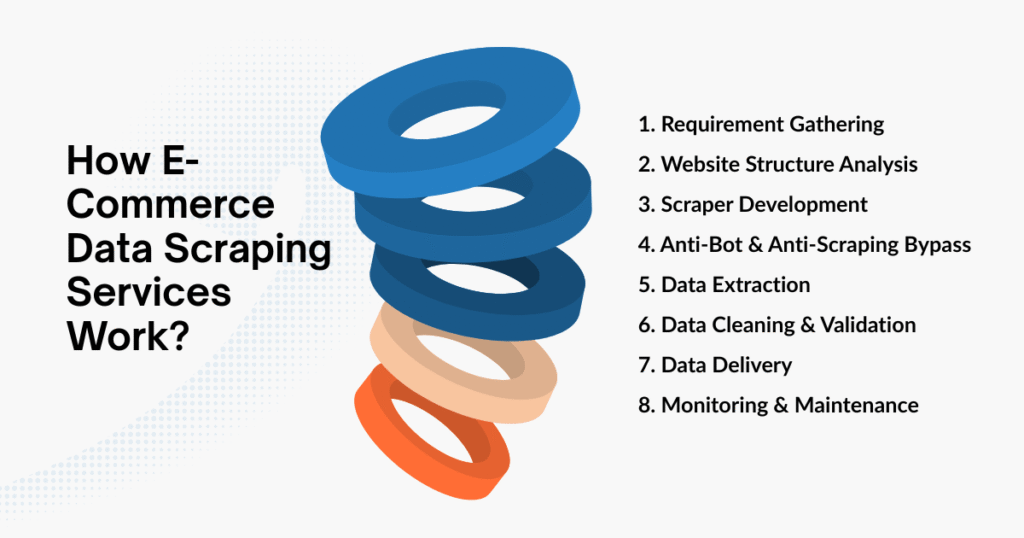
To understand how e-commerce data scraping services operate at scale, it’s important to look at the end-to-end workflow behind a professional scraping setup. A high-quality e-commerce scraper typically follows a robust, multi-stage process:
Learn more: Process of Web Scraping: A Step-by-Step Guide for eCommerce Data Extraction
1. Requirement Gathering
Before scraping begins, the service provider defines:
- Target websites or marketplaces (Amazon, Walmart, Shopify stores, etc.)
- Data fields needed (price, title, images, ratings, reviews, stock, etc.)
- Frequency of updates (real-time, hourly, daily, weekly)
- Delivery format (CSV, JSON, Excel, API)
This ensures the scraper is customized exactly to your business goals.
2. Website Structure Analysis
Specialists or automated tools inspect:
- HTML structure
- Product page templates
- Pagination system
- Dynamic content (JavaScript-loaded data)
- APIs used by the website
This analysis determines the best scraping strategy—HTML extraction, API calls, or browser simulation.
3. Scraper Development
Engineers build scripts or use scraping platforms to extract data. Scrapers can use:
- HTTP requests for static pages
- Headless browsers (e.g., Puppeteer, Playwright) for dynamic pages
- API-based extraction, when possible
- Proxy networks to avoid IP blocks
They also add logic to handle pagination, navigation, login (if allowed), and session management.
4. Anti-Bot & Anti-Scraping Bypass
E-commerce sites often protect their data. Scraping services use:
- Rotating proxies / residential IPs
- CAPTCHA solvers
- Rate limiting to mimic human browsing
- User-agent and header rotation
- Script randomization
This keeps scraping stable and prevents blocks.
5. Data Extraction
The scraper collects structured data such as:
- Product name & brand
- Price & discounts
- SKU, UPC, ASIN
- Stock information
- Ratings & reviews
- Category hierarchy
- Shipping info
- Images & descriptions
Extracted data is cleaned and normalized for consistency.
6. Data Cleaning & Validation
Raw scraped data is processed to remove inconsistencies:
- Removing duplicates
- Standardizing formats (currency, units, attributes)
- Validating missing fields
- Mapping categories and attributes
- Removing HTML noise from descriptions
This step ensures the final dataset is reliable and ready to use.
7. Data Delivery
The cleaned and structured data is delivered in one or more formats:
- API feed (real-time updates)
- CSV / Excel / JSON files
- Database integration (MySQL, PostgreSQL, MongoDB)
- Dashboards for analytics or price monitoring
Automated scheduling ensures continuous updates.
8. Monitoring & Maintenance
Since websites constantly change layout and anti-bot rules, scraping services:
- Monitor scrapers for errors
- Update code when pages change
- Ensure uptime and consistency
- Scale scraping jobs as demand increases
This makes scraping reliable long term.
Benefits for Data Businesses
While off-the-shelf tools and scraping services both collect e-commerce data, only the latter deliver the depth and reliability needed for enterprise use cases.
- Deep customization: tailored exactly to each business requirement
- High stability: unaffected by platform changes or anti-bot updates
- Long-term cost efficiency: reduced internal engineering workload
- Superior data quality: enriched, validated, and standardized
-
Compliance assurance: logs, rate limits, and privacy controls
Focus on core operations: teams can prioritize analytics and insights
Types of Off-the-Shelf Tools for E-commerce Data
Many ready-made solutions allow users to scrape data from major e-commerce platforms. While accessible and easy to adopt, their capabilities vary widely and are best suited for smaller projects. Below are widely used tools across marketplaces.
| MARKETPLACE | OFF-THE-SHELF TOOLS |
| Shopee | Shopee Scraper (Apify – fatihtahta) • Shopee Scraper (Apify – best_scraper) • Shopee Scraper API – ZenRows • AutoShopee Kit (Chrome extension) • Shopee Email/Profile Scraper |
| Lazada | • Lazada Scraper – Apify (fatihtahta) • Lazada Scraper – Apify (dtrungtin) • Listing Scraper (Chrome extension) |
| TikTok Shop | • TikTok Shop Scraper – Apify (pratikdani) • TikTok Shop Scraper – Apify (BarriereFix) • TikTok Shop Scraper – Apify (Jeremy Frost) • TikTok Products Scraper – Apify (Scraping Samurai) |
| Amazon | • Amazon Product List Scraper – Octoparse • Amazon Image Scraper – Octoparse • Amazon Scraper – Octoparse template • ScraperAPI • Bright Data • Oxylabs • Smartproxy |
| Alibaba / Taobao / 1688 | • BigSeller Product Scraper & Promotion Management • AnyPicker |
| Multi-platform | • Octoparse • ParseHub • Scrapy • OutWit Hub • DataMiner (Chrome/Edge extension) |
E-Commerce Data Scraping Services and Off-the-Shelf Tools: Which One Is More Optimal?
While off-the-shelf tools offer convenience, their limited flexibility, reliability, and scalability create significant challenges for data businesses. E-commerce scraping services, on the other hand, provide enterprise-grade stability, customization, compliance, and long-term cost efficiency. This is why data-driven companies increasingly transition from packaged tools to professional e-commerce scraping services.
| Criteria | E-Commerce Scraping Services | Off-the-Shelf Tools |
| Customization | Very high | Limited |
| Scale | Unlimited | Limited |
| Stability | 24/7 maintenance | Prone to failure |
| Bot resistance | Very strong | Basic |
| Data quality | Normalized + QA | Raw |
| Compliance | Transparent and secure | User responsibility |
| Cost | Higher upfront, optimized long-term | Lower upfront, increases with use |
Before choosing between the two, it’s also important to understand that modern e-commerce scraping services can be tailored to each specific marketplace, such as Shopee data scraping, Lazada product scraping, TikTok Shop data extraction, Amazon, Taobao, and many others. Instead of using generic, one-size-fits-all tools, businesses can request platform-specific spiders, custom data formats, and workflow automation that match their exact operational needs.
Easy Data is one of the specialized providers offering fully customized scraping solutions tailored to each platform, ensuring accuracy, scalability, and compliance for data-intensive projects.
Conclusion
Both off-the-shelf tools and e-commerce data scraping services have clear strengths. The best choice depends on your business goals, budget, data scale, and growth trajectory. We hope this overview helps you evaluate the most suitable solution for your organization.
Leave a Reply