


Introduction
Shopee listing observations can support product, pricing and review research when the collection scope is clear. A useful project specifies the country, listings or shops, fields, collection times and permitted use before requesting data. Easy Data offers Shopee data services for marketplace research; exact coverage, frequency and delivery commitments must be agreed for the project.
This guide provides a project-planning workflow, technical options and interpretation checks. The tools below are reference options, not an audited description of Easy Data’s current production stack or a guarantee of access to every Shopee page. The cover uses historical marketplace imagery; it does not show current offers or imply Shopee endorsement.
- Introduction
- 1. Questions Shopee Listing Data Can Help Investigate
- 2. Access and Data-Handling Checks
- Review Source Terms and Access Permission
- Data Privacy and Security Standards
- Server Load Management Through Rate Limiting
- 3. Technical Options to Evaluate
- Python as an Implementation Option
- Static Data Extraction with Requests and BeautifulSoup
- Dynamic Data Extraction with Selenium WebDriver
- Network Configuration and Access Limits
- Data Storage Solutions for Scalability and Flexibility
- 4. A Proposed Five-Step Pilot Workflow
- Step 1: Defining Client Objectives and Target Data Points
- Step 2: Initial Crawling with Requests and BeautifulSoup for Static Content
- Step 3: Handling Dynamic Content Using Selenium WebDriver
- Step 4: Request Limits and Failure Handling
- Step 5: Data Structuring, Cleaning, and Storage
- 5. Overcoming Common Challenges in Shopee Data Crawling
- Anti-Bot Mechanisms
- JavaScript-Driven Content
- Frequent HTML Structure Changes
- 6. Transforming Raw Data into Business Intelligence
- Market Trend Analysis
- Competitive Pricing Insights
- Customer Sentiment Analysis
- 7. Questions to Discuss with Easy Data
- Conclusion
1. Questions Shopee Listing Data Can Help Investigate
Start with a business decision and identify which observable fields could inform it. A defined Shopee sample can help investigate the following questions, but it should not be presented as complete market coverage:
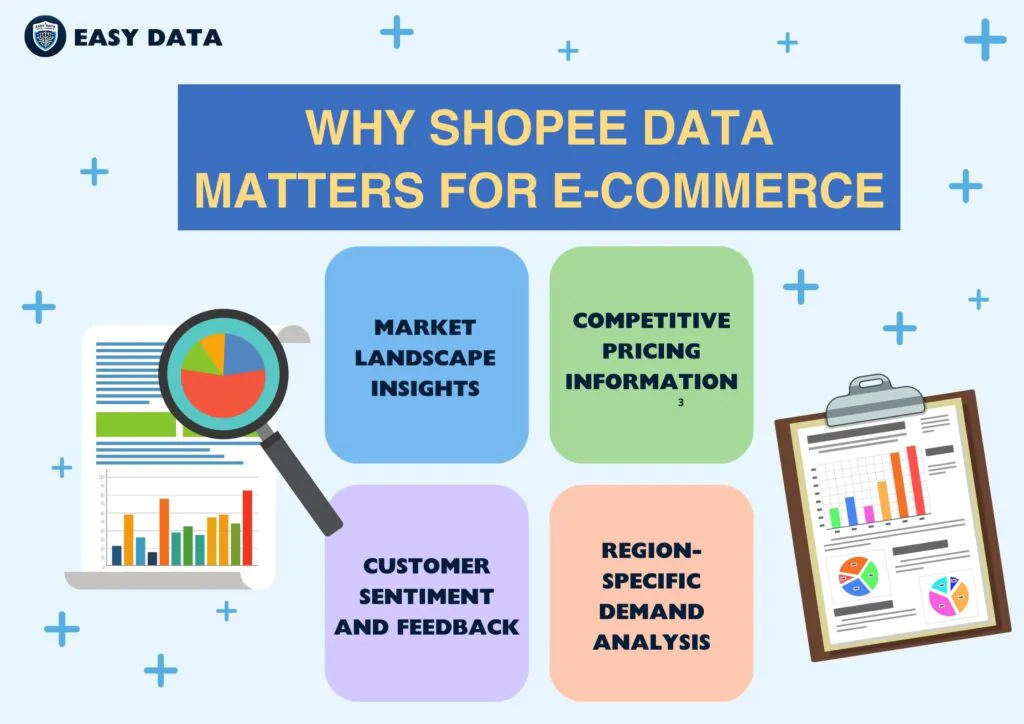
- Market landscape: compare the products and sellers included in a documented sample. Record category and inclusion rules so a change in coverage is not mistaken for market growth.
- Pricing: compare matching variants, sellers, currencies and observation times. Displayed prices, vouchers, shipping and final checkout totals are different measures.
- Customer feedback: use a defined review sample to identify recurring themes. Reviews are contributed by a subset of customers and do not represent every buyer’s experience.
- Country comparisons: keep market, language, currency, product selection and collection period explicit. A difference between two samples is not automatically a difference in national demand.
For the broader project brief, use our marketplace pilot acceptance worksheet. Agree the required evidence and sample checks before expanding the collection.
2. Access and Data-Handling Checks
Assess the specific source, access route, intended use and data fields before collection. These planning checks do not establish that a particular Shopee project is permitted or that Easy Data holds a platform partnership.
Review Source Terms and Access Permission
Review the current terms and any licence or API agreement for the relevant market and access route. The Robots Exclusion Protocol standard distinguishes robots.txt instructions from access authorization. Following crawler instructions does not by itself establish permission for the proposed collection and reuse.
Data Privacy and Security Standards
Define the minimum fields needed for the purpose, including whether review content could contain personal information. Specify access controls, retention and deletion arrangements. Public visibility is not a reason to assume that a dataset contains no personal data or has no handling requirements.
Server Load Management Through Rate Limiting
Agree request limits, bounded retries and stop conditions. Record rate-limit responses and service errors, then reduce or pause activity as appropriate. Request pacing should protect the source and support a documented operating policy; it cannot guarantee continued access.
Keep the access and data-handling review with the project specification. Recheck it when the source, fields, audience or intended use changes, and resolve open questions before expanding the work.
3. Technical Options to Evaluate
Choose an implementation after checking the permitted source and a representative sample. The following are common technical options to evaluate; confirm the actual delivery method and maintenance responsibility with the project team.
Python as an Implementation Option
Python can be used for collection orchestration, parsing and validation. Select tools based on the approved source format, testing needs and team maintenance capacity. A language choice does not establish the accuracy or completeness of a dataset.
Static Data Extraction with Requests and BeautifulSoup
An HTTP client and HTML parser can process fields that are actually present in a permitted response. Inspect a sample response first; do not assume that a product title, price or review is available in the initial HTML simply because it appears in a browser.
- Requests: its official quickstart documents HTTP requests, response status handling and timeouts. A successful response still needs content and schema checks.
- Beautiful Soup: the official documentation describes parsing and navigating HTML or XML. It parses supplied markup; it does not establish that the source contains every required field.
Dynamic Data Extraction with Selenium WebDriver
Where browser-rendered content is within the approved collection scope, browser automation may be an option. Verify the actual page state and available fields rather than assuming that all reviews require the same rendering method.
- Selenium WebDriver: can automate browser interactions. This capability does not establish source permission or complete data coverage.
- Waiting for page state: Selenium’s waiting-strategy documentation explains explicit conditions and warns against mixing implicit and explicit waits. Define the expected element or state and a timeout instead of assuming a page is complete after a fixed delay.
Network Configuration and Access Limits
Network configuration must follow the agreed access policy. Proxies or address changes do not establish permission, eliminate blocking or guarantee uninterrupted collection. If the approved route is unavailable, record the failure and resolve access or scope with the source and project owner.
Data Storage Solutions for Scalability and Flexibility
Choose a file or database handoff around the recipient’s workflow. Specify identifiers, column definitions, types, encoding, timestamps and missing-value rules. Confirm supported formats in the project agreement rather than assuming every storage system is included.
Validate the selected approach against the agreed sample before scaling it. Document which fields were obtained, which checks passed and which limitations remain, regardless of the tools used.
4. A Proposed Five-Step Pilot Workflow
Use the following five stages as a proposed pilot workflow. Each stage should produce evidence that the project owner can review; the diagram is illustrative and does not certify a particular implementation.
Step 1: Defining Client Objectives and Target Data Points
Define one marketplace country and one unit of observation, such as a product variant at a collection time. Confirm whether the source supports each requested field:
- Product identity: source URL, product identifier, seller and variant attributes needed for matching.
- Pricing: displayed price, currency and documented promotion conditions; keep shipping and checkout totals separate.
- Feedback: permitted rating or review fields, sample selection and observation period, with unnecessary personal identifiers excluded.
- Availability: the source’s visible status and the time observed. Do not relabel a status as verified inventory or sales demand.
Write down exclusions as well as requested fields. Record whether search results, selected shops or a fixed URL list define the sample, because each produces a different coverage claim.
Step 2: Initial Crawling with Requests and BeautifulSoup for Static Content
For a permitted HTTP response, check status, content type and required fields before extracting records. A login page, error message or empty response must not silently become a successful product record.
- Request configuration: use the credentials and request settings authorized for the chosen route. Keep secrets out of delivered datasets and logs intended for recipients.
- Bounded operation: set timeouts and retry limits, and retain failures separately from successful records.
- Parsing checks: validate selectors against the sample and distinguish a missing field from an explicit zero. Keep enough source reference information for a later spot-check.
Step 3: Handling Dynamic Content Using Selenium WebDriver
For an approved browser-based route, define the required page state, allowed interactions and collection boundary before a run.
- Visible state: wait for the expected content and verify it belongs to the requested listing before parsing.
- Review scope: record sort order, filters, pages attempted and the stopping rule. Rendering more reviews does not prove that every available review was collected.
Step 4: Request Limits and Failure Handling
Use a written schedule and failure policy. A blocked request, rate limit or unavailable page should produce a traceable exception rather than a claim of uninterrupted access.
- Pacing: use agreed request limits and a bounded backoff policy. Repeated failures should trigger a pause and investigation.
- Access changes: escalate an unavailable approved route to the project owner; reassess permission and scope before resuming.
Step 5: Data Structuring, Cleaning, and Storage
Validate the collected records against the field dictionary and sample acceptance rules. Preserve raw identifiers and observation times so cleaning does not erase meaningful differences.
- Deduplication: define the unique key first. Two observations of the same listing at different times are not necessarily duplicates.
- Delivery: provide the agreed format, field definitions, collection window and an exception summary alongside the records.
Shopee observation checks
| Observation | Check before using it |
|---|---|
| Product or variant | Keep seller, product and variant identifiers distinct; document the matching rule. |
| Price | Record currency, variant and offer conditions; distinguish displayed price from a checkout total. |
| Availability | Retain the visible status and observation time; separate unavailable pages from unavailable stock. |
| Review | Record permitted fields, selection filters, sort order and the stopping rule. |
| Repeated observation | Keep the collection timestamp and timezone; do not deduplicate different collection times blindly. |
| Delivery | Reconcile requested observations, returned records, failed requests and field-validation results. |
Fictional matching example: a file contains 120 rows. Five rows repeat an already-present listing, variant and collection-time key, so removing those exact duplicates leaves 115 unique observations. Ten listings were observed at two different times, one observation per time; retaining those repeated-time observations leaves 105 distinct listing-and-variant pairs. Report 115 observations across 105 pairs, not 115 unique products. This example assumes all other pairs occur once; it does not describe a real Shopee dataset or Easy Data client result.
5. Overcoming Common Challenges in Shopee Data Crawling
Plan for incomplete responses, rendering delays and source changes. A documented limitation is more useful than a silent gap or an unsupported promise that every obstacle can be removed.
Anti-Bot Mechanisms
Access challenges and blocking require a review of the approved route and operating limits. They are not evidence that a dataset is complete or that repeated attempts will succeed:
- Blocked access: retain the failure status and affected scope, then check available licensed or authorized alternatives with the source or project owner.
- Human-verification challenges: stop the automated run at the challenge and follow the source’s authorized process. Do not promise continuous coverage through automated challenge solving.
JavaScript-Driven Content
Test the required browser state and record timeouts. A page that renders partially should remain an exception until the expected fields are verified; automation alone does not prove completeness.
Frequent HTML Structure Changes
Keep a representative validation sample and monitor required fields, types and key uniqueness. If a source change breaks parsing, report the affected interval, repair and retest the parser, then identify any gap or backfill in the delivery notes.
6. Transforming Raw Data into Business Intelligence
Analysis should retain the collection scope and limitations. Separate observed listing facts from interpretations and from business outcomes that require your own order or cost data.
Market Trend Analysis
Compare consistent samples across comparable periods before interpreting a trend:
- Product signals: describe the actual observed field and its limits. A visible popularity label or cumulative count is not automatically a measure of sales in your chosen period.
- Seasonality: compare like periods while accounting for changes in promotions, coverage and collection frequency. A before-and-after change alone does not prove its cause.
Competitive Pricing Insights
Use comparable offers and your own margin constraints when considering a pricing change. Competitor observations are one input to a decision, not a guarantee of profitable pricing.
- Price comparisons: match the product, variant, seller, currency and offer conditions before calculating a difference.
- Promotions: retain the observed campaign dates and conditions; test a proposal against your own costs and outcomes.
Customer Sentiment Analysis
A review-analysis project may use manual coding or a validated text classifier. Confirm language coverage, label definitions and evaluation results before interpreting sentiment totals.
- Recurring issues: group similar complaints, inspect examples and document ambiguous cases before recommending a product change.
- Satisfaction limits: keep the review sample and its selection bias explicit. A sentiment label is not a direct measure of all customer satisfaction.
7. Questions to Discuss with Easy Data
Evaluate Easy Data against the same written scope and sample acceptance criteria you would use for any provider. Bring representative URLs and a business question to the discussion:
- Market fit: confirm the country, category and source coverage needed for the decision.
- Deliverables: distinguish collection, cleaning and analysis, and agree which tasks are included.
- Integration: test a sample in the receiving system and confirm the required file or database interface.
- Operating responsibility: agree access review, failure reporting, maintenance and escalation owners.
Conclusion
A useful Shopee data project provides traceable observations and a clear account of what was collected, when and under which conditions. Define the decision, validate a sample and document the limits before expanding coverage. The value comes from evidence that supports the decision, not a promise of complete or uninterrupted access.
Review the Shopee data scraping service to discuss your proposed source, fields and schedule with Easy Data. Confirm current capabilities and commitments in a project-specific agreement.
Bring your country, sample URLs, desired fields and collection frequency to a demo. Use the acceptance worksheet above to record the sample result and remaining questions before commissioning a larger run.
Leave a Reply