

Dynamic pricing is reshaping the e-commerce industry by enabling businesses to adjust prices in line with real market conditions. With continuously updated data, this model helps optimize performance and enhance competitiveness. This article explores how dynamic pricing works and explains why it has become an inevitable industry trend.
What Is Dynamic Pricing?
Dynamic pricing is a pricing strategy in which the selling price is continuously adjusted based on real-time market data instead of remaining fixed. This model constantly monitors signals such as competitor price changes, real-time demand (views, sales, search trends, etc.), inventory levels, and promotion performance, then recommends or automatically updates the optimal price at any given moment to maximize profit and competitiveness.
To make it easier to visualize, here is an example scenario when you sell any product on an e-commerce marketplace using a dynamic pricing model:
- In the morning, the system detects that your competitor has reduced their price by 10% → The system suggests lowering your price slightly to maintain conversion rate.
- In the afternoon, your product suddenly doubles in views while inventory is low → The system suggests increasing the price to optimize margin.
- During a 12/12 flash sale evening, traffic surges → The system automatically lowers the price during peak hours to maximize revenue.
- The next day, when demand drops → The price returns to the optimal level for regular days.
The Difference Between Dynamic Pricing And Traditional Pricing
Traditional pricing is usually built based on production costs, desired profit margin, and relatively stable market factors. This makes it suitable for slow-moving industries but difficult to compete in e-commerce, where market conditions change hourly.
On the other hand, dynamic pricing is far more flexible because it constantly updates according to market fluctuations and real-time data. Businesses no longer need weeks or months to revise prices; the model can adjust within minutes when detecting competitor price drops, rising demand, or low inventory.
In other words, traditional pricing is a “static” model, while dynamic pricing is a “living” model – continuously adapting to the market through data.
How Does Dynamic Pricing Work In E-Commerce?
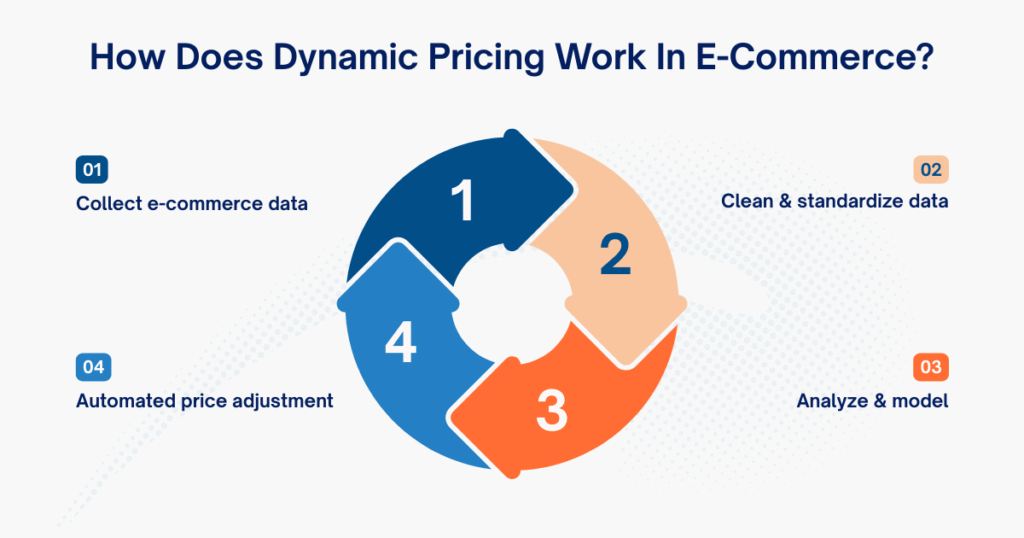
Dynamic pricing operates through a continuous cycle: data collection, processing & analysis, modeling, and finally real-time price adjustment. This cycle works as a feedback loop to ensure that selling prices always reflect true market conditions.
- Collect e-commerce data: Gather real-time data from platforms such as Shopee, Lazada, TikTok Shop, etc., through scraping or standardized raw e-commerce datasets.
- Clean & standardize data: Remove duplicates, handle missing values, and standardize SKU-level data to prepare it for the system.
- Analyze & model: Once the data is clean, the model analyzes it to determine the “optimal price.” Depending on the business’s maturity level, the system will output different optimal price recommendations.
- Automated price adjustment: After the model produces its result, the pricing system automatically sends the new price to the product management platform, updates it directly on the storefront (Shopee, Lazada, TikTok Shop, etc.), and activates monitoring for unexpected market changes.
Why Dynamic Pricing Transforms E-commerce
Dynamic pricing functions like a “self-learning – self-optimizing” model that reshapes seller behavior and buyer experience on e-commerce platforms through its ability to automatically collect data, analyze it, and take action. This has created a turning point in how e-commerce operates and competes.
E-Commerce – Before And After Dynamic Pricing Emerged
| Aspect | E-Commerce – Before Dynamic Pricing Emerged | E-Commerce – After Dynamic Pricing Emerged |
| Price adjustments | Manual, weekly/monthly; dependent on operator experience | Automated and real-time based on algorithms and e-commerce data |
| Market responsiveness | Slow; often lags behind demand and competitor changes | Near-instant; prices update continuously with competition and trends |
| Data used | Based on historical data and past trends | Based on real-time data: competitor prices, inventory, CTR, hourly demand, buying behavior |
| Competitor tracking | Manual monitoring; very limited scope | Automatically crawls and analyzes thousands of competitors and SKUs simultaneously |
| Profit optimization | Not optimized; often underpriced or missing opportunities to increase price | Algorithm optimized for various goals: profit, revenue, buy-box, inventory turnover |
| Pricing scalability | Hard to scale, especially when SKUs > 1,000 | Infinitely scalable; machine learning handles large catalogs without extra manpower |
| Buyer experience | Inconsistent pricing; sometimes unreasonably high due to outdated adjustments | Competitive, flexible prices that reflect true market conditions |
| Competitiveness | Small sellers struggle to compete on price | More equal opportunity as everyone relies on real-time data |
| Operational strategy | Intuition-based and experience-driven | Data-driven, predictive, and automated |
The Scale Of Dynamic Pricing’s Impact In E-Commerce
At the marketplace level, major platforms like Shopee, Lazada, TikTok Shop, Amazon, and Alibaba apply dynamic pricing at massive scale to optimize product ranking, traffic allocation, and competition among sellers.This leads to a significant shift: 80 – 90% of top sellers now use auto-pricing, adjusting prices 4 – 12 times per day on average, and up to 30 – 50 times during mega-sale events.
As the competition moves into “real-time,” pricing reaction speed becomes critical: 30 – 60% of revenue for many brands now depends directly on timely price adjustments, and any delay can immediately lead to losing the buy-box or market share.
Beyond revenue optimization, dynamic pricing also affects warehouse operations through inventory-aware pricing, a standard in modern e-commerce. The system automatically increases prices when inventory is low to protect margin and lowers prices when stock is high to improve turnover and reduce stagnation. As a result, businesses not only compete more effectively but also maintain more stable operational efficiency.
With all these factors combined, the e-commerce market has shifted from a “monthly or campaign-based pricing model” to a real-time competition environment, where prices are shaped by the minute and even small changes can create major differences in revenue, traffic, and ranking..
What Makes Dynamic Pricing To Transform E-Commerce
After looking at how dramatically e-commerce has changed since dynamic pricing emerged and how influential it has become, it is clear that dynamic pricing is reshaping how businesses operate, compete, and make decisions in a market that changes by the minute. The three reasons below explain why dynamic pricing truly transforms e-commerce instead of just offering minor improvements:
- It eliminates the biggest weakness of traditional e-commerce – static pricing: Dynamic pricing solves the major limitation of the old e-commerce era: fixed prices and slow reaction to market changes. When prices can change by the minute based on demand, inventory, and competition, businesses shift from “lagging behind the market” to being “synchronized with the market”.
- It optimizes at a scale far beyond human capability: E-commerce involves thousands of SKUs and real-time fluctuations that humans cannot track. Dynamic pricing workflows not only improve performance but also shift operations to automation + data-driven decision-making.
- It establishes a new competitive standard – real-time market operation: As major marketplaces implement dynamic pricing at scale and most top-tier sellers adopt auto-pricing, the market is forced into a real-time competitive environment. Prices no longer change monthly, they change by the minute. Price delays lead to lost visibility, lost conversions, and lost market share. Dynamic pricing becomes the standard, and every business must adapt.
The Importance of Continuously Updated Data in Dynamic Pricing
The core reason why real-time data is important lies in the speed of market changes. Product prices on marketplaces such as Shopee, Lazada, or TikTok Shop can change multiple times within a few hours, especially during peak times such as flash sales or major campaigns. Competitor’s inventory levels also fluctuate according to purchasing speed, creating competitive gaps that businesses can only take advantage of if they have immediate access to information. At the same time, user demand changes based on search trends, advertising, or viral content, forcing prediction models to continuously update to maintain accuracy. When data is delayed by just one or two hours, suggested prices can quickly become outdated, causing businesses to reduce prices unnecessarily or keep prices high while competitors have already lowered theirs significantly.
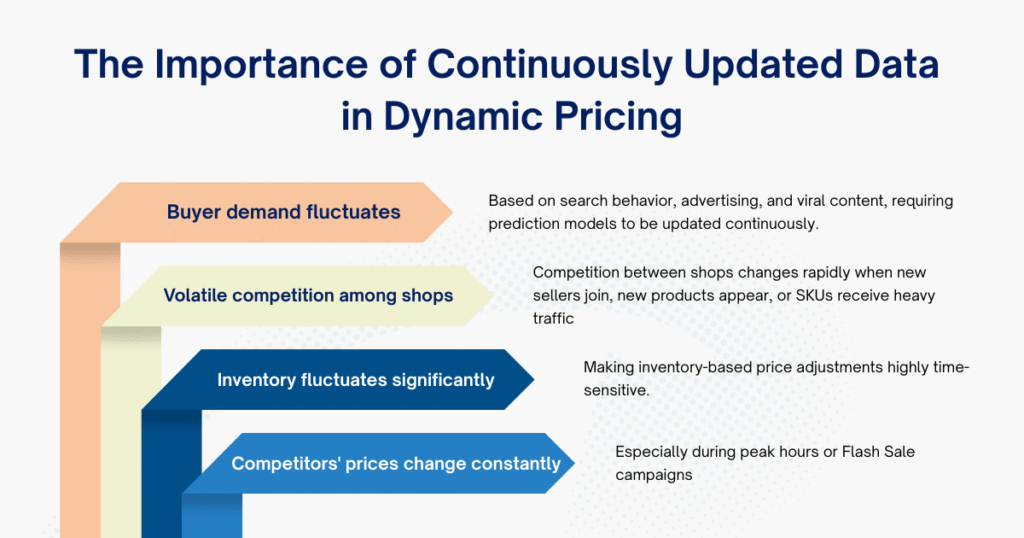
Dynamic pricing is designed to operate based on a continuous loop, but if the input data lacks real-time accuracy, every step in the cycle can break. Pricing decisions become ineffective when they fail to reflect market changes, leading to delays and weak reaction speed. Slow reactions in a highly competitive environment mean losing the buy-box, losing advantages, and reducing overall performance. Therefore, “real-time” data is the core foundation that determines the effectiveness of this model.
To obtain high-quality real-time input data, companies building dynamic pricing models often face significant challenges when collecting data by themselves. Crawling and synchronizing large volumes of data across multiple e-commerce platforms requires strong technical capability and substantial cost, especially for businesses attempting to build in-house systems. As a result, teams developing dynamic pricing models typically choose to work with third-party raw e-commerce data providers to ensure stable and continuous data supply.
Easy Data is one of the most trusted providers of raw e-commerce data with professional e-commerce data scraping services. Not only can it handle the most difficult part of the dynamic pricing process – collecting and updating data in real time, but it also provides data in a structure that fits the model requirements, helping businesses deploy algorithms faster, more sustainably, and more accurately.
Conclusion
In modern e-commerce, speed and data are the two decisive factors. Dynamic pricing is truly effective only when businesses have real-time data to react at the right moment. Investing in high-quality raw e-commerce data provides a long-term competitive advantage for any pricing model and for the entire growth strategy.
Leave a Reply