
Tracking competitor pricing, promotions, and marketplace activities across platforms like Shopee, Lazada, and TikTok Shop has become a standard practice for many e-commerce businesses in Southeast Asia. However, as the volume of data continues to grow, manual tracking methods are often no longer sufficient.
In this article, Easy Data will walk you through what data scraping is, how it works, and why it has become an important part of the data infrastructure for many e-commerce businesses today.
What Is Data Scraping?
Data scraping is the process of using software to automatically collect data from digital sources such as websites, mobile applications, or online platforms, and then convert that data into structured formats like CSV, Excel, or JSON, or synchronize it directly with databases through APIs.
Simply put, data scraping helps businesses automate data collection tasks that would otherwise require manual effort. Instead of visiting individual stores to record prices, sales volumes, or promotions, businesses can automatically collect and consolidate large amounts of data in a fraction of the time.
As a result, teams can save significant operational effort while reducing the errors commonly associated with manual data collection.
How Does Data Scraping Work?
A typical e-commerce data scraping system operates in three main steps:
- Step 1: Access the data source: The system sends requests to the website or application from which data needs to be collected, such as a product category page on Shopee, Lazada, or TikTok Shop.
- Step 2: Extract the data: Once connected, the system identifies and collects the required data fields, such as product names, prices, sales figures, ratings, and other relevant information.
- Step 3: Structure and clean the data: Data collected from the internet often contains unnecessary information or inconsistent formats. The system cleans, filters, and standardizes the data so it can be used in analytics tools such as Power BI, Looker Studio, Google Sheets, or internal BI systems.
Common Data Scraping Techniques for E-Commerce
Depending on the data requirements and platform architecture, technical teams typically use one of the following approaches.
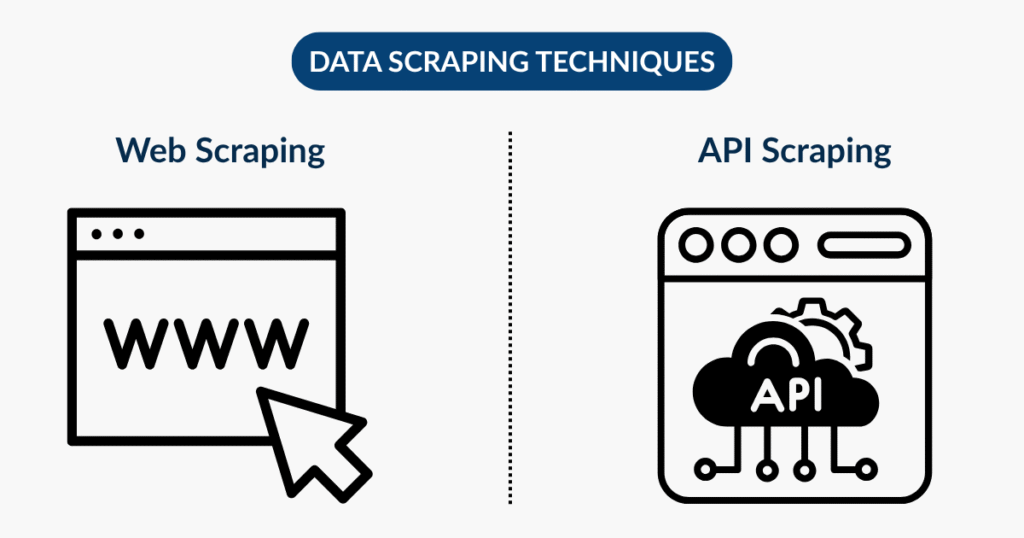
Web Scraping
Web scraping collects data directly from what users see on a website. The system visits product pages or category pages and reads the HTML structure to extract information such as product names, prices, ratings, displayed sales volumes, and seller information.
For websites that rely heavily on JavaScript, such as Shopee and TikTok Shop, scraping systems often use headless browsers like Selenium, Playwright, or Puppeteer to fully render page content before extracting data.
API Scraping
API scraping collects data directly from the data streams that websites or applications use to display information.
In simple terms, when you open a product page on Shopee or TikTok Shop, the application sends requests to backend servers to retrieve the required data. API scraping focuses on collecting that data directly rather than reading it from the user interface.
Because the returned data is usually delivered in structured JSON format, API scraping often requires less processing and data cleaning compared to web scraping.
Applications of Data Scraping in E-Commerce
Data scraping is not limited to collecting product lists or monitoring prices. When implemented effectively, it can support a wide range of business functions, from operations and marketing to market intelligence.
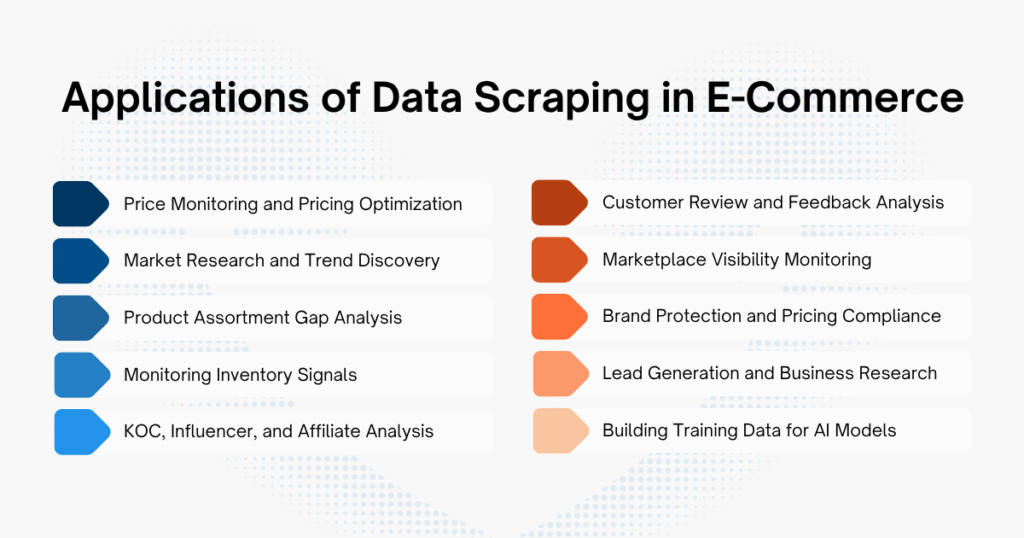
1. Price Monitoring and Pricing Optimization
Businesses can track competitor prices, promotions, vouchers, and flash sales across Shopee, Lazada, and TikTok Shop in near real time. This data helps operations teams understand their pricing position in the market and supports dynamic pricing or repricing systems in making faster decisions.
2. Market Research and Trend Discovery
Continuous monitoring of product categories helps businesses identify products that are gaining traction in terms of sales performance or customer interest. These insights can support merchandising, product development, sourcing decisions, and category expansion planning.
3. Product Assortment Gap Analysis
By collecting data from leading sellers, businesses can compare their own product assortment with competitors. This makes it easier to identify missing price segments, product attributes, or SKU groups that may represent untapped opportunities.
4. Monitoring Inventory Signals
On some marketplaces, product data may provide signals about inventory availability or sales velocity. These signals help businesses identify potential supply shortages or rising demand and adjust their inventory and sales strategies accordingly.
5. KOC, Influencer, and Affiliate Analysis
On platforms such as TikTok Shop and Shopee Video, data scraping can help collect information about content performance, promoted products, and affiliate activity. This allows businesses to better understand which creators and campaigns are generating the most engagement within their category.
6. Customer Review and Feedback Analysis
Product reviews and customer comments are valuable sources of market insight. When combined with NLP or AI technologies, businesses can identify recurring customer pain points, highly rated product attributes, and emerging feedback trends across product categories.
7. Marketplace Visibility Monitoring
Data scraping enables businesses to track product rankings for specific marketplace search keywords. These insights help evaluate brand visibility, optimize product listings, and improve e-commerce SEO performance.
8. Brand Protection and Price Compliance Monitoring
For large brands, marketplace data can help identify unauthorized pricing practices, distribution policy violations, or misuse of brand assets.
9. Lead Generation and Business Research
Some businesses use data scraping to collect information about companies, sellers, or brands that match their target customer profile. This data can support market research and B2B business development initiatives.
Learn more: Top Data Sources Powering Web Scraping for Lead Generation in 2026
10. Building Training Data for AI Models
E-commerce data has become an important source of training data for AI applications, such as:
- Product Recommendation
- Dynamic Pricing
- Demand Forecasting
- Sentiment Analysis
- AI Product Content Generation
However, successful AI initiatives require more than just large datasets. The data must also be cleaned, standardized, and continuously updated over time.
Is Data Scraping Legal?
This is one of the most common questions businesses ask when exploring data scraping.
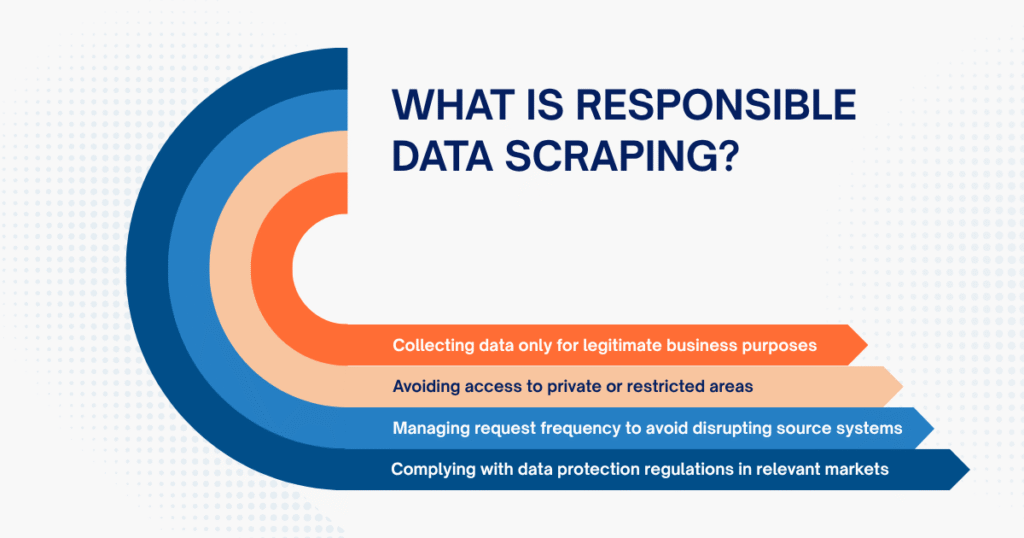
The short answer is: Yes. Data scraping can be conducted legally when it focuses on publicly available data, respects privacy rights, and complies with applicable data protection regulations.
To better understand the topic, it is important to distinguish between the following concepts.
Collecting Public Data
One of the most well-known legal cases involving data scraping is the dispute between hiQ Labs and LinkedIn in the United States. The court ruled that collecting publicly accessible data (information that anyone can view without logging in or bypassing security measures) does not constitute unauthorized access.
In e-commerce, data such as product names, prices, discounts, sales counts, product reviews, and publicly visible seller information is generally considered public data and is commonly used for market research, competitor monitoring, and category analysis.
Avoiding Personal and Private Data
The most important boundary in data scraping involves personal data. Information such as phone numbers, email addresses, personal addresses, payment details, private transaction histories, or any data requiring authentication to access is considered sensitive and protected by privacy regulations in many countries.
Platform Terms of Service
Many websites and platforms include restrictions on the use of bots or crawlers within their Terms of Service. This is different from violating the law.
In practice, platforms that do not want automated data collection often implement technical measures such as CAPTCHA challenges, rate limiting, Cloudflare protection, or IP blocking. Therefore, businesses operating data scraping projects at scale should understand both the technical requirements and the platform policies related to their target data sources.
Choosing the Right Data Scraping Approach for Your Business
When implementing data scraping, businesses typically consider one of three common approaches. Each option is suitable for different data volumes, technical resources, and operational goals.
Building an In-House Data Scraping Team
The company builds its own technical team to develop and maintain data scraping infrastructure using technologies such as Python, Scrapy, Node.js, or other specialized frameworks.
Advantages
- Full control over system architecture and data workflows
- High flexibility to customize according to business requirements
Limitations
- Requires significant technical resources and expertise
- Operational costs increase as data volume grows, particularly for infrastructure such as proxies, storage, and monitoring systems
- Marketplace platforms frequently update their interfaces and anti-bot mechanisms, requiring ongoing maintenance and system updates
Using No-Code Tools, SaaS Platforms, or Browser Extensions
Businesses use existing data collection tools through drag-and-drop interfaces or browser extensions.
Advantages
- Fast implementation
- Lower upfront costs
- Suitable for simple data collection needs or short-term projects
Limitations
- Limited customization options
- Can struggle to scale for larger data requirements
- Output data often requires additional cleaning and processing before analysis
Using a Managed Data Scraping Service
The business defines its data requirements (such as tracking specific shops, keywords, categories, brands, or use cases) while the service provider manages the underlying infrastructure and operations.
Advantages
- Significantly reduces development and maintenance effort
- Eliminates the need to manage technical challenges such as proxies, CAPTCHA handling, anti-bot protection, and data cleaning
- Data can be delivered through APIs or connected directly to Power BI, Looker Studio, Google Sheets, and internal BI systems
Limitations
- Typically involves higher costs than self-service tools
- Requires selecting a provider with experience in the relevant markets and data sources
If your business needs to monitor data by keywords, product categories, brands, or competitors across Shopee, Lazada, and TikTok Shop in multiple Southeast Asian markets, Easy Data can help design a data collection and update workflow tailored to your specific analytical needs.
Explore Easy Data’s E-commerce Data Services
Click to discover real-time crawling solutions for Shopee, TikTok Shop, and Lazada.
Conclusion
Data scraping can be implemented in different ways, from building an in-house system and using ready-made tools to partnering with a specialized service provider. The right choice depends on your data requirements, technical resources, and long-term business goals.
In many cases, competitive advantage does not come from having more data, it comes from having access to the right data at the right time. Data scraping helps e-commerce businesses build that capability in a more scalable and sustainable way.
Leave a Reply