

Introduction
A beauty-market data project may need product variants, displayed prices, availability labels and review themes from a specific Sephora storefront. These are observations of published offers, not access to customer purchases, complete inventory or the whole beauty market. Define the country, product range and decision before deciding whether collection is useful.
This guide explains how to scope a proposed Sephora crawling project with Easy Data, including access, fields, validation and delivery. Reviewed October 2, 2026: the examples below are planning guidance, not evidence of a current Sephora partnership, a completed client engagement or guaranteed access. A project should proceed only after its source permissions and feasibility are established.
1. Why Crawl Data from Sephora?
| Observed field | Interpretation limit |
|---|---|
| Displayed offer | Price and conditions at the recorded time, not completed sales |
| Availability label | Visible state for the selected variant, not exact stock quantity |
| Review sample | Published feedback in the collected sample, not all customers |
| Category position | Position under a recorded sort order, not verified revenue |
The business question determines which observations to collect. Start with a small authorized sample and define the population it represents. A product appearing in a storefront does not reveal how many units were sold.
1.1 Market Research and Competitive Analysis
Product assortment and merchandising can support competitive research when the source, category, sort order and observation time are recorded. They do not provide a real-time record of what all consumers are purchasing. Useful distinctions include:
- Assortment changes: identify products newly observed or removed within a fixed category sample; distinguish true removal from collection failure.
- Category coverage: count the products and variants actually collected, including missing pages. A listing count is not category revenue or market share.
- Merchandising labels: retain a displayed bestseller badge or ranking with its category, sort order and date. Do not convert it into unit sales without a separate supported source.
Use these observations to form questions for further research, then test them against your own customer and sales data. The market-analysis guide explains how to keep source coverage and business outcomes separate.
1.2 Pricing Insights
Price comparisons need the same country, currency, product, shade, formulation and pack size. Sephora’s product-information terms distinguish U.S. dollar prices on Sephora.com from Canadian dollar prices on Sephora.ca. Do not infer a dynamic-pricing algorithm from a few observed price changes.
- Displayed offers: record the regular or promotional price, currency, collection time and any visible eligibility conditions.
- Historical comparison: retain repeated snapshots of matched variants; a page fetched today does not automatically supply past prices.
- Comparable units: normalize quantity only when the units and formulation support it. Keep tax, delivery, bundle and membership conditions explicit.
For a worked calculation, see the delivered unit-price example. It is fictional and shows why a cheaper pack can have a higher cost per unit. Actual pricing decisions also need your own costs and commercial constraints.
1.3 Observing Product Availability
Sephora’s product-finding guidance describes variant choices and temporary out-of-stock labels. Such labels are not warehouse counts. Track the selected variant, storefront and fulfillment context, then distinguish:
- Availability state: record the displayed label at a known time. A missing field, failed request or blocked page is an unknown observation, not evidence that an item is unavailable.
- Demand hypotheses: investigate repeated unavailable observations alongside other evidence. Supply constraints, discontinued variants or source changes can produce the same pattern.
- Observed transitions: a change from unavailable to available between two checks only locates the change within that interval; it does not reveal the exact replenishment time or quantity.
Report the number of successful observations and the collection interval with any availability rate. Do not use this sample as a measure of Sephora-wide stock levels or a guaranteed sales forecast.
Fictional availability example: schedule ten checks of the same variant and fulfillment context. Suppose eight checks succeed: six show available and two show unavailable; two checks fail. The observed unavailable share is 2 ÷ 8 = 25%, and successful-check coverage is 8 ÷ 10 = 80%. Counting failures as unavailable would instead give 4 ÷ 10 = 40%, which is not supported. These invented figures describe observations, not the share of time out of stock, units sold or Sephora’s actual performance.
1.4 Customer Reviews and Sentiment Analysis
Reviews can help identify recurring themes in a defined sample. Sephora’s review guidelines describe moderation and possible removal of reviews. The visible sample can change and does not represent every purchaser. Avoid an undated total-review claim.
- Recurring themes: classify specific feedback with documented labels and manually review examples, including mixed or ambiguous comments.
- Product context: retain relevant variant and review dates where supported; do not infer that every comment applies to every shade or formulation.
- Trend comparisons: hold sampling and labeling rules constant, report sample size and missing periods, and separate ratings from verified product effectiveness.
Collect only the fields needed for the agreed analysis. Review themes should guide investigation; they are not clinical evidence or a substitute for direct customer research.
2. Challenges in Crawling Sephora
Access and reuse come before tool selection. Sephora’s Terms of Use, section 7, restrict scraping and extraction except as expressly permitted, and prohibit circumventing security-related restrictions. This guide is not authorization to collect data. Establish a permitted source or written permission for the proposed project before implementation.
2.1 Anti-Bot Protections and Rate Limiting
A collection design needs an agreed access route and request limits. This article does not establish the specific protections deployed on every Sephora storefront. If access fails, record the response and investigate through the permitted channel rather than promising uninterrupted extraction.
- Access failures: distinguish denied access, rate limits, timeouts and unavailable pages in the collection log.
- Stop conditions: pause requests when access is denied or the agreed limit is reached. Rotating an IP address does not establish permission or guarantee reliable access.
Agree how failures affect delivery and who can authorize a change in access method. A missing record should remain visibly missing until it is resolved.
2.2 Dynamic Content Loading
The fields available in an initial page response may differ from those shown after interaction. Verify a permitted sample before choosing an HTML parser or a browser-based process; do not assume every required field needs JavaScript execution.
- Rendered fields: compare the permitted source with the visible product and selected variant; verify that the extracted value belongs to that selection.
- Collection completeness: record page or cursor coverage and a stopping rule for lists; detect duplicates and missing results when pagination changes.
Choose the least complex permitted method that supplies the required fields. Browser automation can render a page, but it does not certify data accuracy or grant access rights.
2.3 Website Layout Changes
Layout or schema changes can break future extraction without invalidating every earlier snapshot. Keep raw source references, parser versions and collection dates so discrepancies can be investigated.
- Validation checks: flag unexpected missing fields, invalid currencies, duplicate variant keys and sudden coverage changes.
- Maintenance: test extraction changes against saved permitted examples before resuming a scheduled delivery.
A successful HTTP response alone is not a successful data record. Validate the expected fields and retain the reason when a record fails.
3. Easy Data’s Sephora Crawling Services Overview
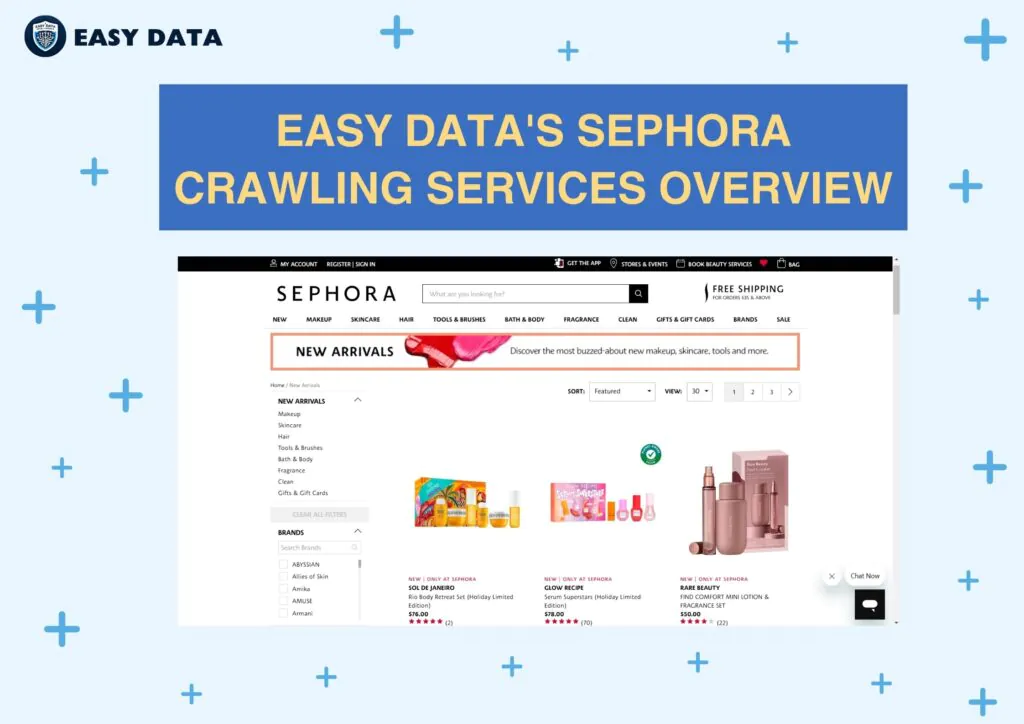
A scoped Easy Data proposal should specify the permitted source, product universe, fields, update interval, validation criteria and delivery format. Confirm these in a sample before treating the service as ready for a production workflow.
3.1 Choosing a Collection Approach
The extraction approach should follow the authorized source and required output. Confirm the actual implementation in the project scope rather than assuming proprietary technology or a particular browser tool from this article.
- Source method: evaluate a permitted export, feed or browser workflow against the requested fields and access conditions.
- Reliability: define request limits, retries, monitoring and stop conditions; do not promise continuous access through IP rotation.
- Coverage: test pagination, variants and field mappings on an agreed sample and report observed gaps.
3.2 Customizable Data Solutions
Specify required and optional fields in a data dictionary. Field availability and reuse rights may differ by storefront and source; a proposal should identify unsupported requests before collection. Examples include:
- Product fields: identifiers, brand, name, size, shade and source URL where permitted and available. Image or description reuse needs its own agreed scope.
- Price observations: timestamped values and conditions from retained snapshots; earlier history requires an independently verified source.
- Review fields: only permitted, necessary rating or text fields, with source dates and documented sampling rules.
3.3 Regular Data Updates
Specify scheduled check times, expected delivery delay and how missed runs will be reported. Source outages and changes can interrupt collection; report stale or incomplete data explicitly instead of guaranteeing uninterrupted freshness.
4. Key Features of Easy Data’s Crawling Services for Sephora
Evaluate a proposed delivery against the following acceptance criteria. They describe what to agree and verify, not a blanket guarantee that every Sephora field is available.
4.1 Defining Available Data Fields
A useful data dictionary states each field’s definition, type, unit, permitted values and missing-value behavior. Confirm the following categories against the sample:
- Product identity: a stable product and variant key with brand, size and shade where available.
- Price: amount, currency, observation time and visible discount conditions; a missing price must not become zero.
- Availability: the displayed status plus storefront and fulfillment context, without inferring exact inventory.
- Reviews: sample dates, rating scale and coverage, with optional analysis clearly separated from source text.
4.2 Collection Schedule and Freshness
Select a collection interval that the permitted source and project budget can support. Scheduled checks provide snapshots; they do not guarantee immediate detection of every change.
- Latency: measure the time between a scheduled check and delivery. Do not label a process real-time without a defined, verified latency requirement.
- Schedule: agree daily, weekly or other intervals only after feasibility testing, and document missed checks and data freshness.
4.3 Data Delivery in Preferred Formats
Agree whether CSV, JSON or an Excel workbook best fits the recipient’s workflow, including encoding, types, date zones and stable keys. Any database integration needs its own mapping, access scope and test; a file format alone does not guarantee compatibility.
5. How Easy Data’s Crawling Process Works
Use a staged project process with explicit acceptance checks:
5.1 Consultation and Customization
First, define the decision, country storefront, product categories, necessary fields, access permission and delivery recipient. Confirm whether the available source can answer the question before committing to scale.
5.2 Data Extraction and Processing
Next, run a permitted sample, reconcile planned versus collected records, verify variant matches and inspect missing or inconsistent values. Agree what constitutes a usable record before expanding collection.
5.3 Delivery and Support
Deliver the agreed sample with its data dictionary, observation dates, coverage summary and unresolved errors. Define the support period and change-handling process in the project scope.
Conclusion
A useful Sephora crawling project starts with permission and a specific business question. Published product offers, availability labels and reviews can support bounded analysis, but they do not expose complete sales, exact stock quantities or every customer’s opinion.
Judge the output by traceable sources, correct product matching and explicit missing-data handling. A larger file or faster collection schedule is not by itself evidence of better decisions.
Use the Easy Data service overview to discuss the proposed source, fields and deliverable. A sample and agreed acceptance criteria should determine feasibility.
Prepare a concrete project brief: name the storefront, product scope, question, required fields and observation period, and identify the permitted access route. This makes the first discussion specific and testable.
📩 Email us: john@easydata.io.vn
🌐 Visit us: easydata.io.vn
Bring a small set of representative product variants and the decision you want the data to support.
Leave a Reply