

The Shopee Affiliate Program lets approved participants earn commissions from qualifying purchases made through their referral links. This beginner’s guide explains how to choose the right regional program, apply, check commission terms, and evaluate results. Earnings are not automatic: approval, order validation, costs, and the quality of your recommendations all matter. Start with the rules for your country and program type before planning any income.
- What is the Shopee Affiliate Program?
- How to Join the Shopee Affiliate Program
- How the Shopee Affiliate Program Works
- Benefits of the Shopee Affiliate Program
- Top Strategies to Maximize Your Earnings
- Challenges and How to Overcome Them
- Illustrative Content Plans
- Earning Potential
- Tips for Long-Term Success
- Joining Affiliate Networks
- Conclusion
What is the Shopee Affiliate Program?
Affiliate marketing connects a product recommendation to a tracked referral link. A click or an order appearing in a report is not the same as a payable commission. Shopee’s Vietnam affiliate handbook explains the basic sequence: obtain your affiliate link, share it, and receive commission from qualifying orders. Use the link generated for your own approved account.
This is a cross-market introduction, not one set of worldwide Shopee rules. Vietnam’s KOL/KOC program and Singapore’s affiliate program have separate guidance. A network offer is another route with its own conditions; joining one program does not establish eligibility for every market or channel.
Why Choose the Shopee Affiliate Program?
Consider these potential advantages alongside the eligibility rules and costs of the specific offer:
- Check joining costs: Singapore’s official introduction advertises free registration. That does not make content production, product samples, tools, or promotion free. Set a budget before spending.
- Flexible content work: You can plan when to create recommendations. Confirm the market, residency, account, and promotional-channel requirements before assuming you can participate from any country.
- Massive Product Selection: Shopee’s catalog spans fashion, electronics, home goods, beauty products, and more, allowing affiliates to target diverse audiences.
- Recognizable marketplace: Readers may already know Shopee, but familiarity does not guarantee a sale. Product fit, seller quality, price, and your evidence still matter.
- Different entry routes: Check the requirements for your creator or affiliate category. Do not assume that every route has no follower minimum.
- Seasonal opportunities: Sales events can provide topics for useful buying guides. Check the actual campaign dates, qualifying products, and commission terms instead of assuming an increased rate or sales volume.
How to Join the Shopee Affiliate Program
Choose your country and affiliate route first. The following checklist explains what to prepare; the local application screen and current terms determine the exact requirements.

-
Sign Up for a Shopee Account
If you don’t already have a Shopee account, create one on the Shopee website or mobile app. Provide your email address or phone number, verify your registration, and set up your profile. This account will be linked to your affiliate activities.
-
Access the correct program
Use an official regional entry point, such as the Vietnam affiliate handbook and dashboard guide or Singapore’s program introduction. If applying through a network, read that particular Shopee offer separately.
-
Complete the Application Form
Fill out the application form with details about your promotional platforms. Specify whether you’ll promote products via social media (e.g., Instagram, TikTok, YouTube), a blog, a website, or other channels. Provide accurate information about your audience size, content niche, and promotional strategies.
-
Provide the requested channel details
Submit accurate links to the accounts or sites you plan to use. Check whether the selected program accepts each channel and requires it to be public or reviewed. Do not assume a messaging group or every social platform is automatically approved.
-
Submit payment and account information
Follow the instructions in your regional account for accepted payment details and required documents. Vietnam’s affiliate terms make participants responsible for accurate, current payment information. Check requirements before submitting; this guide does not recommend one bank for all countries.
-
Check approval status
Use the application dashboard and official messages to confirm whether your account and channels are approved. Follow the stated review timeline for that program and contact its support if needed. Do not plan a launch around an assumed universal approval deadline.
Eligibility Requirements
Use the current regional terms as an application checklist. For example, Vietnam’s terms distinguish program types and approved promotional channels. Confirm the following for your own application:
- Age and participant category: Check the applicable age, identity, and individual or business requirements rather than relying on one global age rule.
- Online presence: Confirm the accepted channels, account visibility, content history, and any audience requirements for your chosen route.
- Compliance: Your content must adhere to Shopee’s guidelines, avoiding prohibited material like explicit or misleading content.
- Regional availability: Verify which market and audience the offer covers and whether your location and payment details are eligible.
How the Shopee Affiliate Program Works
Once approved, affiliates can start promoting products and earning commissions. Here’s a detailed breakdown of how the program operates:
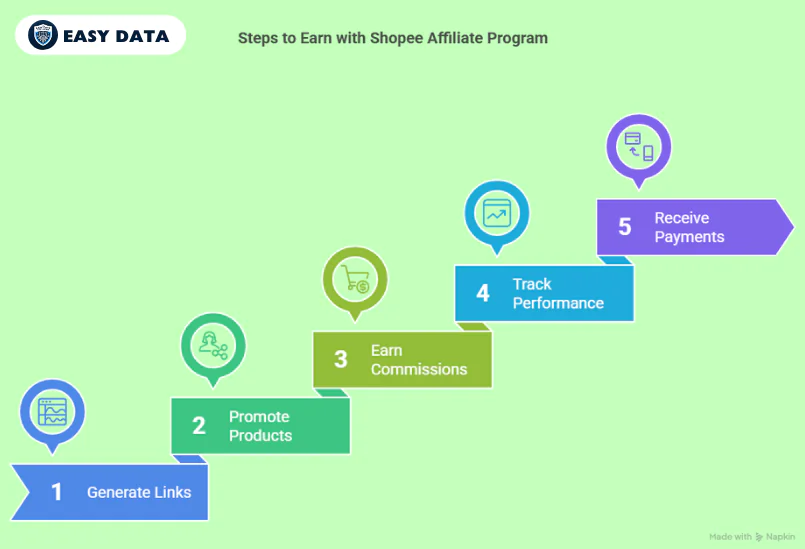
- Generate affiliate links: Use your approved program’s app or dashboard. For Vietnam, the official handbook describes generating product links in the app or through the affiliate dashboard. Open the generated link to check the destination; do not manually replace its tracking parameters.
- Promote products: Share useful recommendations through approved channels. Explain who a product suits, its limitations, and whether you have personally tested it. Respect community rules and avoid unsolicited repeated link posting.
- Check attribution and validation: Read the offer’s attribution window, eligible order rules, and exclusions before estimating commission. Do not assume a universal 7–30-day window. Check how cancellations, returns, non-qualifying purchases, and competing referrals affect the order status shown in your account.
- Track performance: Record clicks, reported orders, validated commissions, and paid amounts separately. Check the reporting period and update delay before interpreting missing or changing results.
- Receive payments: Follow your program’s reconciliation, threshold, payment-document, and payout instructions. There is no single worldwide payout timetable or minimum assumed in this guide; confirm these details in your current account.
Commission Structure
Do not use a generic category-rate table to forecast earnings. Shopee’s Vietnam commission guidance says rates vary by time, category, channel, and applicable participant group; it directs affiliates to the app or dashboard for current details. Record these inputs before promoting an offer:
- Market and program: Country, creator or affiliate category, and direct-program or network route.
- Product and eligible value: Exact item or shop and the purchase amount on which commission is calculated.
- Rate and cap: Base and additional commission components, applicable limits, and the date you checked them.
- Attribution and channel: Qualifying referral path, approved promotion method, and attribution period.
- Validation and deductions: Order status, exclusions, applicable fees or withholding, and expected payout conditions.
Regional example, checked October 1, 2026: Singapore’s published structure differentiates channel, affiliate tier, and direct versus indirect orders, with caps on some components. It should not be applied to a Vietnam account. For Vietnam, use the official commission dashboard linked from Shopee’s help page. Recheck current terms before each campaign.
Benefits of the Shopee Affiliate Program
The practical benefits depend on the program you qualify for and how well your content serves readers:
- Audience fit: A focused audience can make it easier to choose useful products and answer specific questions. Audience size alone does not establish eligibility or predict earnings.
- Official resources: Use the training, approved promotional materials, and reporting tools available to your account. Verify image permissions and campaign details before republishing assets.
- Useful comparisons: Help readers compare specifications, seller information, shipping options, and current prices. Explain limitations instead of promising conversion results.
- Campaign planning: Prepare relevant seasonal content, then update prices, availability, and expiry dates when the campaign changes.
- No stock ownership for referrals: Making a recommendation does not require you to buy inventory for resale. You still need to invest time in research, content, and maintaining readers’ trust.
Evaluate the program with your own records rather than uncited income stories. The worked example below is explicitly fictional and shows how validated orders and costs change the result.
Read more: Ecommerce Growth in Vietnam: 5 Predictions for 2025
Top Strategies to Maximize Your Earnings
Use these strategies as small, measurable experiments. Keep the tactics that help your audience and produce validated results within your budget:
-
Select relevant products
Research your audience’s needs and use the product and campaign information available to your affiliate account. Check specifications, recent reviews, seller details, price, and stock before recommending an item. A popularity label is not proof of quality or guaranteed demand.
-
Create Compelling Content
Content is king in affiliate marketing. Use these formats to engage your audience:- Short Videos: Create 15–30-second TikTok or Instagram Reels showcasing product features or unboxing experiences. For example, demonstrate how a blender works or style a dress from Shopee.
- Blog Posts: Write in-depth reviews, gift guides, or “best of” lists (e.g., “Top 10 Shopee Gadgets Under $50”). Embed affiliate links naturally within the content.
- Social Media Posts: Share aesthetically pleasing photos or carousel posts on Instagram with clear calls-to-action (e.g., “Shop now via my link!”).
- Stories and chats: Share accurate, time-limited deals only where your program and the community allow promotional links. Include the expiry date and avoid unsolicited mass messages.
-
Leverage Social Media Platforms
Focus on platforms where your audience is most active:- Instagram: Use Stories, Reels, and posts to showcase products. Add links in your bio or use link-in-bio tools like Linktree.
- TikTok: Create engaging, trend-driven videos to capitalize on viral potential.
- YouTube: Produce tutorials, hauls, or reviews with affiliate links in the description.
- Facebook Groups: Share links in niche communities (e.g., parenting or tech groups), but avoid spamming.
- WhatsApp/Telegram: Use these channels only if permitted by your program and welcomed by the recipients. Keep recommendations relevant and avoid repeated promotional messages.
-
Optimize for SEO
If you run a blog or website, use search engine optimization (SEO) to attract organic traffic. Incorporate keywords like “Shopee Affiliate Program,” “Shopee deals,” or “best Shopee products” in your titles, headings, and content. For example:- Write a guide answering a specific buying question, explain your selection criteria, and distinguish firsthand testing from desk research.
- Write accurate page descriptions and descriptive image alt text. These help readers and accessibility; adding keywords is not a ranking guarantee.
- Check that the article and its links work on mobile as well as desktop.
-
Capitalize on Seasonal Trends
Align your promotions with Shopee’s sales calendar. For example:- 11.11 and 12.12 Sales: Promote electronics and fashion during these mega events.
- Hari Raya or Christmas: Focus on festive decor, gifts, or traditional clothing.
-
Back-to-School Season: Highlight stationery, laptops, or backpacks.
Check Shopee’s affiliate dashboard for upcoming campaigns and tailor your content accordingly.
-
Use analytics to improve
Compare validated commission per click and per hour of content work, not clicks alone. For each channel, keep the same date range and record clicks, reported orders, approved orders, reversals, and paid commission. Use approved tracking labels if available, and change one variable at a time. Small samples can fluctuate; higher click volume need not mean higher profit.
-
Build trust with transparency
Place a clear disclosure near the recommendation, for example: “I may earn a commission if you buy through this link.” Describe your relationship honestly and distinguish personal experience from product information supplied by others. Check the disclosure requirements that apply to your audience and platform; this sample sentence is not a universal compliance template.
Challenges and How to Overcome Them
Plan for these common measurement and content challenges:
- High Competition: Many affiliates promote similar products, especially during sales events. Stand out by creating unique content, such as niche product reviews or creative video formats. For example, instead of promoting generic phone cases, focus on eco-friendly or customizable options.
- Low returns after costs: Compare validated commission with production, sample, tool, and promotional costs. A more expensive product can still perform poorly if its rate, cap, or conversion rate is unfavorable.
- Pending or missing payments: Separate an order awaiting validation from an approved amount awaiting payment. Check the reporting period, payment details, required documents, and published support process before treating either as lost commission.
- Audience Engagement: If your audience isn’t clicking or converting, reassess your content. Are you targeting the right products? Is your call-to-action clear? Experiment with different approaches to boost engagement.
Illustrative Content Plans
These are illustrative content plans, not documented earnings stories or promises of results:
- Beginner product guide: A student compares three affordable desk lamps using measurements, clear photos, and a stated budget. They disclose affiliate links and track validated orders rather than projecting income from follower count.
- Seasonal buying guide: A food blogger compares gift options, delivery deadlines, and storage requirements. They check campaign eligibility and update unavailable offers instead of assuming a festival will increase commission.
- Short video review: A creator demonstrates a product they have tested, explains one drawback, and checks that the published affiliate link reaches the intended item. They compare approved results with production time before making more videos.
Use these scenarios to design a test. They do not establish what any real affiliate earned.
Earning Potential
There is no reliable monthly income forecast from follower count alone. Use a transparent calculation with your own validated results. The following USD amounts and rates are invented solely to demonstrate the arithmetic; they are not Shopee rates, caps, payout thresholds, or expected earnings.
- Gross commission example: Suppose 40 approved orders each have $25 of eligible value and an assumed uncapped 4% commission. Gross commission is 40 × $25 × 0.04 = $40.
- Cost example: If creating and promoting the content cost $15, the result is $25 before tax and the value of your time, assuming no other deductions. Record your hours separately rather than calling the $40 gross amount profit.
- Validation sensitivity: If only 30 of those orders qualify, gross commission becomes $30 and the result after the same $15 cost becomes $15. Pending or rejected orders must not be counted as paid earnings.
For real offers, calculate each applicable commission component using the correct eligible value, rate, cap, and validation status. Then reconcile deductions and actual payments against your account reports. Do not substitute a product’s headline price or a “maximum commission” banner for these inputs.
Tips for Long-Term Success
To keep the work useful and sustainable, review both reader feedback and validated results:
- Start Small and Scale: Begin with one or two product categories to master your promotional skills, then expand to new niches.
- Invest in Learning: Watch Shopee’s affiliate webinars or join online communities (e.g., affiliate marketing forums) to learn from experienced marketers.
- Diversify carefully: Test another approved channel once you can measure the first. Use email only with an appropriate audience and permission; do not add unsolicited recipients.
- Stay Updated: Follow Shopee’s announcements for new campaigns, commission boosts, or policy changes.
- Engage Your Audience: Respond to comments, ask for feedback, and create content that resonates with your followers’ needs.
Joining Affiliate Networks
If you consider an affiliate network, inspect the current Shopee offer before applying. A network account and approval for a particular advertiser are separate things. Compare the following with the direct regional program:
- Offer coverage: Confirm the country, eligible audience, accepted channels, and whether the offer is currently open to your account.
- Tracking and reporting: Check available link tools, attribution rules, reporting delay, validation status, and export options.
- Payment and support: Read the network’s fees, payout currency, threshold, validation schedule, and support route. Do not assume they match Shopee’s direct program.
Keep a dated copy of the offer terms you are using and recheck them before a campaign. Approval, commission rates, and payment arrangements should be verified for that specific route, not inferred from another network or market.
Conclusion
The Shopee Affiliate Program can be a way to earn from useful product recommendations, but the outcome depends on eligibility, qualifying orders, applicable terms, and your costs. Start with the correct regional program, make honest recommendations, and track approved and paid commission separately.
For a first test, choose one audience need and one approved channel, check the current offer terms, publish a clearly disclosed recommendation, and review validated results before expanding. Keep the test within a budget you can afford without assuming future commission will cover it.
Leave a Reply