
TikTok has transformed from a platform primarily for entertainment into a dynamic e-commerce marketplace with the launch of TikTok Shop. This feature allows businesses and influencers to sell products directly on the platform, leveraging TikTok’s immense user base and engaging content format. As e-commerce on TikTok grows, the importance of data-driven decision-making cannot be overstated.
TikTok Shop data scraping is the extraction of available listing and related data into a structured dataset. A useful project starts with a permitted access route, a defined market and a field specification. This guide distinguishes product listings from sales counters, engagement signals and authorized shop data, then explains collection choices, quality checks and analysis limits.
- What Is TikTok Shop Data Scraping?
- Why Scrape Data from TikTok Shop?
- Types of Data You Can Scrape from TikTok Shop
- Tools and Techniques for TikTok Shop Data Scraping
- Step-by-Step Guide to Scraping TikTok Shop Data
- Legal and Ethical Considerations
- Challenges of TikTok Shop Data Scraping
- Illustrative Analysis Workflows
- Conclusion
What Is TikTok Shop Data Scraping?
TikTok Shop data collection can use authorized platform APIs or another permitted source. Depending on that source, the available fields may include product titles, displayed prices, review counts or other listing attributes. Access to one field or shop does not establish access to every market, seller, customer record or creator metric.
Scraping TikTok Shop data can help businesses track competitors, identify emerging trends, and optimize their product offerings, among other advantages. As TikTok continues to evolve as a marketplace, scraping data becomes a valuable asset for e-commerce brands.
The Role of Data in E-commerce
Data plays a pivotal role in e-commerce, influencing various aspects of business operations. From product development to marketing strategies, data-driven insights enable brands to make informed decisions and adapt to changing market conditions. In a landscape as dynamic as TikTok, the ability to access and analyze real-time data can provide a significant competitive advantage.
- Informed Decision-Making: Brands can base their decisions on real data rather than assumptions or gut feelings. This leads to more effective strategies and resource allocation.
- Personalized Customer Experiences: Data analysis helps brands understand customer preferences, enabling them to tailor their offerings and marketing messages.
- Trend Forecasting: By monitoring data trends, businesses can anticipate changes in consumer behavior and adapt their strategies accordingly.
- Performance Measurement: Data allows brands to track the effectiveness of their campaigns, helping them understand what works and what doesn’t.
Why Scrape Data from TikTok Shop?
There are several compelling reasons to consider TikTok Shop data scraping for your e-commerce business:
1. Competitive Analysis
A permitted listing collection can support comparisons of product assortment and displayed prices. Match country, currency, seller, variant, pack size and observation time before comparing offers. A snapshot does not reveal a competitor’s costs, margins or the reasons behind a price change.
2. Market Trend Identification
Repeated observations can help identify changes in a defined set of listings. Keep collection coverage and field definitions consistent, and distinguish missing records from discontinued products. A change in visibility or a displayed counter is a signal to investigate, not proof of market-wide demand.
3. Customer Behavior Insights
Scraping customer reviews and engagement metrics helps businesses understand consumer preferences and pain points. This knowledge allows for targeted product improvements and enhancements, ultimately leading to higher customer satisfaction and loyalty.
4. Dynamic Pricing
Keeping track of competitor pricing enables businesses to make real-time pricing adjustments to remain competitive. Scraping pricing data helps brands identify pricing trends and optimize their pricing strategies to maximize profits.
5. Product Performance Tracking
Repeated listing snapshots can track observable changes in the selected products. Verify the meaning and period of any sales counter before using it; a displayed total may not represent units sold during your collection window. Revenue and conversion analysis require suitable transaction or attribution data, not just public listing prices.
6. Influencer and Affiliate Monitoring
For creator or affiliate analysis, establish which account has authorized access and which metrics are actually available. Engagement counts describe interactions; they do not by themselves measure attributed orders, profit or the causal effect of a partnership.
Types of Data You Can Scrape from TikTok Shop
Treat the following as candidate data requirements, not a guaranteed output from one endpoint or tool. Availability varies by source, market, authorization and collection date. Record missing fields explicitly and keep product, shop, video and creator identifiers separate when joining datasets.
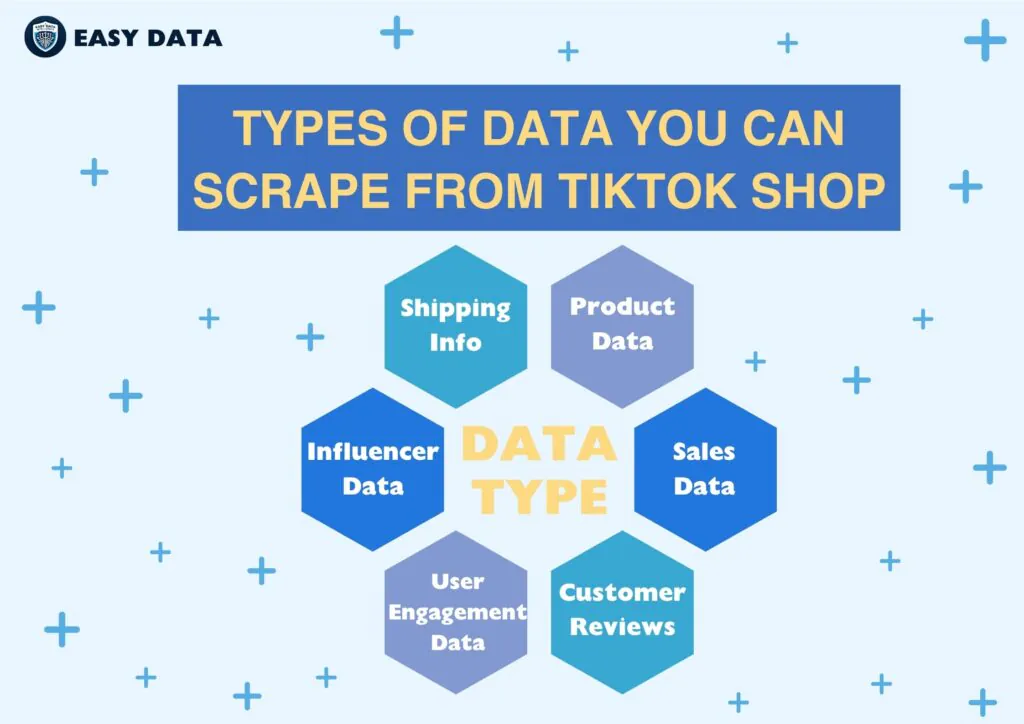
1. Product Data
- Product Titles: Extracting names and descriptions of products helps in tracking competing listings and understanding consumer appeal.
- Prices: Monitoring product prices enables brands to stay updated on market trends and competitor pricing strategies.
- Discounts and Promotions: Scraping data on discounts helps businesses take advantage of promotional opportunities and adjust their marketing tactics accordingly.
- Categories: Tracking product categories provides insight into market segmentation and consumer behavior.
2. Sales Data
- Sales counters: Preserve the source label and reporting period, if documented. Do not treat an unspecified cumulative counter as monthly units sold.
- Changes over time: Compare consistent observations and account for counter resets, refunds, missing records and coverage changes before interpreting a trend.
3. Customer Reviews
- Ratings: Scraping customer ratings gives brands insight into product satisfaction and helps identify areas for improvement.
- Review Content: Analyzing customer reviews provides qualitative insights into consumer experiences and preferences.
4. User Engagement Data
- Likes, Comments, and Shares: Scraping engagement metrics allows businesses to assess the impact of their content and products on users.
- Video Views: Views describe exposure. Calculating conversion rates also needs a defined denominator, attributed completed actions and a consistent time window.
5. Influencer Data
- Influencer Engagement: Compare interaction metrics within their documented definitions; use authorized attribution data separately when evaluating commercial outcomes.
- Sponsored Product Mentions: Scraping data about product mentions in influencer content helps brands assess reach and impact.
Tools and Techniques for TikTok Shop Data Scraping
Choose a collection method after confirming the permitted source and the required fields. The tools below serve different roles; their general capabilities do not prove that a TikTok Shop workflow works in your market or account. Validate a small representative sample before scheduling a larger collection.
1. No-Code Web Scraping Tools
For non-technical users, no-code scraping tools offer an intuitive way to extract data from TikTok Shop without programming knowledge.
Octoparse
Octoparse is a cloud-based web scraping tool that features a user-friendly interface. It allows users to create custom scraping workflows, schedule scrapes, and export data in multiple formats like CSV or Excel. The tool’s visual point-and-click interface makes it accessible for beginners, while its advanced features cater to more experienced users.
ParseHub
ParseHub is another visual web scraping tool that can handle complex websites, including those with dynamic content. It provides a point-and-click interface that enables users to easily define data extraction rules. ParseHub also allows for scheduling and automated scraping, making it suitable for ongoing data collection.
DataMiner
DataMiner is a browser extension for Google Chrome and Microsoft Edge that allows users to scrape data directly from websites. It’s suitable for smaller projects and can be helpful for quick data collection from TikTok Shop. Users can choose from pre-built recipes or create their own to extract specific data points.
2. Python-Based Web Scraping
For more advanced users, Python-based web scraping provides greater flexibility and customization options.
BeautifulSoup
BeautifulSoup is a popular Python library for web scraping. It allows users to parse HTML documents and extract specific data points, making it a powerful tool for scraping product information and reviews from TikTok Shop. BeautifulSoup is especially useful when combined with requests to handle HTTP requests and HTML parsing.
Scrapy
Scrapy provides crawling and extraction infrastructure, but data visible after JavaScript runs may be absent from its initial response. Its dynamic-content documentation explains how to identify the underlying data source or use a browser when necessary. Confirm that your access method is permitted before implementing either approach.
Selenium
Selenium WebDriver automates browsers and has bindings for multiple programming languages, including Python. It can interact with a rendered page, but you still need reliable locators, explicit waits and extraction validation. Browser automation does not guarantee access to a particular TikTok Shop page or permission to collect it.
3. APIs
TikTok Shop has official APIs, including a documented Search Products endpoint. Shop identification, authentication and access requirements matter: review the endpoint and TikTok Shop API calling requirements for the applicable version. Do not interpret an authorized shop integration as unrestricted access to competitors’ private orders or customer data. TikTok’s separate Research Tools FAQ says commercial users are not eligible for those research tools; they are not a general substitute for a commercial shop-data integration. Documentation reviewed October 4, 2026; confirm current scopes and market support before implementation.
Step-by-Step Guide to Scraping TikTok Shop Data
If you’re ready to begin scraping TikTok Shop data, follow this step-by-step guide to get started:
Step 1: Define Your Data Requirements
Define the decision and minimum dataset first: country, currency, shop or product URL, observation time, product and variant identifiers, price meaning, pack quantity, and any counter’s definition. Separate desired fields from fields verified in a sample. Document permitted access, refresh frequency, expected coverage and how missing values will be represented.
Step 2: Choose a Scraping Tool
Select a tool that fits the verified source, authorization and rendering requirements. For a seller-authorized API, confirm the required scopes and endpoint version. For another permitted source, check whether the fields exist in the returned document or require browser interaction. Compare the extracted sample with the visible or documented source before choosing a workflow.
Step 3: Set Up Your Scraper
Once you’ve chosen a tool, set up your scraper to extract the desired data from TikTok Shop. This may involve configuring the tool to navigate the site, selecting specific HTML elements to scrape (like product titles or prices), and testing the scraper to ensure accuracy.
Step 4: Run the Scraper
With everything set up, run your scraper to collect data from TikTok Shop. Depending on the tool, you can schedule scrapes to gather updated information over time.
Step 5: Store and Analyze the Data
Keep an unchanged raw copy and export an analysis copy to a structured format such as CSV or Excel. Preserve long identifiers as text, record currency and timestamps, and separate gifts, bundles and variants before price comparisons. Track rejected and missing records alongside accepted ones so a clean-looking file does not conceal incomplete coverage.
Step 6: Iterate and Optimize
Data scraping is not a one-time task; it’s an ongoing process. Regularly review and refine your scraping strategy based on your findings and market changes. This may involve adjusting the scraping frequency, expanding the data points you collect, or even pivoting your focus based on emerging trends.
Legal and Ethical Considerations
Before scraping data from TikTok Shop, it’s crucial to understand the legal and ethical implications of data scraping:
1. Terms of Service Compliance
Check the terms that apply to your region, account and access route before collecting data. Public visibility alone does not establish permission for automated collection. For API projects, the TikTok Developer Terms tie use to the developer documentation and applicable conditions; shop integrations may have additional requirements. Resolve an unclear permission or proposed use before scaling the project.
2. Respect for Privacy
Minimize personal data and collect only fields needed for the stated purpose. A publicly visible profile, review or identifier can still raise privacy obligations. Define access controls, retention and permitted reuse, and avoid collecting customer contact details or other private records without an appropriate authorized basis.
3. Data Usage Ethics
Use the scraped data ethically and responsibly. Avoid engaging in practices that could mislead consumers, such as using scraped data to undercut competitors unfairly. Maintain transparency with your customers about how you use their data to foster trust.
4. Legal Regulations
Familiarize yourself with relevant data protection regulations, such as the General Data Protection Regulation (GDPR) or the California Consumer Privacy Act (CCPA). Ensure that your scraping practices align with these laws to avoid potential legal repercussions.
Challenges of TikTok Shop Data Scraping
While TikTok Shop data scraping offers numerous benefits, it also presents certain challenges that businesses should be aware of:
1. Technical Barriers
For non-technical users, setting up a data scraping operation can be complex and may require a learning curve to understand the tools and techniques involved. Businesses may need to invest time in training or hire experts to navigate technical challenges.
2. Dynamic Content
TikTok Shop’s content may change frequently, requiring businesses to adapt their scraping strategies continuously. This can complicate the scraping process and require regular adjustments to the scraping setup. Keeping up with changes in site structure or content delivery can be time-consuming.
3. Legal Risks
As mentioned earlier, businesses must navigate legal and ethical considerations when scraping data. Non-compliance with regulations can result in serious consequences, including fines or litigation.
4. Data Quality and Accuracy
Ensuring the accuracy and reliability of scraped data can be challenging, especially if the scraping process is not configured correctly. Businesses must validate their data sources to ensure quality and may need to implement data cleaning processes to address inaccuracies.
For a source-based example, the September 2024 Maybelline TikTok Shop archive shows how gift-labelled listings change a price summary. Its 40 Thailand listings include 16 promotional-gift entries; separating them changes the recorded-price mean, but neither result is an average market price. Classify gifts, bundles and product variants before comparing offers, and keep a single dated snapshot separate from claims about sales trends.
Repeated model codes create a different comparison problem. In the September 2024 Simplus TikTok Shop archive, three KFJH011 listings have different promotional labels and THB prices. The worked example shows why listing URLs should stay separate until variants and bundle contents are checked; a same-day offer difference is not a price trend.
Illustrative Analysis Workflows
1. Example: Fashion Retailer
Illustrative workflow, not a documented client result. A fashion retailer could build a matched-product price panel for one market, keeping size, color, seller, shipping treatment and observation time consistent. Review unmatched variants and promotion conditions before reporting a price difference. Assess any subsequent pricing change with margin and transaction data; the listing panel alone cannot establish increased sales.
2. Example: Beauty Brand
Illustrative workflow, not a documented client result. A beauty analyst could separate gift-labelled entries, bundles and different product types before summarizing a store’s assortment. The historical Maybelline example linked above demonstrates why classification changes a price summary. It does not establish trending hashtags, consumer demand or campaign effectiveness.
3. Example: Home Decor Business
Illustrative workflow, not a documented client result. A home decor business could compare creator content and interaction metrics where access is permitted, then use separately authorized order attribution and campaign costs to evaluate commercial results. Define the observation window and attribution model in advance. Higher engagement alone does not establish higher conversion or return on investment.
Conclusion
TikTok Shop data can support a defined business question when the access route, coverage and field meanings are clear. Choose the method for the available source, preserve identifiers and observation dates, and validate gifts, variants and counters before drawing conclusions.
Start with a small, checked sample and an explicit acceptance rule. Scale only after the collection is permitted, the required fields are available and the output matches the source. Benefits and risks depend on the particular use; this guide does not establish a universal return or justify unrestricted collection.
A useful deliverable includes the raw snapshot, a field dictionary, the cleaning rules and a short limitations note. For assistance, define your target market, fields and refresh requirements with our TikTok Shop data scraping service.
Leave a Reply