


Introduction: Understanding the Uses of Web Scraping
The uses of web scraping include collecting product offers, job postings, property listings and research metadata into a consistent format. A useful project starts with a question and a permitted source, then checks whether the observations are complete and comparable. A scrape is a timestamped observation; it does not automatically provide real-time or representative data.
- Introduction: Understanding the Uses of Web Scraping
- 1. E-Commerce Price Monitoring & Competitor Analysis
- 2. Lead Generation & B2B Sales Prospecting
- 3. SEO & Digital Marketing Insights
- 4. Social Media Sentiment Analysis
- 5. Dropshipping & E-Commerce Automation
- 6. Financial & Stock Market Data Extraction
- 7. Job Market & Recruitment Data
- 8. Travel & Hotel Price Aggregation
- 9. Real Estate Market Insights
- 10. Scientific Research & Academic Studies
- Final Thoughts: Choosing a Useful Application
What Web Scraping Can Support
✔ Automate repeatable collection tasks and record failures.
✔ Compare market observations using consistent definitions.
✔ Support SEO research with measured search data and page audits.
✔ Prepare structured data for analysis, with checks for missing values, duplicates and labeling errors.
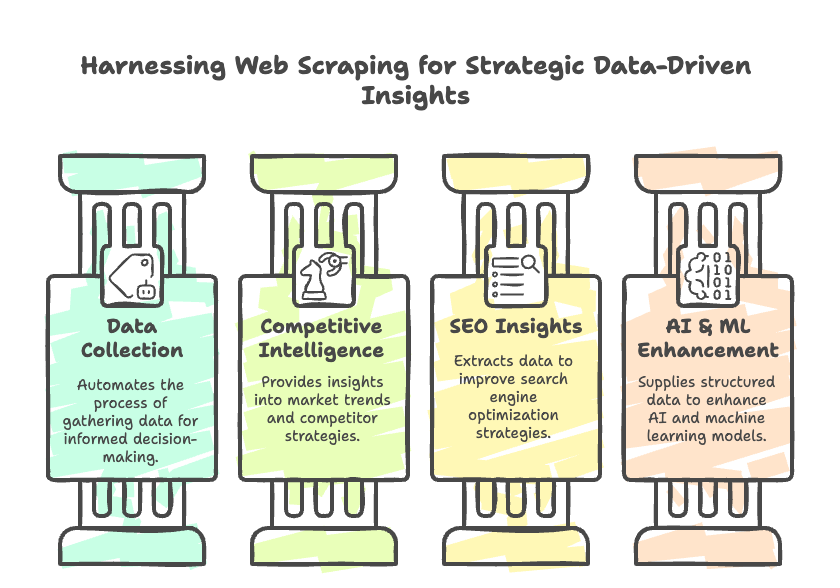
The following ten applications illustrate different decisions and data requirements, rather than a measured ranking. Reviewed October 2, 2026: the references and operational limits below update this originally published guide. Prefer a supported API, licensed feed or export when it meets the need; public visibility alone does not establish permission to collect or reuse content.
1. E-Commerce Price Monitoring & Competitor Analysis
📌 Industry: E-Commerce, Retail, Travel
Price monitoring compares observed offers for the same product and variant. A displayed availability label is not an inventory count, and a promotional price may depend on membership, location or a coupon. For a beauty-retail example, see the source and availability checks in our Sephora data guide.
How It Works:
- Record the source URL, seller, product identifier, variant, currency, displayed price and observation time. Check the source’s supported access method and limits before collection.
- Flag price changes for review against margin floors, fees and stock policy. Collection and analysis do not themselves authorize changes to a live store.
- Capture pack size, shipping charges and discount conditions where available; keep missing charges distinct from zero. Match offers before comparing them.
For a broader decision framework, see our ecommerce market-analysis guide. The fictional price example below shows why headline prices alone can mislead.
Fictional price-comparison example: two offers contain the same product, with no discounts or additional taxes in this invented example. Delivery charges are known for the same destination.
| Field | Offer A | Offer B |
|---|---|---|
| Units per pack | 2 | 3 |
| Displayed pack price | $18 | $24 |
| Delivery per pack | $4 | $3 |
| Delivered cost per unit | $11 | $9 |
Offer A: (18 + 4) ÷ 2 = $11 per unit. Offer B: (24 + 3) ÷ 3 = $9 per unit. B has a higher pack price but a lower delivered unit cost under these assumptions. If pack size or delivery were missing, the normalized comparison would be unknown, not zero. Product equivalence, purchase quantity and discount conditions still need checking in a real comparison. For a worked example of coupon eligibility, see the payable-price comparison in our Momoshop guide.
2. Lead Generation & B2B Sales Prospecting
📌 Industry: Sales, Marketing, Real Estate
Company-level research can help a sales team identify organizations that fit an offer. It should be separated from personal-profile collection, permission to contact someone, and any outreach automation. A directory record is not a qualified lead.
How It Works:
- Start with necessary organization fields such as company name, website, sector, geography and source date; verify stale or conflicting records.
- Define qualification criteria and the applicable contact-permission process before outreach. Do not treat a published email address as an opt-in.
- Deduplicate company records and review a sample for relevance. Measure qualified responses separately from the number of rows collected.
For a practical pilot structure, see our web-scraping applications and coverage checks.
3. SEO & Digital Marketing Insights
📌 Industry: SEO, Digital Marketing, Content Strategy
SEO work can combine audits of accessible pages with search-performance data for a property you control. A collected search-result page describes one query, location, device and time; it is not a universal ranking or a complete view of a competitor’s traffic.
How It Works:
- Use authorized Search Console data to compare your own queries and pages over consistent periods, countries and devices. Its API does not guarantee every underlying data row.
- Inspect titles, headings and internal links to identify navigation or content gaps. Links observed on sampled pages do not establish a complete backlink graph.
- Record topics and structural patterns to inform original content. Copying another page’s text is not evidence of an SEO improvement.
Primary reference: Google Search Console Search Analytics query documentation, including authorization, dimensions and data limits.
4. Social Media Sentiment Analysis
📌 Industry: Brand Management, Consumer Research
An authorized sample of brand mentions or reviews can reveal recurring themes. Platform access, languages, moderation, deleted posts and who chooses to publish all affect the sample; it should not be presented as the opinion of every customer.
How It Works:
- Define the sources, query terms, language, date window and permitted fields; remove duplicates and record the number of usable observations.
- Check sentiment labels against a manually reviewed sample, including sarcasm, mixed opinions and translation errors. Record the labeling rules and disagreements.
- Report theme frequency within the collected sample. Keep engagement counts, sentiment labels and actual business outcomes separate.
Use the same source-and-coverage discipline described in our application evaluation guide before comparing sentiment across periods.
5. Dropshipping & E-Commerce Automation
📌 Industry: E-Commerce, Dropshipping
Supplier monitoring can help identify changes in price, availability and delivery estimates. Prefer a supplier-authorized feed or integration, and retain when each value was observed. A delivery estimate is not a fulfillment guarantee.
How It Works:
- Use currently supported supplier sources. Oberlo is not a current inventory source: Shopify announced its shutdown for June 15, 2022.
- Treat best-seller badges and rankings as source-specific observations, not verified unit sales or proof of future demand.
- Validate product and variant mappings before updating a catalog. Use the store’s authorized integration with review, error handling and rollback for live changes.
Primary reference: Shopify’s Oberlo shutdown announcement. Recheck current supplier support before selecting an integration.
6. Financial & Stock Market Data Extraction
📌 Industry: Finance, Investment, Cryptocurrency
Financial research may collect filings, disclosed financial facts and dated news. These sources differ from licensed market-price feeds; scraping a web page does not establish low-latency, complete or trading-grade prices.
How It Works:
- For price data, document the venue, instrument, currency, timestamp and whether quotes are delayed. Do not use an unverified scrape as a live trading feed.
- Separate publication time from collection time, and distinguish a reported event from commentary. A sample of headlines is not a measure of all investor sentiment.
- For SEC filings, use EDGAR submissions and XBRL APIs where appropriate. Preserve filing identifiers, reporting periods, units and amendments when comparing facts.
Primary reference: SEC EDGAR API documentation. It covers submissions and financial-statement data, with automated-access guidance.
7. Job Market & Recruitment Data
📌 Industry: HR, Recruitment
Job-listing analysis can describe advertised roles, locations and skills in a defined source sample. It does not establish total vacancies, completed hires or the suitability of individual applicants.
How It Works:
- Use authorized job-posting sources and preserve the employer, role, location, posting date and source URL. Deduplicate reposts and cross-posted vacancies where evidence permits.
- For advertised pay, preserve currency, range, pay period and missing values. Compare similar roles and locations; do not interpret missing pay as zero.
- Track changes in unique postings and stated requirements. Keep this market-level research separate from personal candidate profiling or hiring decisions.
See our job-listing collection guide for field and validation checks.
8. Travel & Hotel Price Aggregation
📌 Industry: Travel, Hospitality
Travel comparisons require matching the itinerary or stay conditions. A sample of offers can support comparison, but it cannot guarantee the best available deal across every provider.
How It Works:
- Use supported travel APIs, partner feeds or otherwise authorized sources. Record travel dates, route, passengers, cabin or room type and collection time.
- Compare total payable amounts only when taxes, mandatory fees, baggage and cancellation terms are known and comparable. Mark unknown charges explicitly.
- When studying seasonality, hold booking lead time and travel conditions consistent; changes in the mix of offers can otherwise resemble price changes.
Practical check: save the comparison conditions with every offer and recheck availability before a customer makes a booking.
9. Real Estate Market Insights
📌 Industry: Real Estate, Property Investment
Property listings can describe advertised supply and asking prices in a selected area. Asking prices and rent advertisements are not confirmed transaction prices or independently assessed property values.
How It Works:
- Collect permitted listing fields such as asking price, rent period, property type, size, location and observation date. Preserve currency and units.
- Deduplicate relisted properties and compare similar property cohorts across dates. Report coverage changes and missing fields rather than assuming a market-wide trend.
- Use appropriate official records for completed transactions or legal property status where available; verify definitions and update dates separately from listing claims.
Practical check: label a report “asking prices in the collected listings” when that is what the source supports. Do not relabel it as completed sales or investment returns.
10. Scientific Research & Academic Studies
📌 Industry: Academia, Research Institutions
Research collection can assemble publication metadata or reusable public data for a defined study. Discovery, metadata access and permission to reuse full text are separate questions; record the source and inclusion criteria.
How It Works:
- For PubMed-related workflows, consider NCBI’s E-utilities for search and retrieval. Check the applicable content license and access route separately before collecting full-text papers.
- Deduplicate using stable identifiers such as DOI or PMID where available. Document missing identifiers, database coverage, publication dates and the query used.
- For government datasets, prefer an official download or API and preserve the dataset version, units, geographic scope and reuse terms.
Primary reference: NCBI’s API directory, including E-utilities and PMC services.
Final Thoughts: Choosing a Useful Application
A useful web-scraping project connects a specific decision to a permitted source, a reproducible collection method and checked output. Start with a small pilot, report coverage and missing data, and expand only when the observations answer the original question. More rows alone do not establish better insight.
📩 Need a web scraping solution? Contact Easy Data for expert data extraction services.
Leave a Reply