

Ever noticed a beauty shop just like yours (same price range, same type of products) that somehow always outsells you every time a sale rolls around? It’s not necessarily because their products are better. Often, it comes down to things you haven’t noticed yet: when they adjust prices, how they optimize their storefront, and how they respond to customer demand.
Analyzing beauty competitors isn’t just about glancing at a few products or comparing prices. By tracking the right data and metrics, you’ll start to see the opportunities your competitors are capitalizing on and the gaps they haven’t yet addressed. The 5-step process below will help you analyze beauty competitors on Shopee more effectively and in a more structured way.
Step 1 – Identify the Right Beauty Competitors to Track
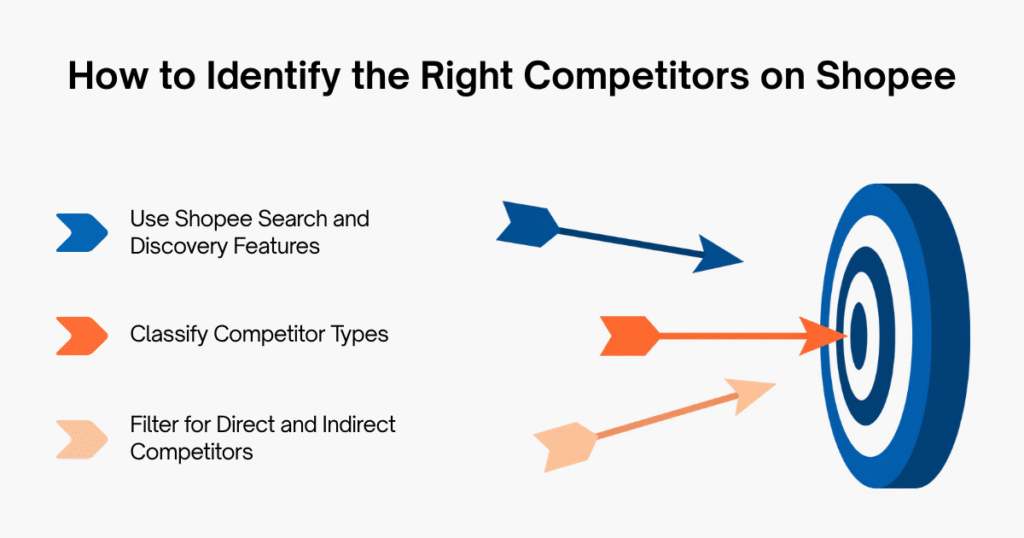
Start by typing your exact product keyword into Shopee’s search bar and see which shops are ranking at the top (both organic results and ads). Then check the “Related Products” or “Customers Also Bought” sections, since these are usually where Shopee surfaces the products and shops that customers naturally compare you against.
Don’t skip the reviews and Q&A section either. If customers keep asking things like “Is this better than [other brand]?”, make a note of that brand; there’s a good chance it’s a competitor your customers are already weighing against you.
In the beauty industry, competitors usually fall into two main groups:
- Official Shopee Mall stores: typically local brands or authorized distributors for K-Beauty and J-Beauty labels.
- Non-official Top Sellers: parallel-import resellers or private-label shops with more flexible pricing.
These two groups compete in different ways:
- Shopee Mall stores lean on brand trust as their advantage
- Top Sellers compete on flexible pricing and being quicker to jump on trending products
When identifying competitors, focus on shops that share the most in common with you: same subcategory (skincare, makeup, hair care…), same product function, same price range, and the same target customer. For example:
- If you sell gel-based sunscreen, other brands selling gel-based sunscreen in the same price range are your direct competitors.
- If you sell acne serum, a brand selling acne patches could still be an indirect competitor, since both products solve the same customer need.
You don’t need to track too many competitors right from the start. About 5–10 shops is enough to analyze in depth while still staying manageable. A simple tracking table like the one below can help you log information as you observe, instead of trying to keep it all in your head:
| Brand / Shop | Core Product | Price Range | Target Customer | Key Strength |
| (Shopee Mall) | Gel sunscreen | 180,000–220,000 VND | Women 20–30, oily skin | Authentic, has SkinCam |
| (Top Seller) | Mini gel sunscreen | 90,000–120,000VND | Women 18–25, low budget | Cheap, fast on new releases |
| … | … | … | … | … |
Step 2 – Benchmark Their Core Sales & Visibility Metrics
The biggest challenge at this step is that Shopee doesn’t make competitors’ sales data public. You can only see detailed figures for your own shop through Business Insights. So when benchmarking competitors, most of what you can do is rely on publicly observable metrics to make a relative assessment.
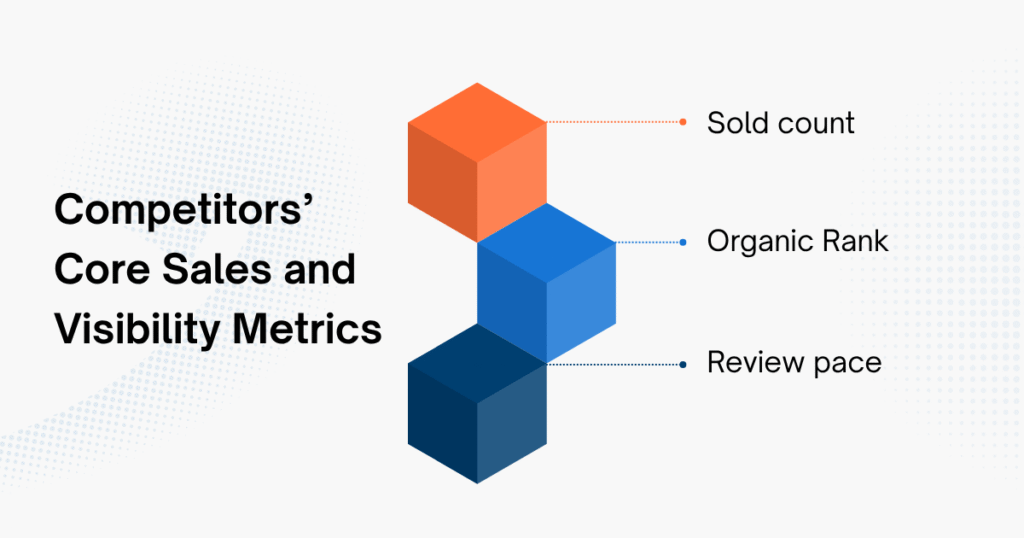
The three most important metrics when you don’t have real sales data:
- The “sold” count displayed under each product is the closest proxy for estimating sales volume. It’s not perfectly accurate, but tracking this number week by week still lets you spot which competitor products are selling better or starting to gain traction.
- Organic Rank when you search the right category keyword, combined with whether the product also shows up in Shopee Ads placements, tells you whether a competitor is focused on organic traffic or investing more heavily in paid ads.
- The volume and pace of new reviews is also well worth tracking. For example, a product that gains 50 new reviews in a month is almost certainly selling better than one that only picks up 3, regardless of what the “sold” count shows.
For the beauty category, the average conversion rate (CR) typically runs at around 2–3% or higher. So if a product has a high Organic Rank but its review count is growing much slower than expected, there’s a good chance most of its traffic is coming from paid ads rather than organic search demand.
Step 3 – Decode Their Pricing & Promotion Patterns
Instead of trying to track competitor prices in real time right away, start with a simpler goal: find the pattern in how they price products and run promotions. Just log the list price and discounted price for a few core SKUs each week for about a month, and you’ll gradually start to notice recurring patterns.
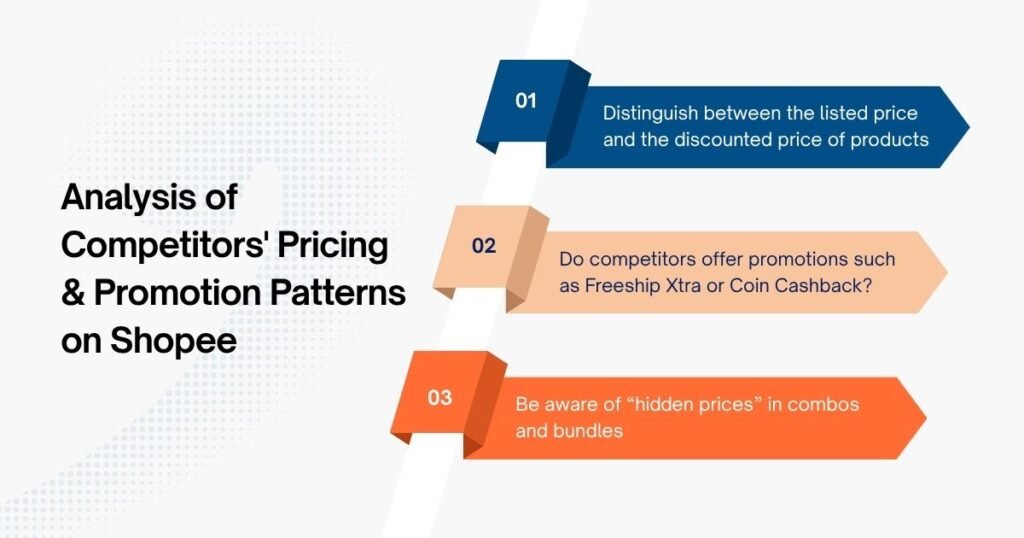
Some competitors slash prices hard on double-date sale days, then hold steady for the rest of the month. Others cut prices only slightly but keep programs like Freeship Extra or Coin Cashback running consistently, to maintain a stable search ranking rather than relying solely on big flash-sale events.
Bundles and combos are also a form of “hidden pricing” you shouldn’t overlook in the beauty category. For example, a shop selling a serum-and-mask combo at a price 15–20% lower than buying separately is actually competing on order value, not the price of each individual product. If you only compare the listed price of a single SKU, it’s easy to misread a competitor’s real pricing strategy.
At this stage, you don’t need automated price-tracking tools yet. A simple spreadsheet logging the date, price, and promotion type for each competitor is enough to help you spot trends after a few weeks of observation.
If you need to track price changes continuously in real time, see Monitor Beauty Product Prices Like Top Brands for more details.
Step 4 – Audit Competitors’ Product Content & Mine the Reviews
Going back to the 5–10 competitors you identified in Step 1, this is where you take a close look at how they build their storefront and product content. Start by examining their listings:
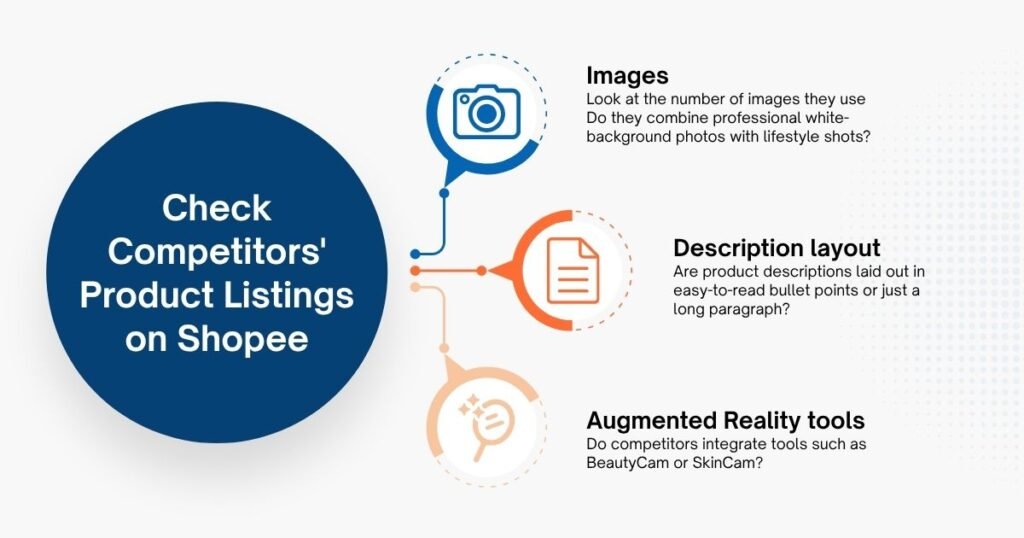
- How many images do they use?
- Do they mix white-background photos with lifestyle shots?
- Are product descriptions laid out in easy-to-read bullet points or just a long paragraph?
In the beauty category, there’s one more thing worth watching: the AR tools your competitors are using. For instance, do they integrate BeautyCam so customers can try on lipstick or foundation shades, or SkinCam to analyze skin condition with AI? These features help customers shop with more confidence, especially for products that come in many shades or need to be chosen based on skin condition.
The most insight-rich part of this step is the one most people tend to skip: 1–3 star reviews. Instead of just looking at the average rating, filter out the low-star reviews and look for the issues customers mention over and over again.
In the beauty category, negative feedback usually circles around a few familiar issues: packaging that leaks during shipping, products irritating or not suiting certain skin types, actual color not matching the photos (especially for lipstick and foundation), or a size that feels smaller than expected for the price.
If one issue keeps showing up across reviews, that’s an opening for you to stand out. For example, you could improve your packaging to prevent leaks, add photos that show true-to-life color, or clearly state the suitable skin type right in the product title and description to help customers decide more easily.
The goal at this step is to analyze each competitor individually to understand their strengths and shortcomings. If you want to widen the lens and find gaps across the whole market, you can check out Guide to Identifying Beauty Market Opportunities Using Data.
Step 5 – Automate Competitor Tracking With the Right Tools
Shopee Seller Center only shows data for your own shop. Whether you’re a Shopee Mall or a regular store, Business Insights doesn’t give you competitor figures either. So if you do all 4 steps above entirely manually, tracking 5–10 competitors on an ongoing basis will eat up a significant amount of your time.
In this case, third-party data scraping services would be the appropriate choice. These solutions can automatically collect competitor pricing, stock levels, reviews, and rankings on a set schedule, so you no longer have to check each shop manually. Depending on your needs, you can choose the update frequency that fits: hourly to track prices during sale season, or weekly for data like listings and follower counts.
When automating this process, only collect data that’s publicly available, such as prices, stock levels, and reviews. Don’t try to access competitor accounts, bypass Shopee’s limits, or use fake orders and fake reviews (doing so violates the platform’s policies and makes your analysis results unreliable).
If you want to save even more time, you can turn to Beauty Market Intelligence systems. Instead of collecting and analyzing data yourself, these platforms already compile market and competitor insights for you to follow. In exchange, that extra convenience usually comes with a bigger investment cost.
Conclusion
Competitor analysis isn’t something you do once or twice and then set aside. The beauty market on Shopee moves fast; a shop that looks like it hasn’t changed all month can still swap out its product photos, adjust prices, and pull ahead right after a single sale event.
What sets you apart isn’t whether you analyze competitors, but whether you turn it into a habit. Spend just a little time each week tracking the changes that matter, and you’ll soon start spotting new trends, catching opportunities before your competitors do, and making decisions based on data instead of gut feeling.
Leave a Reply