
If you want to learn how to scrape Shopee data without coding, there are several practical approaches available. Even users without technical expertise can scrape Shopee data for market intelligence using manual collection methods, no-code data extraction tools, data extraction APIs, or specialized data providers. In this guide, we’ll walk through practical ways to scrape Shopee data without programming knowledge, and explain which approach works best depending on your needs.
What Data Can Be Scraped From Shopee
Shopee contains a wide variety of structured marketplace data that can be extracted and analyzed. Different scraping techniques collect different fields. Here are some of the most common datasets:
| DATA FIELD | DETAIL |
| Product data | Product name Category Price Discount and promotion details Stock availability |
| Seller data | Store name Seller rating Number of products Store performance metrics |
| Review data | Customer ratings Review text Feedback trends |
| Search data | Keyword rankings Search trends Popular products per query |
| Pricing data | Historical price changes Competitor price monitoring |
Why Businesses Scrape Shopee Data
Businesses that learn how to scrape Shopee data can transform marketplace activity into actionable insights. Product listings, pricing signals, and seller performance data help ecommerce teams understand market trends and competitor strategies.
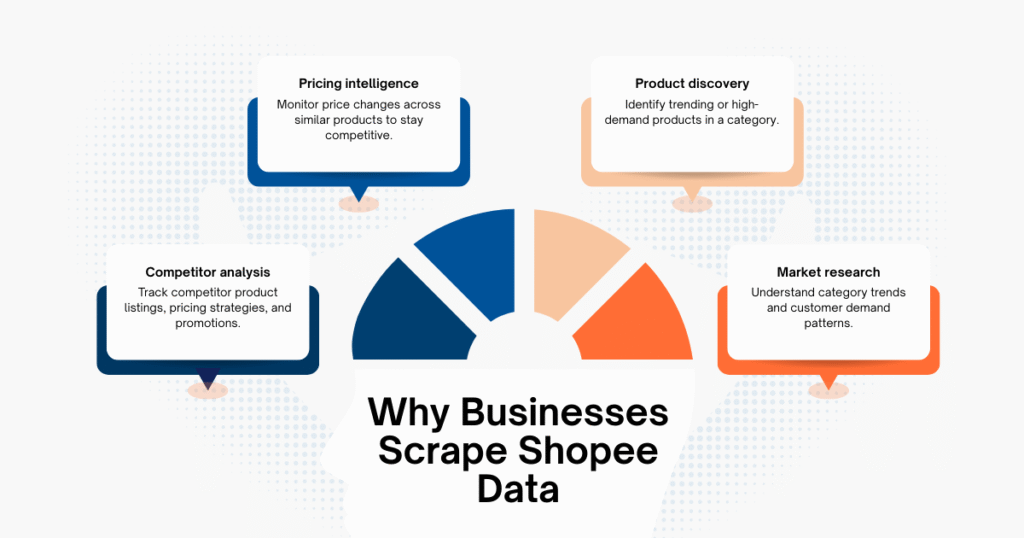
Here are the most common use cases:
- Competitor analysis: Track competing listings, pricing strategies, and promotions by analyzing marketplace data when businesses scrape Shopee products and monitor product performance across different stores.
- Pricing intelligence: Monitor price changes across similar products to stay competitive when teams analyze marketplace positioning across product categories.
- Product discovery: Identify trending or high-demand products by observing seller activity and product listings across the platform.
- Market research: Understand customer preferences and product satisfaction patterns by collecting feedback data when analysts scrape Shopee reviews and analyze sentiment trends.
For many ecommerce sellers and analysts, learning how to scrape Shopee data is essentially a shortcut to better business decisions.
Ways to Scrape Shopee Data Without Coding
Many guides focus only on Python scripts or Selenium tutorials. In reality, businesses today have several alternative methods to scrape Shopee data without writing code.
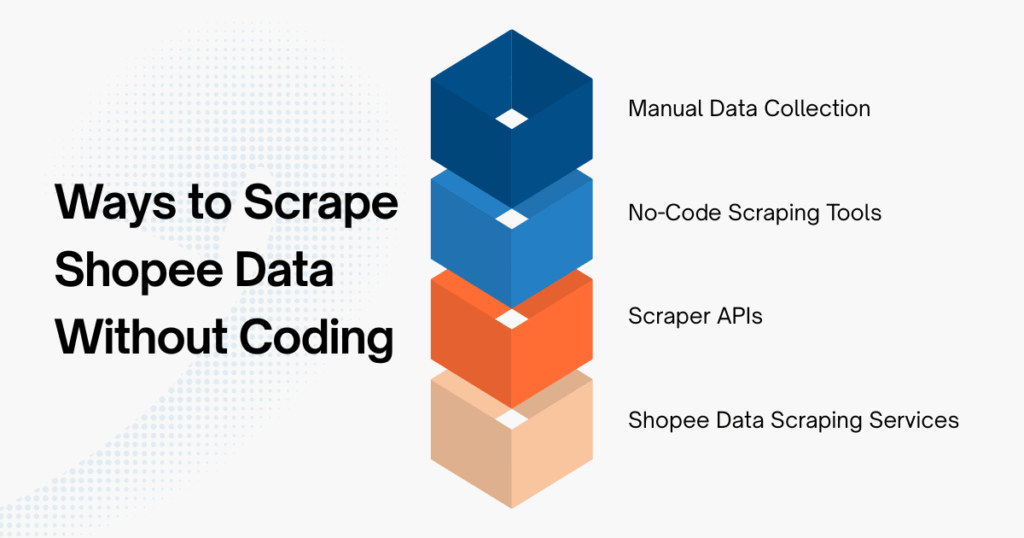
Manual Data Collection
In this approach, users simply browse Shopee pages and copy product information into spreadsheets. This may include product names, prices, seller ratings, or review counts.
For very small datasets, perhaps a competitor check involving a few products, this method can work. However, manual scraping quickly becomes impractical when dealing with large product catalogs. Shopee pages update frequently, and copying data by hand makes it difficult to track trends over time. Manual collection is therefore best suited for quick one-off checks, not ongoing data analysis.
Using No-Code Scraping Tools
A more scalable option is using no-code scraping tools. These platforms allow users to extract website data visually without writing scripts. Instead of coding selectors, you simply click elements on a page and define the data fields you want to collect. Common examples include:
| Tool | Key Features | Best For |
| Octoparse | Visual point-and-click scraping, built-in templates, cloud extraction, and scheduling | Beginners and business users who need automated scraping without coding |
| Parsehub | Handles dynamic websites with JavaScript rendering, advanced workflow logic | Medium-scale scraping projects and complex page structures |
| Instant data scraper | Lightweight Chrome extension, automatic data detection, quick table extraction | Quick data extraction and small experiments directly in the browser |
| Dataminer | Extract structured lists and tables, prebuilt scraping recipes | Small to medium data collection tasks and non-technical users |
| Browse ai | AI-assisted data extraction, automated monitoring, workflow automation | Tracking product changes or collecting data continuously from webpages |
Most no-code scrapers follow a visual workflow:
- Load a Shopee product or category page.
- Select the data fields (price, title, rating, etc.).
- Define pagination rules.
- Export results to CSV or Excel.
This approach makes it much easier for non-technical users to start Shopee data scraping. However, no-code tools still have limitations: Shopee’s dynamic content, anti-scraping measures, and large datasets can make visual scrapers unstable or slow when scaling up.
Using Scraper APIs
Another option for scraping Shopee data without coding is using a scraper API platform. Scraper APIs handle the technical side of web scraping (proxies, request management, and parsing infrastructure) while users simply send requests to retrieve structured data.
In many cases, these APIs provide ready-made endpoints for:
- Product information
- Seller profiles
- Product listings
- Price data
The advantage of APIs is reliability. They automate large parts of the scraping process and allow continuous data collection. However, APIs still require some technical integration. Even if coding is minimal, users usually need to configure requests or connect the API with analytics tools.
Using Shopee Data Scraping Services
For organizations that require large-scale datasets, the most efficient approach is outsourcing the entire scraping process. A Shopee data scraping service manages everything behind the scenes:
- Crawler infrastructure
- Proxy management
- Anti-bot handling
- Data cleaning
- Dataset delivery
This approach is especially useful when collecting data across thousands or millions of products. It also ensures the dataset is structured, consistent, and ready for analysis.
Why Many Businesses Choose Shopee Data Providers
When companies first explore how to scrape Shopee data, they often start with manual methods or scraping tools. But as their data needs grow, they encounter several limitations.
Large-scale ecommerce analytics requires: reliable data pipelines, consistent dataset structure, continuous updates, and large-volume crawling capacity. Building this infrastructure internally can be time-consuming and technically demanding.
Data providers solve this problem by delivering ready-to-use datasets while maintaining the scraping infrastructure themselves.
| Advantage | Why it matters |
| Scalability | Scrape thousands or millions of products |
| Clean datasets | Structured fields ready for analysis |
| Automation | Continuous updates without manual scraping |
| Reliability | Stable data collection pipelines |
In practice, this allows analysts can spend their time interpreting market trends, competitor strategies, and product demand instead of maintaining scraping infrastructure or fixing broken data pipelines.
Shopee Data Scraping With Easy Data
For companies that need consistent access to marketplace data, providers like Easy Data provide a streamlined alternative to traditional scraping tools.
Easy Data specializes in collecting and structuring large-scale ecommerce datasets across Southeast Asian marketplaces, including Shopee. Instead of manually scraping pages, businesses can access structured datasets covering:
- Product listings
- Seller information
- Pricing history
- Marketplace trends
- Keyword search data
This approach is particularly useful for ecommerce teams running competitor monitoring, product research, or pricing intelligence projects.
If your team needs reliable Shopee datasets at scale, exploring a dedicated Shopee data scraping service can significantly reduce the time and technical overhead required to collect and maintain marketplace data.
Conclusion
Understanding how to scrape Shopee data without coding allows ecommerce teams and analysts to access valuable marketplace insights without technical barriers.
Shopee offers a rich source of data on products, sellers, pricing, and customer behavior. Depending on the scale of your needs, data can be collected through manual methods, no-code scraping tools, APIs, or automated platforms.
For businesses that require reliable datasets at scale, working with a specialized data scraping service can be the most efficient approach. Access to structured marketplace data ultimately helps companies identify opportunities, respond faster to market changes, and make more informed strategic decisions.
Leave a Reply