


Shopee generates one of the most comprehensive ecommerce data ecosystems in Southeast Asia. Yet for most organizations, the real challenge is not accessing Shopee big data, but understanding how to apply it meaningfully in market analysis and business intelligence. Rather than treating this Shopee-scale data as a technical asset, this article examines how it is used in practice to answer real business questions. The focus is on applications that support decision-making, competitive understanding, and long-term market strategy.
How Large-Scale Shopee Data Translates Into Market Intelligence
At scale, Shopee data becomes more than a collection of listings or transactions. When aggregated, structured, and analyzed over time, it provides a market-level perspective that supports deeper analytical reasoning.
This section explains how large-scale Shopee data functions as an input to market intelligence, connecting raw marketplace signals with the types of insights business intelligence teams rely on for strategic analysis (often framed through broader Shopee business insights).
Shopee big data represents more than large volumes of product listings or transactional signals. When structured and analyzed correctly, it provides a system-level view of how markets evolve, how competition forms, and how demand shifts over time.
For market analysis and business intelligence teams, the value of this Shopee big data lies in its breadth, continuity, and granularity. It enables analysts to move beyond isolated snapshots and instead observe patterns across categories, sellers, pricing structures, and consumer behavior.
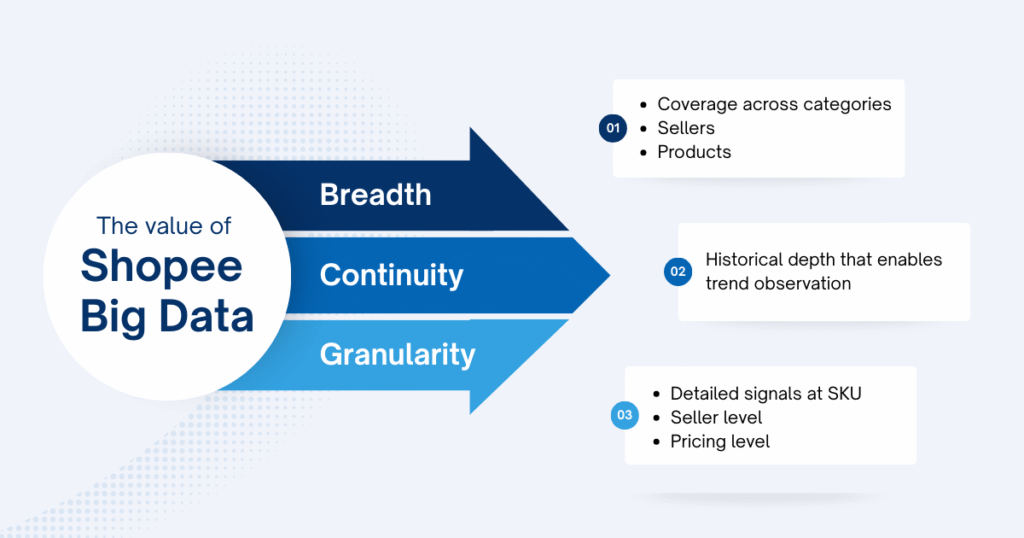
In practice, transforming this Shopee-scale data into actionable market intelligence requires a stable and consistent data foundation. This is why many analytics teams rely on specialized data infrastructure (often supported by Shopee data providers such as Easy Data), to ensure coverage, historical depth, and analytical reliability before insights are generated.
Key Market Intelligence Use Cases Enabled by Shopee Big Data
Once Shopee big data is translated into a reliable analytical foundation, its value emerges through specific, repeatable applications. These use cases reflect how organizations apply marketplace data to answer concrete business questions rather than generate descriptive reports.
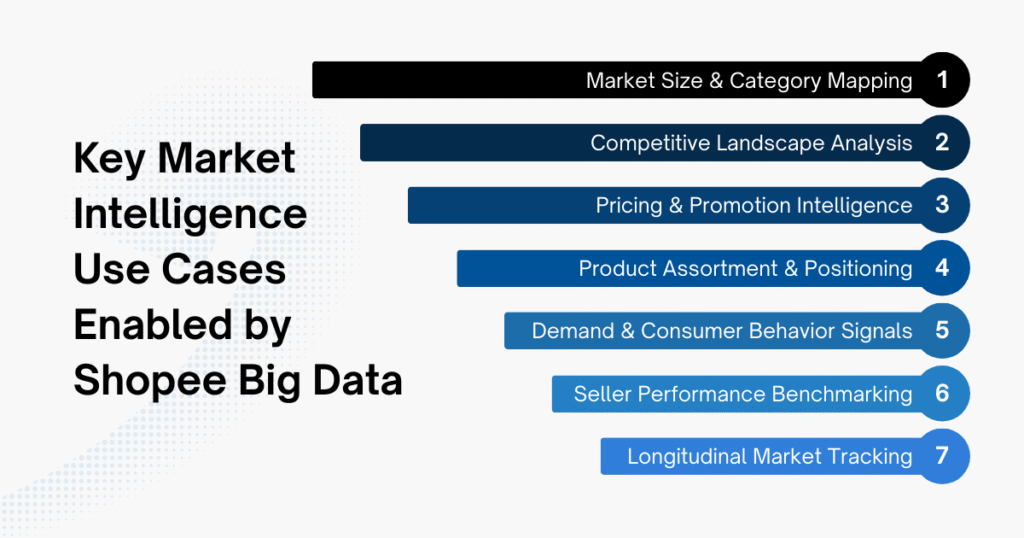
The following seven applications illustrate where Shopee-scale data most consistently supports market analysis and business intelligence across categories, competitive environments, and time horizons.
1. Mapping Market Size and Category Growth Dynamics
- Business question: How large is a Shopee market segment, and is it expanding or reaching saturation?
Using Shopee big data, analysts can assess category size by examining total listings, seller participation, and product turnover over time. Rather than relying on revenue estimates alone, category-level data reveals whether growth is driven by genuine demand or simply by an increase in supply.
- Insight generated: Clear differentiation between structural growth, temporary spikes, and stagnant categories.
- Decision impact: Supports market entry decisions, investment prioritization, and category expansion planning.
2. Understanding Competitive Structure and Seller Concentration
- Business question: Is competition fragmented or dominated by a small number of sellers?
Shopee big data allows businesses to analyze seller distribution, revenue concentration, and ranking stability across categories. Tracking how seller positions change over time reveals whether competitive advantages are durable or easily disrupted, a dynamic commonly observed in large digital platform markets.
- Insight generated: Understanding of competitive intensity, entry barriers, and consolidation trends.
- Decision impact: Informs competitive positioning, partnership strategy, and go-to-market planning.
3. Interpreting Pricing Structures and Market Positioning Signals
- Business question: How is price structured within a category, and where do competitive pressures concentrate?
By analyzing price distributions, discount behavior, and price band saturation, this Shopee big data exposes the true pricing logic of a market. This goes beyond average prices to show where competition is most intense and where differentiation is possible.
- Insight generated: Identification of overcrowded price tiers and underexplored positioning opportunities.
- Decision impact: Guides pricing strategy, margin planning, and product differentiation.
At scale, analyses like these depend on consistent category coverage, deduplicated listings, and historical price tracking, capabilities often supported through managed Shopee data scraping services designed for long-term analytical use.
4. Identifying Product Assortment Patterns and Feature Trends
- Business question: Which product features or attributes are shaping demand?
Shopee big data enables detailed analysis of product attributes, variants, and feature frequency across time. Tracking how certain features become standardized (or lose relevance) helps businesses anticipate shifts in consumer expectations.
- Insight generated: Early detection of emerging features and commoditization signals.
- Decision impact: Informs product roadmap decisions and feature prioritization.
5. Monitoring Demand Signals Through Sales Velocity Patterns
- Business question: How is demand evolving across categories and products?
By observing sales velocity, review activity, and stock turnover, Shopee big data reveals demand momentum beyond surface-level sales figures. This distinction is critical for separating short-term spikes from sustained demand growth.
- Insight generated: Clear signals of demand acceleration, decline, or seasonal behavior.
- Decision impact: Improves inventory planning, forecasting accuracy, and campaign timing.
6. Evaluating Promotional Impact and Campaign Effectiveness
- Business question: Do promotions create real growth or temporary volume shifts?
Shopee big data allows analysts to compare pre- and post-campaign performance, measure price elasticity, and detect cannibalization effects. This helps businesses understand whether promotions generate incremental value or simply redistribute demand.
- Insight generated: Transparent evaluation of promotional effectiveness.
- Decision impact: Supports smarter budget allocation and campaign design.
7. Observing Long-Term Market Evolution for Strategic Forecasting
- Business question: Where is the Shopee market heading over the long term?
When analyzed longitudinally, this Shopee-scale data provides visibility into category life cycles, seller churn, and structural market shifts. These patterns are essential for strategic forecasting and long-term investment decisions.
- Insight generated: Recognition of maturity stages, emerging opportunities, and declining segments.
- Decision impact: Guides long-term strategy, market entry timing, and portfolio management.
Final Thoughts
Shopee big data is most valuable when it is treated as a strategic asset rather than a raw dataset. Its true power lies in supporting informed decisions across market analysis and business intelligence, from competitive positioning to long-term forecasting.
When applied thoughtfully, this Shopee-scale data becomes more than information, it becomes a durable lens through which businesses understand markets, anticipate change, and act with confidence.
Leave a Reply