

Shopee prices change constantly due to Flash Sales, vouchers, campaign promotions, and SKU-level pricing strategies. As a result, for businesses implementing pricing intelligence, simply monitoring the price displayed on the product page is often not enough for deeper analysis.
In this article, Easy Data focuses on the data layer behind Shopee price scraping: how to work with returned responses, which pricing fields should be stored, and how to structure data properly for large-scale Pricing Intelligence systems.
What is Shopee Price Scraping?
Shopee price scraping is the process of automatically collecting product pricing data from Shopee at scale and in near real time. The collected data may include current prices, pre-discount prices, discount rates, SKU-level pricing information, and historical price movements over time.
For businesses, the goal of Shopee price scraping is not simply to track a single marketplace price. More importantly, the system should capture the pricing signals behind each product and build a historical dataset for market analysis.
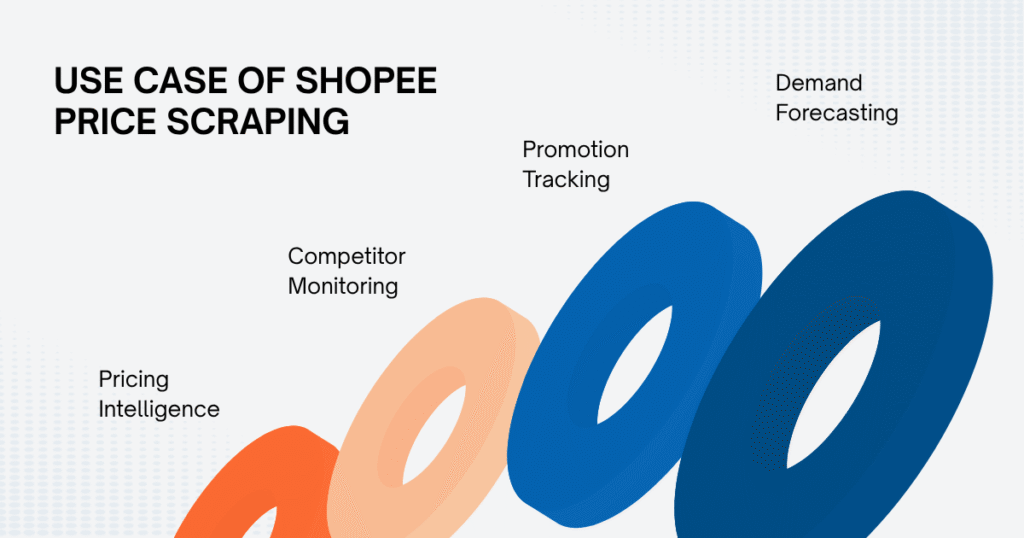
When collected and stored consistently over time, this data supports use cases such as pricing intelligence, competitor monitoring, promotion tracking, and demand forecasting. However, for dynamic pricing systems or automated decision-making workflows, pricing data should still be validated across multiple sources and time periods.
Which Shopee Pricing Data Matters Most for Pricing Intelligence?
Many businesses starting with Shopee price scraping focus only on collecting the product’s current selling price. While simple, this approach often misses important context behind the numbers.
A Shopee product may have multiple variations, such as color, storage capacity, size, or bundle type. Each variation can have its own price, inventory level, and promotional program. In addition, some sellers may display the lowest possible price to attract clicks, even though that price only applies to a less popular or limited-quantity SKU.
For more accurate analysis, pricing data should generally be separated into two main groups: SKU-level and item-level.
SKU-Level Data
SKU-level data reflects the price of each specific product variation.
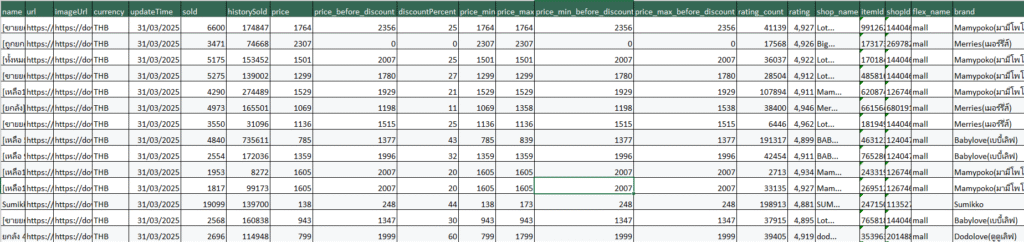
| Field | Purpose for Pricing Analysis |
|---|---|
price / current_price
|
Current selling price of a specific SKU |
price_before_discount |
Original price before discount if available in the response |
discount_percent |
Discount percentage calculated from the original and current prices. This is a reference metric and may differ from the discount displayed on Shopee |
stock |
Inventory quantity of the SKU if available |
model_id, model_name, sku
|
SKU identifiers and names used to track price history over time |
For example, a smartphone may display a price range of $300–$450, but the 256GB version may be the SKU receiving the deepest discount. Focusing solely on the product-level price could cause businesses to miss this important promotional signal.
Item-Level Data
Item-level data provides a broader view of the product as a whole rather than individual variations.
| Field | Purpose for Pricing Analysis |
|---|---|
price_min / price_max
|
Lowest and highest price across all variations |
price_min_before_discount / price_max_before_discount
|
Pre-discount price range if available |
sku_count |
Number of product variations detected |
lowest_sku_price / highest_sku_price
|
Lowest and highest prices recalculated from SKU data for validation against item-level ranges |
These metrics are particularly useful for competitor monitoring. In many cases, the lowest displayed price serves mainly as a click-attraction mechanism, while the best-selling SKU is actually priced much higher. Storing both item-level and SKU-level data allows analysts to validate these assumptions instead of relying on a single displayed price.
How to Scrape Key Pricing Fields for Pricing Intelligence
When performing Shopee price scraping, pricing information is typically returned alongside other product-related data such as variations, inventory levels, and promotions. Therefore, instead of storing only a single price value, businesses should extract and structure the relevant fields during data collection so they can support future Pricing Intelligence initiatives.
The example below demonstrates how Python can be used to collect and normalize key pricing fields from a Shopee product response:
Copied!import requests PRICE_DIVISOR = 100000 def normalize_price(value): if value is None: return None return value / PRICE_DIVISOR def calculate_discount(price_before_discount, current_price): if not price_before_discount or current_price is None: return None return round( (price_before_discount - current_price) / price_before_discount * 100, 2 ) def scrape_shopee_price_fields(shop_id, item_id): """ Example of collecting key pricing fields from Shopee for Pricing Intelligence. This example focuses on price fields collected at: SKU Level and Item Level. """ url = "https://shopee.vn/api/v4/pdp/get_pc" response = requests.get( url, params={ "shop_id": shop_id, "item_id": item_id, }, headers={ "User-Agent": "Mozilla/5.0", "Accept": "application/json", }, timeout=10, ) response.raise_for_status() raw_data = response.json() item = raw_data.get("data", Array).get("item", Array) # 1. SKU Level: actual prices for each variation sku_level_prices = [] for model in item.get("models", []): current_price = normalize_price(model.get("price")) price_before_discount = normalize_price( model.get("price_before_discount") ) sku_level_prices.append({ "model_id": model.get("modelid"), "model_name": model.get("name"), "sku": model.get("sku"), "current_price": current_price, "price_before_discount": price_before_discount, # Reference metric that may differ from Shopee's displayed discount "discount_percent": calculate_discount( price_before_discount, current_price ), "stock": model.get("stock"), }) sku_prices = [ sku["current_price"] for sku in sku_level_prices if sku["current_price"] is not None ] # 2. Item Level: overall product price range item_level_price = { "item_id": item.get("itemid"), "shop_id": item.get("shopid"), "product_name": item.get("name"), "price_min": normalize_price(item.get("price_min")), "price_max": normalize_price(item.get("price_max")), "price_min_before_discount": normalize_price( item.get("price_min_before_discount") ), "price_max_before_discount": normalize_price( item.get("price_max_before_discount") ), "sku_count": len(sku_level_prices), "lowest_sku_price": min(sku_prices) if sku_prices else None, "highest_sku_price": max(sku_prices) if sku_prices else None, } return { "item_level": item_level_price, "sku_level": sku_level_prices, }
In the example above, pricing data is separated into two main groups:
- SKU Level: Stores current prices, pre-discount prices, inventory levels, and other variation-specific attributes.
- Item Level: Stores the overall product price range for validation and pricing strategy analysis.
Maintaining both layers of data enables businesses to track changes in pricing, promotions, and product structures more accurately over time instead of relying on a single displayed price.
Challenges in Shopee Price Scraping for Pricing Intelligence
Building a parser and normalizing pricing data is only one part of the Shopee price scraping process. At scale, the real challenge lies in maintaining a stable and reliable data pipeline over time.
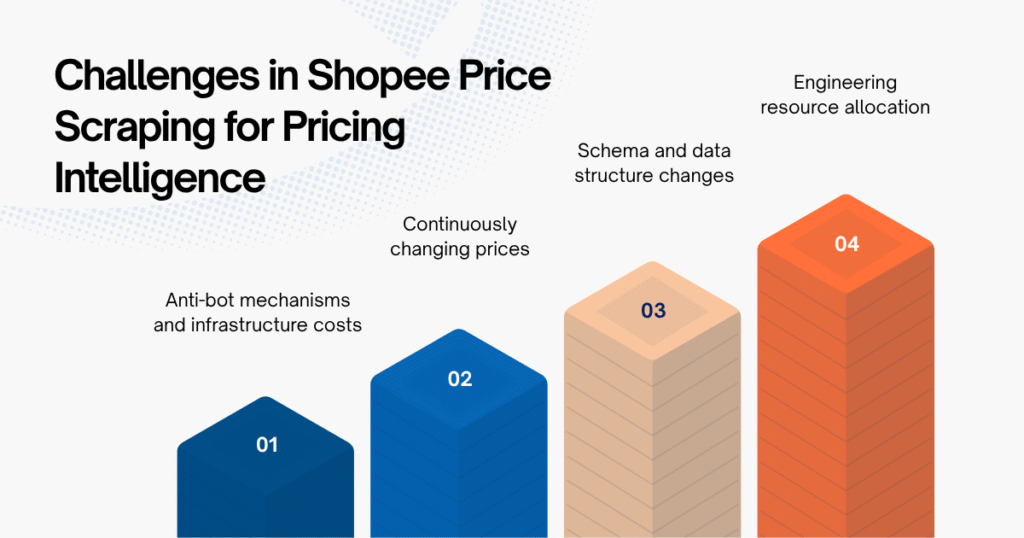
- Anti-bot mechanisms and infrastructure costs: Shopee continuously strengthens automated access controls through rate limiting, CAPTCHA, IP blocking, and authentication changes. As Shopee scraping volume grows, businesses often need additional investment in proxies, monitoring, and infrastructure to keep pipelines stable.
- Continuously changing prices: Shopee prices are highly dynamic. Flash Sales, vouchers, campaign promotions, and SKU-level pricing strategies can cause multiple price changes throughout the day. If collection frequency is not aligned with business needs, important pricing signals may be missed.
- Schema and data structure changes: Even when a Shopee price scraping system runs smoothly, data structures and response formats can change over time. Without proper monitoring and validation, data quality issues may emerge gradually without immediate detection by the analytics team.
- Engineering resource allocation: The ultimate goal of pricing intelligence is to support market analysis and pricing decisions. However, teams managing their own Shopee price scraping infrastructure often spend substantial time maintaining crawlers, resolving pipeline issues, and monitoring data quality instead of focusing on higher-value analytical work.
Shopee Data Solutions from Easy Data
Writing a crawler for Shopee price scraping is usually not the hardest part. The real complexity appears when the system must scale, remain stable over time, and consistently deliver high-quality data. This is why many businesses choose to outsource data collection infrastructure instead of building and maintaining a full scraping stack internally.
Easy Data provides specialized Shopee data scraping services for businesses implementing pricing intelligence, competitor monitoring, and market intelligence initiatives.
Key benefits include:
- Analysis-ready structured data: Pricing data is normalized and organized across both Item Level and SKU Level, including current prices, pre-discount prices, promotional signals, and related analytical fields.
- Reliable data pipelines: Easy Data manages the collection infrastructure, platform access changes, query limitations, and other technical updates.
- Continuous data quality monitoring: The system monitors schema and structural changes to reduce the risk of data disruption and quality degradation.
- More time for analysis: Instead of spending resources on crawlers, proxies, and pipeline operations, data teams can focus on market analysis, pricing optimization, and forecasting models.
Depending on business requirements, data can be delivered through scheduled files or integrated directly into existing data warehouses and BI platforms.
Conclusion
Shopee price scraping is more than just collecting prices. For Pricing Intelligence systems, the more important challenge is how pricing data is structured, stored, and monitored over time.
A single price point rarely reflects the full pricing strategy behind a Shopee listing. For more accurate analysis, businesses should track both item-level and SKU-level data while preserving signals related to promotions, inventory, and historical price changes.
When organized correctly, pricing data becomes more than a competitor monitoring tool, it becomes a foundation for market analysis, demand forecasting, and long-term pricing optimization.
Leave a Reply