


In the fast-moving world of e-commerce, adhering to Minimum Advertised Price (MAP) is crucial to maintaining a fair and competitive marketplace. Yet, this policy contains multiple loopholes that allow retailers (intentionally or unintentionally) to bypass the rules. This article explains how real-time insights uncover these weaknesses, while offering practical solutions to strengthen compliance and build a more transparent, fair, and sustainable digital commerce environment.
What is the Minimum Advertised Price?
Minimum Advertised Price is the lowest price a product is allowed to be publicly displayed or advertised on retail platforms. MAP is not the actual selling price, it is the minimum visible price (advertised floor price) used to protect brands from price wars and prevent value erosion. Example:
- A brand sets the MAP of a shirt at $20
- Seller A wants to sell it at $19 to VIP customers → Allowed
- But Seller A displays $19 on marketplaces, websites, banners, or social media → MAP violation
How is MAP different from MSRP and MRP?
Many businesses confuse MAP with MSRP and MRP because all three relate to “retail pricing,” but they serve completely different purposes. Misunderstanding any of these terms can lead to incorrect MAP setup, inaccurate price monitoring, and misjudgment of retailer violations on e-commerce platforms.
| MAP | MSRP | MRP | |
| Definition | Minimum Advertised Price controls publicly displayed prices, not actual selling price | Manufacturer’s Suggested Retail Price – recommended but not enforced | Maximum Retail Price – the highest permissible selling price |
| Applies to | All retailers | Retailers | Mostly India and some markets |
| Regulated by | Brand or manufacturer | Brand or manufacturer | Law or manufacturer |
| Requirement | Cannot display a price below MAP on any channel | Not mandatory | Cannot sell above MRP |
| Actual selling price | Can be lower (as long as not advertised publicly) | Can be higher or lower | Must be lower |
| Purpose | Maintain price consistency, protect brand image, prevent public price erosion on e-commerce | Provide price reference, help consumers understand product value | Protect consumers from excessive pricing, ensure maximum transparency |
Why Monitor The Minimum Advertised Price?
In e-commerce, minimum advertised price acts as a price-regulating mechanism to ensure consistent pricing across retailers, regardless of their size or competitive strategies. Because online prices can change every minute and sellers often reduce prices to capture traffic or win the Buy Box, MAP helps brands maintain control over public pricing to prevent destructive price wars.
MAP also protects brand value. A premium product displayed at an unusually low price due to a single rogue seller can create doubts about quality and distort consumer perception. MAP keeps the brand properly positioned, while stabilizing the distribution ecosystem so wholesalers and retailers can confidently invest in marketing, inventory, and service without fear of being undercut.
Additionally, MAP becomes the foundation for real-time price monitoring, enabling brands to quickly detect violations, respond promptly, and prevent broader disruption across the distribution network.
Minimum Advertised Price is not a sales restriction, it is a protective framework that keeps the e-commerce ecosystem healthy. That is why it requires continuous, accurate monitoring.
Why MAP Is Often Not Applied Correctly in E-commerce
Although minimum advertised price is a widely accepted standard, many businesses struggle to implement it effectively due to marketplace characteristics such as dynamic pricing (flash sales, vouchers, automatic discounts), algorithm-driven displayed prices, and frequent price changes made by sellers. These complexities make MAP monitoring difficult and prone to errors.
How MAP works in e-commerce
The minimum advertised price process typically includes five key stages, from policy creation to violation enforcement. However, on platforms like Shopee, Lazada, or TikTok Shop, the process becomes far more complex than expected.
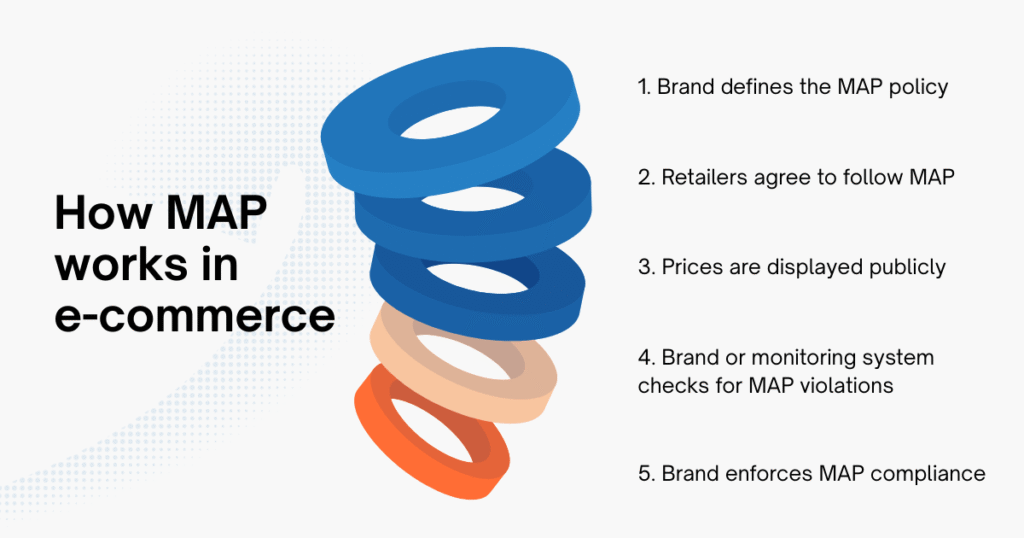
- Brand defines the MAP policy: The brand establishes MAP rules, including minimum advertised prices, scope, and enforcement mechanisms.
- Retailers agree to follow MAP: Retail partners must confirm compliance to ensure clarity and alignment across the sales ecosystem.
- Prices are displayed publicly across e-commerce channels: Retailers list their prices on Shopee, Lazada, TikTok Shop, and other online channels, each with its own discount algorithms and promotional structures.
- Brand or monitoring system checks for MAP violations: Prices are compared against MAP. Because data changes by the minute, real-time monitoring is essential to avoid missing violations.
- Brand enforces MAP compliance (warnings, penalties, delisting): Violations are addressed through warnings, penalties, or delisting, depending on the policy.
Common mistakes when implementing MAP in e-commerce
Brands often run into recurring issues, including:
- Unclear policy: MAP level is defined, but scope is vague: display price? price after voucher? flash sale price?
- No clear enforcement mechanism: Without specified penalties or warning processes, sellers lack motivation to comply.
- No real-time monitoring: Prices change dozens of times per day. Manual checks inevitably miss most violations.
- Unstandardized price data across platforms: Each marketplace structures prices differently (listed price, discounted price, combo price, shop vouchers, platform vouchers), causing misinterpretations and false violations.
- No control over unauthorized sellers: Parallel imports or grey-market sellers frequently drive price erosion.
- Only monitoring flagship products: Sellers often undercut older SKUs or secondary categories to gain traffic, lowering overall brand pricing.
- Poor communication with retailers: Lack of transparency or policy updates causes misunderstanding and resistance.
These issues typically become visible only when price erosion has already escalated.
MAP Monitoring Using Real-Time E-commerce Data
Because online prices shift constantly due to vouchers, flash sales, and algorithmic adjustments, accurate minimum advertised price monitoring is only possible with real-time e-commerce data. This type of data captures the true advertised price along with timestamps and metadata, critical details that scheduled crawling or manual checks simply cannot provide.
How real-time data accurately detects price violations
Real-time data includes key fields such as advertised_price, actual_price, discount_rate, seller_id, and timestamps for every price change. This enables the system to detect when advertised prices fall below minimum advertised price and determine the root cause – whether seller manipulation, platform-wide discounts, or temporary flash sale mechanics.
With minute-by-minute updates, even short-lived minimum advertised price violations are captured, important because many marketplace violations are intentional and brief.
Core Benefits of Real-Time E-commerce Data in MAP Monitoring
Real-time e-commerce data allows brands to maintain full control over public pricing while eliminating false violations caused by automatic platform adjustments. It also enables:
- Early detection of rogue sellers
- Monitoring violation frequency
- Identifying high-risk SKUs
- Taking preventive action before MAP violations spread across the catalog
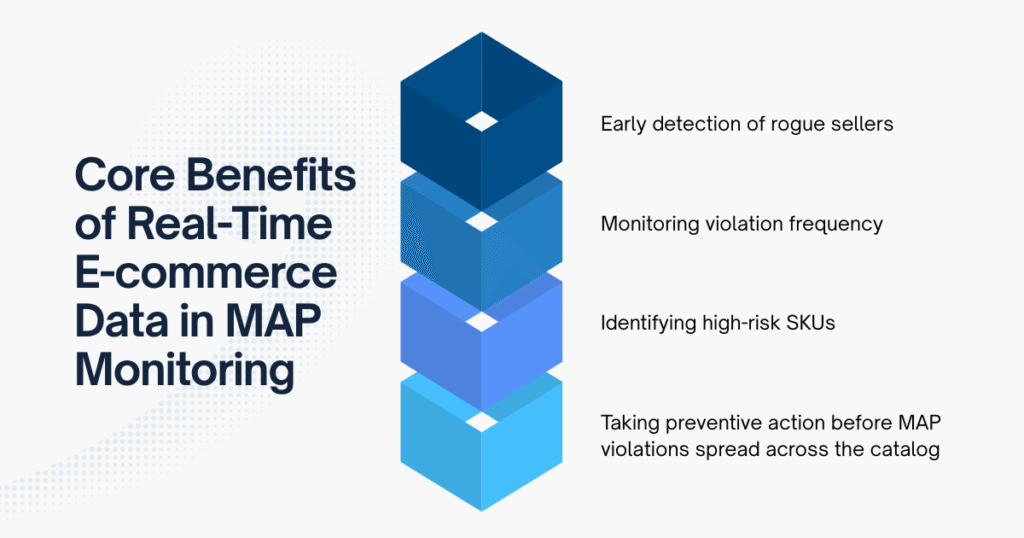
This makes real-time data an essential tool for protecting minimum advertised price policies and brand positioning.
How to effectively implement MAP Monitoring
To ensure minimum advertised price monitoring works, brands must combine a clear minimum advertised price policy, standardized e-commerce data, and automated alert systems. Real-time data is the backbone that keeps the entire model accurate, even with thousands of SKUs and hundreds of sellers.
- Define Minimum Advertised Price Correctly
This MAP levels by SKU, price scope before/after vouchers, thresholds to avoid false violations, and transparent enforcement rules. Brands should also store seller-level price history to identify repeat offenders.
- Set Up Automated Minimum Advertised Price Monitoring
Automation saves 80–90% of manual effort while ensuring no violations are missed. A strong MAP monitoring pipeline includes:
- Reliable real-time e-commerce data collection
- Pipeline matching MAP – advertised price – actual price
- Real-time dashboard visualization
- Real-time alerts via Email / Slack / API
- Scheduled reporting for brand/commercial teams
- Price history and violation logs for enforcement
The first and most critical step – “collecting reliable real-time e-commerce data” requires a robust approach. Marketplace data changes rapidly and is increasingly complex due to dynamic vouchers, category-level promotions, and algorithmic price rendering. Relying on unstable or incomplete data sources weakens the entire MAP monitoring system.
For this reason, many brands turn to specialized data providers capable of high-frequency e-commerce data scraping with complete metadata. Building an internal crawling system is costly, technically demanding, and requires ongoing maintenance to keep up with platform changes.
Easy Data is a trusted provider offering clean, standardized real-time price data with wide coverage, ideal for businesses monitoring hundreds or thousands of SKUs while maintaining accuracy and scalability.
Conclusion
In an ever-changing digital business environment, ensuring compliance with Minimum Advertised Price (MAP) is a major challenge for brands and suppliers. Real-time insights provide a powerful advantage by capturing every market fluctuation as it happens. With real-time data, businesses can monitor MAP with precision, respond quickly to violations, maintain fair competition among retailers, and preserve long-term market stability.
Leave a Reply