

Many ecommerce teams have started scraping with high expectations: tracking competitor prices, monitoring new sellers, analyzing campaign behavior. But after a few months, things become messy. Data starts drifting. Scripts break. The team spends more time fixing issues than generating insights.
The problem is rarely technical. More often, it’s the absence of a clear web scraping roadmap. Without direction, scraping turns into scattered experiments instead of a structured data capability that supports business strategy.
What Is a Web Scraping Roadmap?
A web scraping roadmap is a phased strategy that aligns data collection with business decisions and evolves from exploration to monitoring, automation, and long-term infrastructure.
Put simply, you don’t scrape just because you can, you scrape because a specific decision depends on it. You scrape because a specific decision depends on it. A web scraping roadmap forces you to answer uncomfortable questions early:
- What decisions will this data influence?
- What signals actually matter?
- At what point does automation make sense?
- Who owns validation when something breaks?
Without those answers, scraping becomes experimentation disguised as strategy.
Why Ecommerce Teams Need a Scraping Roadmap
Ecommerce marketplaces are dynamic environments: prices change hourly; sellers enter and exit categories constantly; campaigns distort rankings and visibility. Without a structured web scraping roadmap, three things usually happen:
- Teams collect too much data that never gets used
- Benchmarks become unreliable due to inconsistent normalization
- Maintenance effort grows faster than analytical value
A roadmap forces better questions:
- What stage are we in?
- Is the data reliable enough for decision-making?
- Do we really need automation yet?
This distinction separates tactical scraping from developing a scalable ecommerce web scraping foundation aligned with strategic decision-making.
A Practical Web Scraping Roadmap for Ecommerce
Below is a practical web scraping roadmap that reflects real ecommerce implementations (not theoretical models).
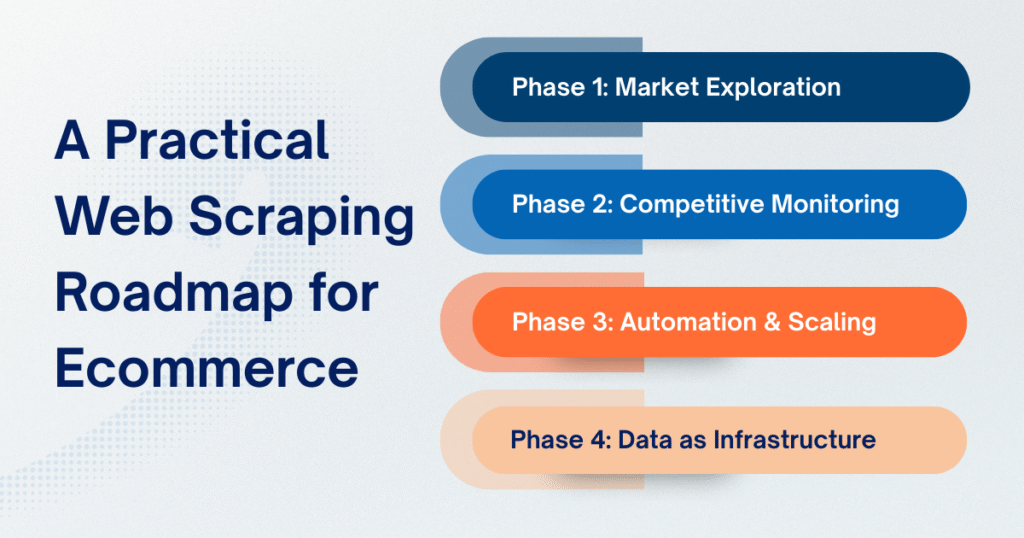
Phase 1: Market Exploration
This phase is not about building infrastructure. It’s about understanding the market.
Goal: Understand category structure, pricing ranges, seller density, and volatility.
Typical data:
- Product prices
- Number of listings
- Active sellers
- Basic campaign patterns
Output:
- Saturation insights
- Average pricing bands
- Early demand–supply imbalances
At this stage, scraping may still be semi-manual. Speed is less important than clarity. The objective is to identify which signals actually matter.
Phase 2: Competitive Monitoring
Once the market is understood, scraping becomes structured. Pricing, seller movement, and campaign patterns are collected on consistent schedules.
Key shift in this phase:
- Same categories
- Same parameters
- Same time intervals
Frequency increases, but with discipline.
Many teams rush to automation here. However, automation should only follow once you clearly know:
- Which variables influence decisions
- Which data points are noise
Phase 3: Automation & Scaling
At this stage, the web scraping roadmap moves from experimentation to operations. Automation is not just about running scripts daily. It requires:
- SKU standardization
- Price normalization
- Layout-change monitoring
- Validation checks
The focus shifts to data reliability.
One subtle parsing issue can skew competitive benchmarks for weeks without detection. Automation must include:
- Validation rules
- Monitoring logic
- Alert systems
When scraping supports recurring decisions, it stops being a technical project. It becomes infrastructure.
Phase 4: Data as Infrastructure
In the most mature phase of a web scraping roadmap, data feeds multiple decision systems.
- Pricing teams monitor competitor shifts
- Category teams track saturation trends
- Strategy teams evaluate expansion timing
The key questions become:
- How do we ensure historical continuity?
- How do we reduce internal maintenance burden?
- How do we maintain signal clarity across markets?
At this level, scraping stops being a technical function, it becomes operational infrastructure.
Learn more: How to Implement Automated Web Scraping for Your Data-Driven Strategies
Common Roadmap Mistakes
Even with good intentions, teams often undermine their own web scraping roadmap.
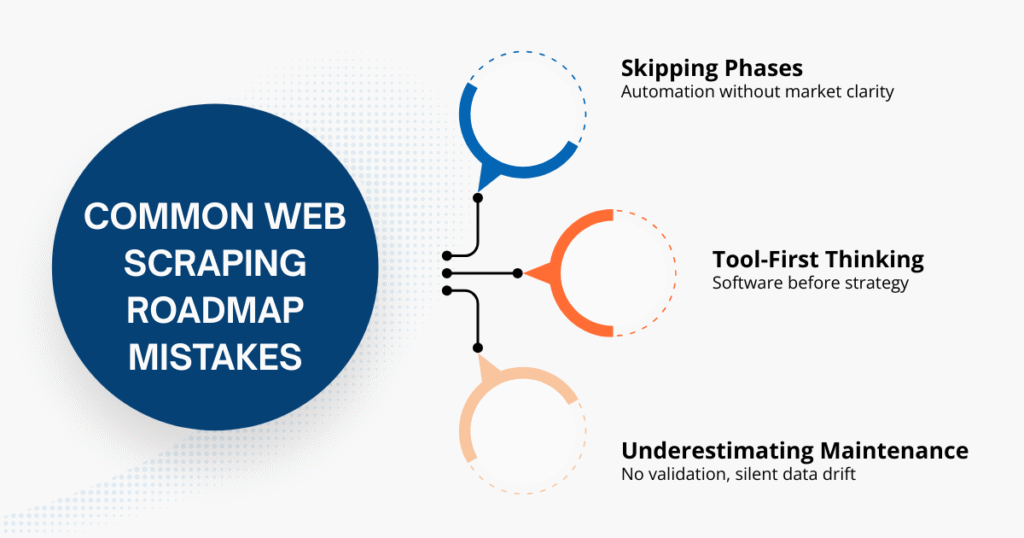
- Skipping Phases: Jumping straight into automation before understanding market signals leads to complex systems with weak insights.
- Tool-First Thinking: Choosing tools before defining business objectives is one of the most common structural errors. The roadmap must start with decisions, not software.
- Underestimating Maintenance: Scraping is never “set and forget.” Marketplaces evolve. Campaign mechanics change. Seller behavior shifts. Without ongoing validation and adaptation, data reliability erodes silently.
Before working with Easy Data, many SEA ecommerce teams find themselves in a familiar cycle: scraping pipelines are running, data is flowing, yet more time is spent fixing broken logic and inconsistencies than generating strategic insight.
The issue is rarely extraction. It’s normalization gaps, fragile monitoring logic, and historical data drift as marketplaces evolve. As operations expand across categories and countries, maintaining consistency becomes an operational burden that directly impacts pricing and growth decisions.
At this stage, ecommerce data scraping services are no longer about outsourcing collection. They become infrastructure, stabilizing strategic inputs and ensuring long-term signal clarity. That’s the perspective behind how Easy Data approaches ecommerce data architecture: not just collecting data, but making it decision-ready and sustainably reliable.
Conclusion
A strong web scraping roadmap doesn’t help you scrape more. It helps you scrape smarter. In fast-moving ecommerce environments, the difference between random data collection and strategic insight lies in sequencing, maturity, and reliability.
Scraping itself is not a strategy. But when embedded in a well-structured web scraping roadmap, it becomes the foundation of a sustainable ecommerce data strategy.
Leave a Reply