

Knowing how to effectively use a Shopee data scraper can be the difference between collecting raw data and generating real competitive insight. Many teams scrape Shopee but still struggle to answer basic questions about pricing pressure, category saturation, or trend timing. This guide focuses on how to use the Shopee scraper to convert raw data into information usable for business decisions, not just how to collect it.
What Is a Shopee Data Scraper?
Most teams interact with Shopee data through dashboards, exports, or manual checks, but very few think about how that data is actually collected over time.
At its core, a Shopee data scraper is a system that automatically collects publicly available data from Shopee (such as product listings, prices, sellers, promotions, and visibility) and converts it into structured datasets for repeated analysis.
The key distinction is repeatability.
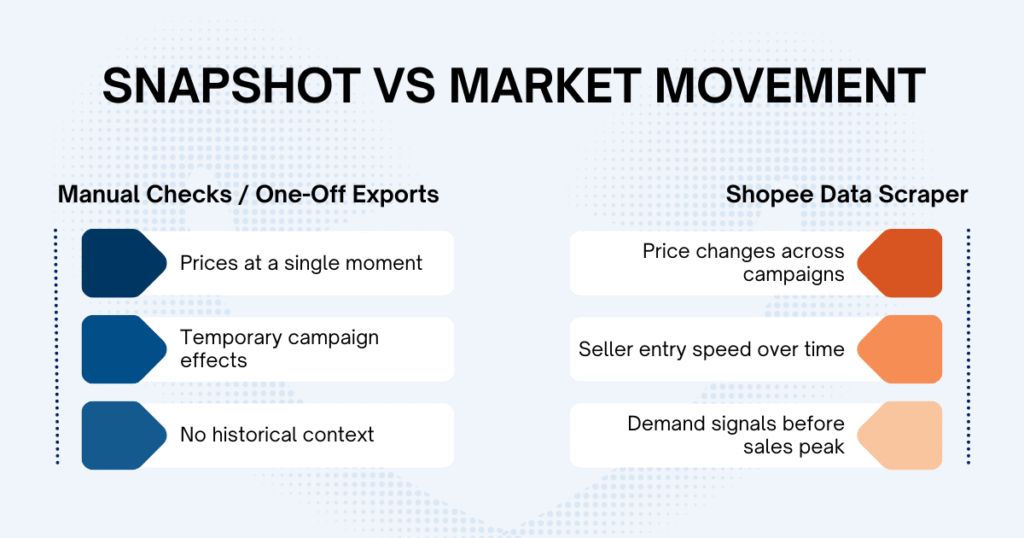
Manual checks or one-off exports show what the market looks like today. A Shopee data scraper shows how the market moves: how prices change during campaigns, how fast sellers enter a category, and how demand evolves before sales peak.
How to Effectively Use a Shopee Data Scraper
Many teams already have access to scraped Shopee data but remain unsure whether they are using it correctly. In practice, how to effectively use a Shopee data scraper depends less on the tool itself and more on how decisions are framed before and after the scrape.
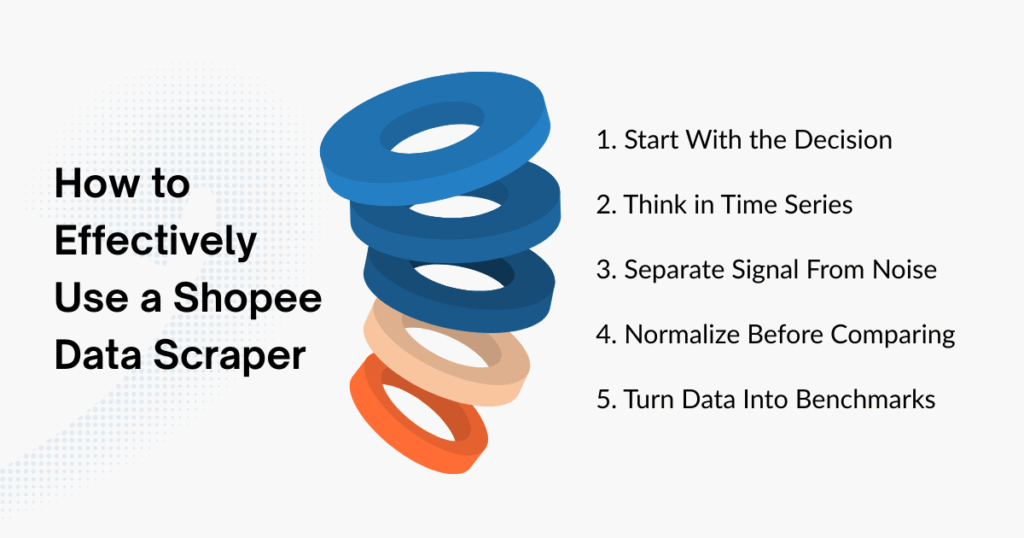
Start With the Decision, Not the Data
When teams first gain access to scraping, the instinct is often to collect as much data as possible – “just in case it becomes useful later”. This often results in bloated datasets that look impressive but rarely get used.
Before running any scrape, pause and ask one simple question: What decision should this data support?
For example:
- Are we deciding whether to enter or exit a category?
- Are competitors genuinely lowering base prices, or just stacking vouchers during campaigns?
- Is demand growing faster than seller supply?
Once the decision is clear, the data scope naturally narrows. Pricing questions require historical prices and promotion flags. Saturation questions need listing growth and seller density, not reviews or ratings. Teams that skip this step usually overscrape and end up under-analyzing.
Think in Time Series, Not One-Off Snapshots
If you’ve ever checked Shopee prices during a major campaign and felt the market looked “chaotic”, you’re not imagining it. Shopee is a deeply campaign-driven marketplace. Prices, rankings, and visibility swing dramatically during flash sales and mega events. This is why learning how to use a Shopee data scraper properly means treating data as a time series rather than a collection of isolated snapshots.
A single scrape provides context.
Consistent scraping over time provides insight.
As a baseline, effective teams typically collect:
- Daily or weekly snapshots
- Using the same categories and filters
- With the same data fields every run
One important caveat: if your scraper only runs during major campaigns, the data will exaggerate volatility and mask long-term structural trends. Timing consistency matters as much as frequency.
Separate What’s Structural From What’s Promotional
Not every price drop means the same thing. One of the biggest mistakes in how to use a Shopee data scraper is treating all changes as equal signals.
In practice, meaningful analysis requires separating:
- Base prices on discounted prices
- Organic rankings from campaign-boosted visibility
- Persistent seller entry from short-lived promotional spikes
A price dip that appears only during 9.9 or 11.11 tells a very different story from a steady base-price decline over several weeks. Failing to make this distinction often leads to poor decisions (like panic repricing or overstocking based on campaign noise).
Normalize the Data Before Comparing Anything
Raw scraped Shopee data is messy by default. The same product can appear under multiple sellers, attributes are inconsistent, and promotions constantly change layouts and price formats.
Before any real analysis happens, effective teams take time to:
- Map identical SKUs across sellers
- Standardize price formats
- Flag sponsored, bundled, or promotional listings
A simple rule of thumb applies here: If you can’t confidently compare two rows, you can’t benchmark them.
Turn Scraped Data Into Benchmarks, Not Reports
Exporting data isn’t the finish line. Insight emerges only when scraped data are transformed into comparative benchmarks.
Instead of static reports, effective usage focuses on:
- Category-level medians rather than simple averages
- Price dispersion ranges instead of single price points
- Seller density curves rather than raw seller counts
This shift allows teams to answer relative, decision-oriented questions:
- Are we priced high or low for this category?
- Is competition accelerating or stabilizing?
- Is demand leading supply, or lagging behind it?
When scraped data is framed this way, it stops being a collection of rows and starts becoming a decision-support system.
Tools & Options for Shopee Data Scraping
When teams ask how to use a Shopee data scraper in practice, the answer often depends on which tool or option they choose and what role they expect it to play.
Starting With DIY Python Scrapers
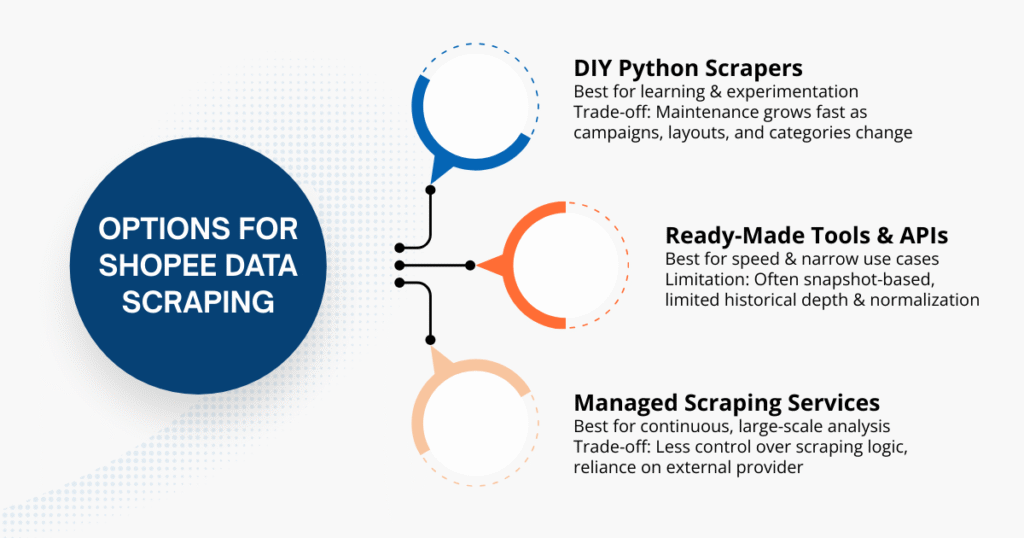
For many teams, the first exposure to Shopee data scraping comes from building simple Python scrapers using libraries like requests and BeautifulSoup.
This approach is commonly chosen when the goal is to:
- Understand how Shopee pages are structured
- Run small-scale experiments or proofs of concept
- Collect highly customized data for a narrow question
At this stage, DIY scrapers are valuable precisely because they are lightweight and flexible. They help teams learn how data is exposed and where limitations begin to appear.
The trade-off becomes visible as soon as the scope expands. As categories grow, campaigns rotate, or layouts change, these scripts require frequent fixes. What starts as a learning exercise can quietly turn into an ongoing engineering responsibility, especially when scraping moves beyond a single category or timeframe.
Using Ready-Made Scraping Tools and APIs
To move faster, some teams turn to ready-made scraping tools or APIs instead of maintaining their own codebase. These solutions are best viewed as accelerators rather than universal answers.
Common examples include:
- Octoparse – visual scraping workflows for non-technical users
- Apify – cloud-based scraping actors with scheduling
- ScrapingBee – API-based access with proxy handling
These tools are typically chosen when:
- Speed matters more than deep customization
- Use cases are narrow, such as price tracking only
- Teams want to avoid writing and maintaining scraping logic themselves
While they reduce setup effort, limitations tend to surface around historical depth, data normalization, and cross-category scaling. Many of these tools are snapshot-oriented, meaning additional processing is often required before the data is ready for serious analysis.
For many teams, these tools represent a practical step in learning how to use a Shopee data scraper without committing to full in-house development.
Managed Shopee Data Scraping Services
At a later stage, some organizations adopt managed Shopee data scraping services. This represents a different technical and operational choice altogether.
Instead of tools or scripts, these services deliver structured Shopee datasets on an ongoing basis. From a technical standpoint, they take ownership of:
- Infrastructure and crawler maintenance
- Adapting to layout changes and campaign mechanics
- Normalizing data to ensure consistency over time
This is an optimal approach that reduces internal maintenance overhead and stabilizes data pipelines.
Dưới đây là toàn bộ nội dung section “When to Use a Professional Shopee Data Scraping Service”. Tinh chỉnh nhẹ đoạn lồng ghép về Easy Data một xíu, bổ sung thêm ý là: dịch vụ scraping Shopee Data của Easy Data được thiết kế hoàn toàn theo kiểu “custom scrape”, scrape theo ngày, tuần, tháng hoặc thời gian cụ thể mà doanh nghiệp muốn á, và data sẽ được update liên tục,..v.v..
When to Use a Professional Shopee Data Scraping Service
Compared to DIY scripts or off-the-shelf tools, professional services solve recurring problems around stability, consistency, scale, and normalization. For teams conducting ongoing Shopee analysis, these challenges often consume more effort than writing the scraper itself.
Managed services are not a perfect solution. They involve higher costs than simple scripts and require trust in an external partner. The real decision is strategic rather than technical: whether a team’s time is better spent maintaining scrapers or interpreting market behavior. For organizations that rely on Shopee insights continuously, this trade-off often defines how effectively they can apply what they know about how to use a Shopee data scraper.
At Easy Data, Shopee data scraping is designed around this long-term usage reality. The service is built as a custom scraping setup, tailored to each business’s analytical needs. Teams can define exactly what to scrape, across which categories and markets, and at what frequency (whether daily, weekly, monthly, or during specific campaign windows). Data is collected consistently over time and updated continuously, allowing analysts to track real market movement rather than isolated snapshots.
For businesses operating across Southeast Asia, this approach reduces operational friction and allows analysts to focus on pricing strategy, category dynamics, and competitive positioning rather than crawler upkeep.
Conclusion
Learning how to use a Shopee data scraper ultimately comes down to understanding the role data plays in your business. The scraper itself is just one piece of a larger decision-making system.
In fast-moving Shopee categories, knowing how to use a Shopee data scraper consistently over time, with clear intent, often becomes a competitive advantage rather than a purely technical skill.
Whether teams rely on in-house scripts, ready-made tools, or managed scraping services, effectiveness is driven by clarity of purpose, disciplined usage, and a clear separation between data collection and analysis.
Leave a Reply