

Choosing a Lazada scraper starts with the decision you need to support, the data you are authorized to access, and the quality of the delivered records. A tool that collects visible listing prices does not automatically provide seller orders, exact stock quantities or competitor revenue. This guide explains how to evaluate a Lazada data service in Southeast Asia, including Easy Data, without relying on an unverified “best” or “#1” ranking. Reviewed October 1, 2026.
The Importance of Lazada Web Scraping in Southeast Asia
Lazada operates across several Southeast Asian markets, so a useful collection brief must identify the country, source and observation period. Separate your own seller business data from public marketplace research. Lazada’s seller authorization documentation says applications need seller authorization to access that seller’s business data. A seller token is not permission to retrieve every competitor’s private records. Potential research questions include:
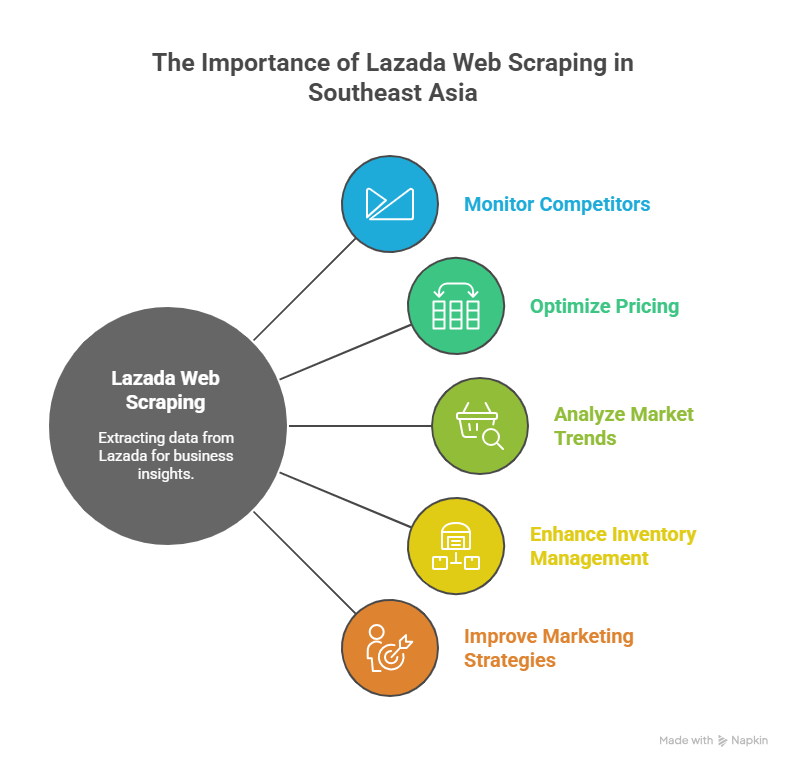
- Competitor comparisons: Compare equivalent products, variants, sellers and observed promotions. Keep the source URL and collection time with each observation.
- Price decisions: Separate the displayed item price from shipping, minimum-spend vouchers and buyer-specific discounts. A periodic snapshot is not a live price feed.
- Market research: Track a defined sample over time. Changes in search results or missing listings can change the sample, so report coverage alongside trends.
- Inventory planning: Distinguish visible availability from authorized inventory quantities. An out-of-stock label alone does not reveal sales volume or future demand.
- Review analysis: Define the review sample, language, period and exclusions. Separate original review text from a derived sentiment label and check the latter against human-reviewed examples.
For a small one-off question, a manual sample may be enough. Recurring collection becomes useful when it has a defined scope, reliable identifiers and repeatable checks. Evaluate a provider on a representative sample and documented limits rather than promises of complete coverage or uninterrupted access.
How to Evaluate a Lazada Data Service
The Easy Data Lazada service page is a starting point for discussing a project. Before choosing any provider, confirm the requested market, fields, collection method, delivery schedule and acceptance criteria. The eight checks below help turn a broad scraping request into a reviewable scope.
1. Required Fields and Data Quality
Build a field specification that distinguishes raw observations, authorized account data and calculated outputs. The following are categories to evaluate, not a guarantee that every field is available for every listing:
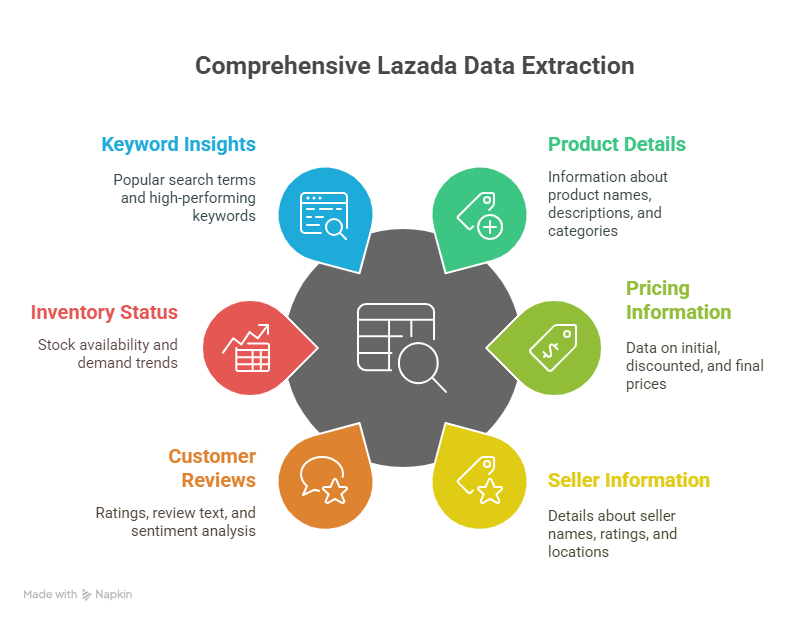
- Product identity: Keep the market, product identifier, variant or SKU identifier where available, seller identifier and source URL. Do not merge variants solely because their titles match.
- Price context: Record the original currency, displayed price, variant, observation time and any discount conditions. Keep shipping and voucher assumptions separate.
- Seller information: Define which displayed seller fields are required and what each rating or location label means. Missing values should remain identifiable as missing.
- Reviews and derived analysis: Record the available rating, text, date and language only within the agreed scope. Sentiment analysis is a separate interpretation with its own validation requirements.
- Availability: Preserve the observed status and distinguish unavailable data from zero stock. Do not label a public availability indicator as an exact warehouse quantity.
- Search observations: Record the query, market, filters and collection conditions if comparing search results. An observed position is not a measurement of total keyword search volume.
A price comparison needs a consistent definition. In this fictional example, two listings offer the same variant in VND at the same observation time. Shipping is known for the same destination, and no voucher is applied. The lower displayed item price does not produce the lower delivered total.
| Fictional offer | Comparable delivered total |
|---|---|
| Listing A | Item: 120,000 VND Shipping: 15,000 VND Total: 135,000 VND |
| Listing B | Item: 130,000 VND Shipping: 0 VND Total: 130,000 VND |
2. Usability and Delivery Workflow
Distinguish a self-service scraping interface from a managed data-delivery service. Ask to see the workflow you will actually use: defining fields, reviewing a sample, changing scope and receiving an export. Confirm the supported formats and delivery method in the project scope; this article does not establish that Easy Data provides a point-and-click scraper or every advertised format for every project.
3. Scale and Refresh Requirements
Define scale as a measurable workload: requested markets, listings or variants, refresh interval and permitted collection window. Ask for expected coverage, limits, failure reporting and pricing at that workload. Test representative categories and variants before expanding; a successful small sample does not prove reliable collection of an entire marketplace.
4. Access and Failure Handling
Choose the access method before implementation. Lazada’s authorization configuration guide describes seller approval and application-specific authorization policies. For a proposed collection workflow, require clear handling of:
- Authorization boundaries: Identify the account, source and permissions the workflow uses. Keep seller credentials and tokens out of ordinary data exports and public examples.
- Incomplete or dynamic pages: Confirm required fields are actually available before marking a record complete. Missing content should produce a documented status, not invented values.
- Access challenges: Agree when to stop, investigate or seek an approved alternative. Do not promise that a service will bypass every CAPTCHA or platform restriction.
- Retries and failures: Require bounded retries, timestamps and reasons for failures. Review persistent errors rather than repeatedly treating failed requests as successful records.
No collection method can establish uninterrupted access by assertion. Agree how delayed, partial or failed deliveries are communicated. Our web-scraping troubleshooting guide explains common parsing, retry and data-validation problems.
5. Permissions and Data Handling
Review the applicable regional platform terms, account permissions and intended data use before starting. Public visibility alone does not establish permission or remove privacy obligations. For example, Lazada Singapore’s Content Terms restrict automated access to portions of the platform that are not expressly authorized. That is a regional document, not a legal conclusion for every market or project.
6. Output and Integration Requirements
Specify the output contract before integration: field names, types, identifiers, currency, time zone, missing-value rules and observation timestamps. Agree whether delivery is a file, scheduled transfer or an API, and how changed records are represented. Test a sample in your actual import workflow before assuming compatibility with a CRM or analytics system.
7. Support and Maintenance Scope
Confirm support hours, response expectations, maintenance scope and the process for source changes in writing. Distinguish an acknowledged issue from a restored delivery. The original article’s 24/7 support and continuous-monitoring claims were not substantiated in this review; do not assume they are included in every Easy Data project.
8. Costs and Trial Conditions
Ask for a quote tied to the requested scope, refresh frequency, delivery method and support arrangement. Clarify sample or trial conditions, setup charges, recurring costs and what happens when coverage changes. Compare total operating effort, not just a headline per-record price; a free trial or a particular service level must be confirmed.
Possible Uses of a Validated Lazada Dataset
These are possible applications of a validated dataset, not measured client results or guarantees of commercial improvement:

- E-commerce sellers: Compare a matched set of competing offers using consistent price and shipping assumptions before testing a listing change.
- Market researchers: Describe the category sample, countries, dates and missing observations so readers can judge what the results represent.
- Retailers: Combine permitted marketplace observations with their own inventory and sales records, keeping the sources and definitions separate.
- Marketing teams: Review recurring themes in a documented review sample. Avoid treating a small or selected set of reviews as the opinion of all buyers.
- Data analysts: Build a reproducible dataset first, then evaluate any predictive model against held-out observations and a suitable baseline. Collection alone does not validate a forecast.
Testing Delivery Quality
Before accepting a recurring delivery, test how the workflow handles these cases:
- Unavailable sources: The delivery should distinguish access denied, timeout, removed listing and missing data. Agree how failures affect coverage and billing.
- Changed page structure: Check known fixtures or sample records after a source change. A nonempty response is not proof that the parser extracted the right field.
- Duplicates and variants: Repeated records should follow a documented identity rule. Retain meaningful variants and observations from different times instead of deleting them as apparent duplicates.
- Partial batches: Reconcile requested, attempted, successful and failed records for the same batch. Ask for an explanation of the difference and a plan for any permitted retry.
Legal and Ethical Considerations
Treat permissions and data handling as part of the project scope. Lazada’s Open Platform terms apply to use of its platform and tools; using an API does not remove the need to follow its rules. For the proposed dataset:
- Document the approved purpose, source and permitted recipients. Limit collected fields to those needed for that purpose.
- Agree retention, access controls and deletion arrangements for delivered data and operational logs. Avoid unnecessary personal information.
- Review uncertain permissions or privacy requirements with the responsible business and legal teams before collection. Do not treat a vendor’s blanket compliance claim as a substitute for that review.
Planning for Southeast Asian Markets
A Southeast Asia project should specify each market separately. Instead of relying on an outdated market-size projection, define the practical differences your dataset must preserve:
- Country and currency: Record the marketplace country and original currency. If converting prices, retain the original values and the exchange-rate source and date.
- Language and text: Preserve original text and encoding. Identify any translation or sentiment output as derived, with its method and limitations.
- Local conditions: Document destination-dependent shipping, promotion eligibility and time zones. Compare like-for-like offers rather than assuming one price definition works everywhere.
Conclusion
The best-fitting Lazada scraper or service is the one that can demonstrate an authorized collection method, useful coverage and dependable records for your specific task. Evaluate Easy Data or another provider against the same sample and acceptance criteria. A clear scope and a reconciled delivery are more informative than an unsupported market-leader label.
To discuss a project, use our Lazada data service page and bring the target market, representative URLs, required fields, intended use and refresh schedule. For related planning, see Lazada Data Scraper: Extract Data for E-Commerce Success; verify any proposed capability against the current agreed scope.
Leave a Reply