

A useful Lazada dataset needs more than product names and prices. The same listing can contain several variants, conditional promotions and destination-dependent shipping offers. This guide explains how to define the observation you need, choose an authorized source, and check the resulting records before using them for pricing or product research.
Lazada data scraping converts information available through an authorized web source into structured records. It is one possible collection method alongside seller-authorized APIs, exports and licensed feeds. The appropriate route depends on your permission, market, fields and refresh requirements.
The walkthrough below uses a clearly fictional HTML sample to demonstrate extraction, variant-level validation and CSV export. It does not claim to be a working live Lazada crawler. The surrounding checklist explains the additional source verification, access, pagination and monitoring work a production collection needs.
- What Is Lazada Data Scraping?
- Why Scrape Data from Lazada?
- Key Data Types You Can Scrape from Lazada
- Tools for Scraping Lazada Data
- How to Scrape Lazada Data: A Step-by-Step Guide
- Legal and Ethical Considerations of Lazada Data Scraping
- Benefits of Lazada Data Scraping
- Challenges and Limitations of Lazada Data Scraping
- Conclusion
What Is Lazada Data Scraping?

Lazada data scraping is the process of using automated bots or programs to extract publicly available information from Lazada’s web pages. This could include product titles, prices, descriptions, reviews, seller information, and other relevant details. The purpose of scraping is to convert unstructured web data into structured data that can be analyzed for insights.
Lazada identifies six operating markets: Indonesia, Malaysia, the Philippines, Singapore, Thailand and Vietnam. Keep the market and currency with each observation; do not combine records from these markets as though their prices, assortments or delivery conditions were interchangeable.
Why Scrape Data from Lazada?
Data scraping from Lazada offers a wide array of benefits for businesses that aim to grow, optimize pricing strategies, and improve customer satisfaction. Here are some of the key reasons why businesses choose to scrape Lazada data:
1. Competitive Pricing and Strategy
Compare matched product variants from the same market, currency and observation period. Store the displayed price separately from vouchers, shipping charges and membership conditions. A scheduled snapshot can support a pricing review; it does not establish a real-time feed or guarantee that a price change will improve profit.
2. Product Research and Selection
Listing attributes, visible review activity and availability can help generate product-research hypotheses. They do not by themselves establish demand or a best-seller ranking. Validate a proposed assortment with your own sales, margin and return data before committing inventory.
3. Market Trend Analysis
Build a history by storing dated observations from a consistent sample. A current listing cannot reconstruct prices or availability you did not previously record. Distinguish collection time from a review date or source-provided reporting period, and record sampling or collection changes alongside the series.
4. Customer Sentiment Analysis
Reviews can reveal recurring product or delivery complaints, but reviewers are a selected subset of purchasers and visible reviews may not be complete. Keep rating, text, language and review date separate; validate sentiment labels against a manually checked sample before summarizing them.
5. Seller Performance Monitoring
Compare observable seller ratings, assortments and listed prices with their definitions and collection dates attached. Public observations do not establish a competitor’s complete inventory, revenue or fulfillment performance. Compare your own operational metrics only with equivalent measures.
6. Efficient Data Collection and Automation
Automation can reduce repeated collection effort, but it can also repeat an extraction error across many records. Track successful pages, failed pages, missing fields and duplicate identities separately, and inspect representative records before accepting a run.
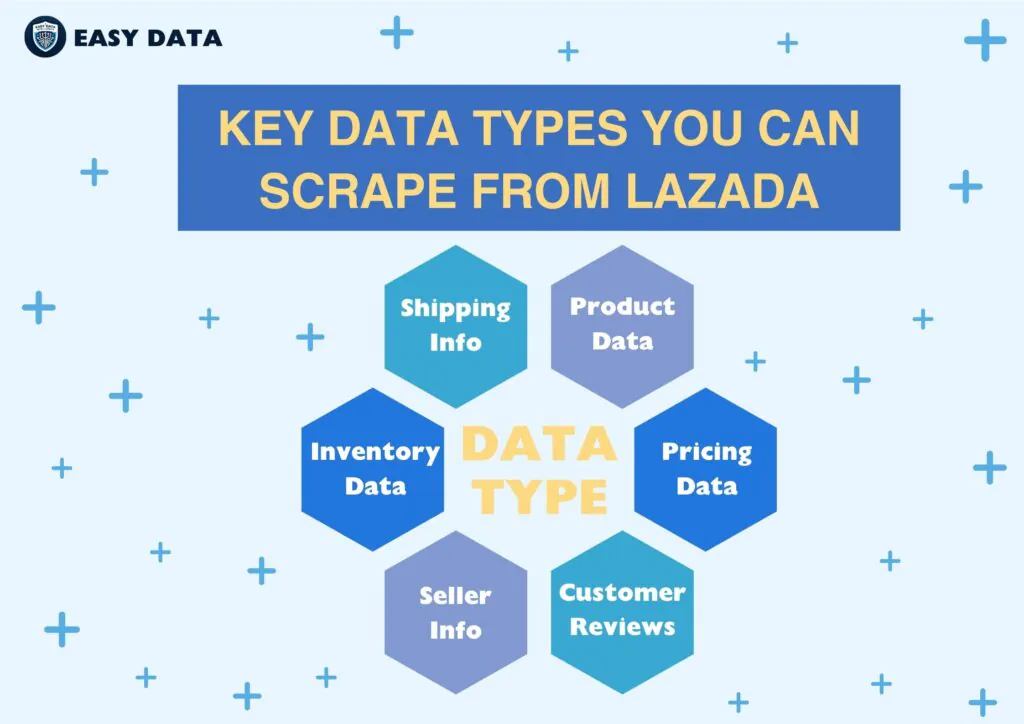
Key Data Types You Can Scrape from Lazada
Treat the following as a field checklist, not a promise that every field is available through every Lazada source. Verify each field on the permitted source, document its meaning and keep missing values explicit.
1. Product Data
- Product Name: Scraping product titles helps you monitor various product listings and identify trends.
- Product Description: Understanding how top sellers describe their products can give insights into effective selling techniques.
- Product Categories: Categorization helps businesses track product trends across different segments.
- Product Specifications: Extract technical details or attributes about products for comparison purposes.
- Product Images: Keep an image reference where permitted and useful for matching. Access to an image does not establish permission to republish it; preserve source attribution and usage restrictions.
2. Pricing Data
- Product Price: Store the selected variant, currency, observed amount and collection time. Distinguish a displayed starting price from a price confirmed for a specific variant.
- Discounts and Promotions: Record the eligibility, minimum spend and expiry shown with an offer. Do not subtract every displayed voucher from every product price.
- Historical Pricing Data: Use retained snapshots or a source that explicitly supplies history. A single current observation cannot establish a previous price or a trend.
3. Customer Reviews
- Review Ratings: Retain the rating scale and number of reviews behind an aggregate. A star rating is not a sales count or a complete sentiment label.
- Review Text: The content of customer reviews provides deeper insights into consumer satisfaction and areas for product improvement.
- Review Dates: Analyze review timelines to understand product performance trends and customer feedback consistency.
4. Seller Information
- Seller Name: Monitor top competitors or sellers in your product category.
- Seller Ratings: Scrape seller ratings to benchmark your store’s performance against competitors.
- Visible Sales Labels: Preserve the label, unit, scope and stated period exactly when available. Rounded product-level sold counts cannot establish seller-wide orders or marketplace share.
5. Inventory Data
- Availability: Record the selected variant and observed availability state. A purchase limit or availability label is not a verified warehouse stock count.
- Availability Changes: Repeated in-stock/out-of-stock observations may flag a change worth investigating. They do not prove a restocking quantity or sales velocity.
6. Shipping Information
- Shipping Costs: Record the destination, quantity, service and promotion assumptions with a quote. Compare like-for-like quotes rather than treating one shipping price as universal.
- Delivery Estimates: Store the displayed date range and observation date. An advertised estimate is different from measured fulfillment time; see our shipping-data measurement guide.
Tools for Scraping Lazada Data
Choose tools after identifying the authorized source and testing representative pages. A tool category describes how extraction is configured, not guaranteed support for Lazada or access to all fields. Use the Lazada scraper evaluation checklist to compare sample accuracy, failure reporting and export requirements.
1. No-Code Web Scraping Tools
If you’re looking for an easy-to-use solution without the need for coding, no-code web scraping tools can automate the process.
Octoparse
Octoparse provides visual workflow configuration and cloud scheduling. Test the exact market, variants, pagination and fields you need before relying on a template. Confirm current plan limits with the publisher; a successful sample does not establish complete coverage.
ParseHub
If considering ParseHub, evaluate it against the same representative-page and export checklist. Confirm its current features, limits and suitability directly with the publisher rather than assuming that a visual workflow will collect every Lazada field.
DataMiner
Data Miner is a browser-based extraction tool with reusable recipes and spreadsheet exports. Verify what each recipe selects and how it handles missing or repeated rows. Test the required pages before deciding whether browser-based collection fits the workload.
2. Python-Based Web Scraping Tools
For those with programming knowledge, Python-based tools offer flexibility and scalability. You can customize your scraping scripts to extract specific data points and automate the process for large datasets.
BeautifulSoup
Beautiful Soup parses HTML and XML supplied to it. It does not fetch pages or execute their JavaScript. Use it when the authorized response already contains the required fields; the local example below makes that distinction explicit.
Scrapy
Scrapy manages requests, extraction and data pipelines. You still implement the source-specific selectors, pagination and failure handling. Its dynamic-content documentation distinguishes retrieving the actual data source from browser rendering; Scrapy does not automatically render every page.
Selenium
Selenium controls a browser and can inspect rendered content. Its waiting documentation explains why page load completion may not mean a required element is ready. Use bounded waits and explicit failure reporting; browser automation does not grant permission to access restricted data.
3. APIs
The Lazada Open Platform seller-authorization documentation requires seller authorization to access seller business data. Check the app’s permitted API operations, relevant market and seller scope. A seller access token is not unrestricted authorization to collect competitors’ private business data; do not assume that a desired marketplace-wide field is covered.
How to Scrape Lazada Data: A Step-by-Step Guide
Step 1: Identify the Data You Need
Write a collection contract: market, permitted source, seller/product/variant identifiers, currency, price definition, destination assumptions, observation time, refresh schedule and page or record limits. Decide how to represent missing data and report partial runs. This makes two exports comparable and exposes gaps before analysis.
Step 2: Choose the Right Tool or Framework
Try a small representative sample using the least complex authorized route that supplies the required fields. Include multiple variants, unavailable items, missing values and pagination in acceptance checks. Separate retrieval from parsing so each can fail visibly. The following local exercise tests parsing and export without making a network request.
Step 3: Prepare a Reproducible Sample
Create lazada_example.py with the three code blocks below, in order. Use Python 3.9 or later and install the documented parser with python -m pip install beautifulsoup4. These three fictional offers use invented classes and IDs; they are not Lazada HTML or market observations. The two bottle rows intentionally share a product ID but have different variants.
Copied!from bs4 import BeautifulSoup from decimal import Decimal import csv import re # Fictional fixture; these are not Lazada selectors or observations. HTML = """ <div class="offer" data-market="SG" data-seller="demo-store" data-product="bottle" data-variant="500ml" data-currency="SGD"> <h2 class="title">Demo bottle</h2><span class="price">49.90</span> </div> <div class="offer" data-market="SG" data-seller="demo-store" data-product="bottle" data-variant="750ml" data-currency="SGD"> <h2 class="title">Demo bottle</h2><span class="price">64.90</span> </div> <div class="offer" data-market="SG" data-seller="demo-store" data-product="mug" data-variant="standard" data-currency="SGD"> <h2 class="title">Demo mug</h2><span class="price">9.50</span> </div> """
Step 4: Extract Data from the HTML
Parse every offer and require a market, seller, product, variant, currency, title and unambiguous price. The identity includes the variant so the two bottle offers remain distinct. Reject duplicate identities and malformed prices rather than silently skipping them. This fixture accepts SG/SGD and decimal-point prices only; define a separate tested normalization rule for other locales.
Copied!def parse_offers(markup): cards = BeautifulSoup(markup, "html.parser").select(".offer") if not cards: raise ValueError("No offers: verify source and selectors") rows, seen = [], set() for card in cards: row = {name: card.get("data-" + name, "").strip() for name in ("market", "seller", "product", "variant", "currency")} if not all(row.values()): raise ValueError("Missing source identity or currency") if (row["market"], row["currency"]) != ("SG", "SGD"): raise ValueError("This fixture requires SG and SGD") key = tuple(row[name] for name in ("market", "seller", "product", "variant")) if key in seen: raise ValueError("Duplicate offer identity") title = card.select(".title") price = card.select(".price") if len(title) != 1 or len(price) != 1: raise ValueError("Missing or ambiguous title/price") row["title"] = title[0].get_text(" ", strip=True) raw_price = price[0].get_text(strip=True) if not row["title"] or not re.fullmatch(r"[0-9]+(?:\.[0-9]{1,2})?", raw_price): raise ValueError("Invalid title or price format") row["price"] = format(Decimal(raw_price), ".2f") rows.append(row) seen.add(key) return rows
Step 5: Store Data in a Structured Format
The final block writes a new lazada_sample.csv without overwriting an existing file. Run python lazada_example.py in a working folder. Expected output is three rows: bottle/500ml at SGD 49.90, bottle/750ml at SGD 64.90, and mug/standard at SGD 9.50. These are fictional variant offers, not three distinct products or evidence about Lazada prices. CSV handling follows the Python documentation; formula-like text is prefixed for spreadsheet export.
Copied!def spreadsheet_text(value): return "'" + value if value.lstrip().startswith(("=", "+", "-", "@")) else value def write_csv(rows, path): if not rows: raise ValueError("No rows to export") fields = ["market", "seller", "product", "variant", "currency", "title", "price"] # Exclusive creation protects an existing export from accidental overwrite. with open(path, "x", newline="", encoding="utf-8") as handle: writer = csv.DictWriter(handle, fieldnames=fields) writer.writeheader() for row in rows: writer.writerow({key: spreadsheet_text(value) for key, value in row.items()}) if __name__ == "__main__": rows = parse_offers(HTML) write_csv(rows, "lazada_sample.csv") print(f"Wrote {len(rows)} fictional offers to lazada_sample.csv")
Legal and Ethical Considerations of Lazada Data Scraping
While data scraping can be incredibly valuable, it’s important to understand the legal and ethical boundaries that govern the practice.
1. Terms of Service (ToS)
Review the current terms for the exact market, source and intended use, and confirm authorization before automated collection. The Philippines terms, for example, include restrictions on automated programs; they should not be treated as a substitute for another market’s terms. Resolve an access or reuse restriction before implementing the collection.
2. Respect for robots.txt
Respect applicable robots.txt rules, but do not interpret an allowed path as permission to collect or reuse its contents. RFC 9309 explicitly distinguishes crawler instructions from access authorization.
3. Data Privacy and GDPR Compliance
Names, account identifiers and identifiable review text can raise privacy obligations. The European Commission’s data-protection guidance explains the distinction between personal and anonymous data. Assess the rules applicable to the people, markets and processing involved; minimize identifiers, restrict access and set retention limits. Removing a display name alone may not make text anonymous.
4. Avoid Excessive Scraping
Set a bounded collection rate and overall run budget agreed for the source. Use connection/read timeouts, status checks and a limited retry policy; the Requests documentation explains timeout behavior. Stop on authentication or access challenges and investigate them rather than retrying indefinitely.
Benefits of Lazada Data Scraping
Useful outputs depend on validated coverage and a business decision they can inform. The following are potential applications, not guaranteed commercial outcomes:
1. Dated Competitive Pricing Observations
A dated series of matched variant prices can support a pricing review. Report its collection interval and failures so users know how current it is. Check margin, shipping and promotion constraints before acting; a scraped snapshot alone cannot guarantee profitable dynamic pricing.
2. Enhanced Product Selection and Inventory Management
Combine observed assortment and availability changes with your own sales, returns and replenishment lead times. Treat competitor stock quantities as unknown unless a permitted source explicitly supplies them. This avoids converting an availability label into a false inventory forecast.
3. Improved Marketing and Sales Strategies
Use recurring review themes and verified listing attributes to improve the clarity of product descriptions or identify questions for customer research. Test the resulting marketing change with your own outcome data; competitor observations do not demonstrate conversion lift.
4. Time-Saving Automation
Measure time saved against the full workflow, including maintenance, failed-run review and quality checks. Schedule only the refresh rate the decision needs, and preserve a run log so automation does not conceal missing coverage.
5. Better Customer Insights
Summarize review topics alongside sample size, language, collection scope and label uncertainty. Keep product quality, delivery and seller-service themes separate. A review sample describes the reviews collected, not every customer’s preference.
Challenges and Limitations of Lazada Data Scraping
While Lazada data scraping offers numerous benefits, it’s not without challenges:
1. Frequent Website Changes
E-commerce platforms frequently update their website layouts, adding new features or redesigning their pages. These changes can disrupt scraping scripts, requiring regular maintenance to ensure they continue to work correctly.
2. IP Blocking and CAPTCHA Challenges
Access challenges can have several causes, not only request volume. Record the response and stop the affected run. Use the approved API, export or source-owner support route to resolve access; changing an IP or repeatedly attempting a challenge is not a data-quality strategy.
3. Data Accuracy
For a live authorized source, first verify whether the returned HTML contains the required data; a successful HTTP status can still contain a login or challenge page. Add bounded pagination, loop detection, collection timestamps and per-page status. Compare counts with the agreed scope and preserve failures separately from empty results. The fictional parser above does not implement or validate a live Lazada collection.
Conclusion
A dependable Lazada research workflow starts with a permitted source and a precise observation contract. Preserve variant identity, currency, collection time and price conditions; validate missing and duplicate records before interpreting the result. Keep operational seller data separate from public marketplace observations.
Use the local exercise to test parsing behavior, then validate the actual authorized source separately. For a collection brief covering markets, required fields and delivery format, see our Lazada data scraping service. A useful handoff includes a reviewed sample and known limitations, not just a row count.
Ready to discuss Lazada data? Visit easydata.io.vn to learn more about our data services and book a demo through the booking link below.
Leave a Reply