


Introduction
Ecommerce market analysis helps a team decide what to sell, which customers to serve and which assumptions to test. Begin with a specific decision and distinguish your own orders and customer records from sampled competitor offers, search interest and third-party estimates. These sources answer different questions; combining them does not automatically produce a complete view of the market.
This guide explains metric definitions, tool roles and a repeatable comparison workflow. Editorial review: October 2, 2026. The original publication title is retained; discontinued products and changed product names are identified below. Product availability, coverage and plans should be checked before selection.
- Introduction
- Why Ecommerce Market Analysis Matters
- Key Metrics in Ecommerce Market Analysis
- Tools for Ecommerce Market Analysis: Uses and Limits
- How to Conduct an Effective Ecommerce Market Analysis
- Conclusion
Why Ecommerce Market Analysis Matters
A market analysis can support the following decisions when the evidence is appropriate. Treat each as a question to investigate, not a promised business outcome:
- Identify Emerging Trends: Compare consistent time periods and separate search interest from actual purchases.
- Optimize Pricing Strategies: Adjust prices based on competitor data and demand.
- Understand Customer Preferences: Improve targeting and marketing efforts.
- Enhance Inventory Management: Test replenishment assumptions against your authorized inventory, lead-time and order records.
- Evaluate SEO & Ads: Compare acquisition and conversion evidence under consistent measurement and attribution rules.
- Expand into New Markets: Analyze global and regional market potential.
- Enhance Customer Retention Strategies: Personalize offers based on historical behavior.
Key Metrics in Ecommerce Market Analysis
Choose metrics for the decision at hand. Record the date range, market, currency, source and exclusions before calculating them. Conversion or refund analysis is not inherently low impact; priority depends on the business question and measurement quality. Use our guide to types of e-commerce to separate buyer-seller relationships from sales channels and billing arrangements before combining market totals.
| Metric | Definition and limits |
|---|---|
| Sales trend | Compare your recorded revenue or units over comparable periods; define refunds, taxes, shipping and currency treatment. Competitor offer observations do not reveal exact sales. |
| Competitor price | Match the product, variant, pack quantity, currency and observation time. Keep listed, unit and delivered prices distinct. |
| Customer acquisition cost | Divide the acquisition costs included in your definition by newly acquired customers in the matching period or cohort. State the attribution rule and cost exclusions. |
| Conversion rate | Name both numerator and denominator: for example, sessions with at least one completed purchase divided by eligible sessions. Orders per session is a different measure when sessions can contain multiple orders. |
| Average order value | Divide the defined revenue by the corresponding order count. State whether refunds, tax and shipping are included; do not mix periods. |
| Customer lifetime value | Specify whether value means revenue or contribution margin, the customer cohort and observation horizon. A forecast also needs explicit retention and cost assumptions. |
| Return or refund rate | Use a consistent order cohort and allow time for returns. Distinguish returned units, refunded orders and refunded value rather than treating them as one rate. |
| Market share | Divide your sales by total sales in the same defined market, category and period only when that denominator is supported. Search visibility and a sampled listing share are not sales market share. |
For a marketplace application, see the Shopee business insights guide. For source and field checks before analysis, use the dataset validation guide.
Tools for Ecommerce Market Analysis: Uses and Limits
1. Sales & Market Trends Analysis
Google Trends
- Shows relative Google search interest. Google explains that Trends uses sampled, normalized data scaled from 0 to 100; it is not a count of purchases or total market demand.
- Use changes in a defined topic or query as a signal to investigate alongside orders, surveys or other evidence.
- Keep geography, time window, category and search type consistent. Equal interest scores in different regions do not establish equal search volumes.
Easy Data Analytics
- Agree with Easy Data on a defined source set, target market, fields and observation period; verify sample coverage before a larger delivery.
- Separate public marketplace observations from seller-authorized order or inventory records. Missing targets and fields should remain visible in the report.
- If a forecast is proposed, ask for its input history, target variable, validation period and measured error. Do not assume forecasting is included in every collection project.
Statista
- Consult the source and methodology attached to each statistic; distinguish observed historical data from modeled estimates and forecasts. For examples of how geography, reporting periods and denominators change a comparison, see our eCommerce growth statistics guide.
- Check market boundaries, geography, currency and revision date. Statista describes its sourcing and modeling process; a published forecast is not a guaranteed outcome.
2. Competitor & Price Monitoring
Prisync
- Monitors selected competitor offers on scheduled update cycles. Prisync describes update frequencies that depend on tracking method; do not assume continuous real-time coverage.
- Evaluate any repricing configuration with product matching, price floors and approval rules before enabling changes.
- Check retained history, supported targets and observation timestamps against the proposed comparison.
DataWeave
- DataWeave describes competitive pricing intelligence from public online data. Confirm current marketplace and product coverage for your brief.
- Use matched offer observations to investigate price gaps; a gap does not by itself measure demand or identify the most profitable price.
- Define which visible promotion conditions are captured and how vouchers, membership, shipping and missing offers are handled.
3. Customer Behavior & Conversion Optimization
Google Analytics for Ecommerce
- Measures activity on properties you instrument and are authorized to analyze. It does not expose competitors’ private customer journeys.
- Implement and verify the relevant GA4 ecommerce events, including purchase identifiers, values and currency. Reconcile transactions to your order records.
- Keep item and category definitions consistent, respect consent choices, and document missing measurement and attribution differences.
Hotjar
- Hotjar is now part of Contentsquare, whose current offering includes heatmaps and session replay. Verify the applicable plan and implementation.
- Use observed interaction patterns to form a testable usability hypothesis; a heatmap alone does not prove why someone left.
- Configure privacy, masking and consent appropriately. Review observed sessions alongside funnel and order data, accounting for incomplete capture.
Crazy Egg
- Crazy Egg lists A/B testing, heatmaps and recordings. Choose an outcome and decision rule before running an experiment.
- Use recordings to investigate behavior on the instrumented site; verify privacy settings and avoid treating selected recordings as a representative market sample.
4. SEO & Digital Marketing Insights
SEMRush for Ecommerce
- Tracks organic keyword rankings.
- Provides modeled competitor traffic estimates. Semrush describes Traffic Analytics as clickstream-based estimates, not direct access to a competitor’s analytics account.
- Compare search intent and page evidence, then verify your own outcomes in Search Console; a tool recommendation does not guarantee ranking gains.
Advertising conversion measurement
- Use the measurement settings of the advertising platform you actually run. Google Ad Manager is a publisher ad-management product; it should not be confused with advertiser conversion reporting in Google Ads.
- Define conversions around confirmed outcomes, verify consent behavior, and check event deduplication before using reports for optimization.
- Compare attribution windows and definitions before combining platform reports. A platform-attributed conversion does not independently establish incremental lift.
Ahrefs
- Provides backlink analysis for SEO growth.
- Uses its own Domain Rating metric for backlink-profile comparison. Ahrefs explains that this is not a search-engine ranking factor; keep it separate from actual rankings and traffic.
5. Supply Chain & Inventory Management
TradeGecko (QuickBooks Commerce)
- This is a historical product entry: Intuit’s clarification states that standalone QuickBooks Commerce was discontinued after August 31, 2023. Do not select that retired product for a new implementation.
- QuickBooks Online ecommerce accounting features are distinct from the retired standalone inventory product; evaluate current requirements and integrations separately.
Skubana
- Skubana is the former name of Extensiv Order Manager. Its role concerns order and inventory operations; confirm supported channels and workflow fit before selection.
- Assess any planning or forecasting feature with your own history, lead times and error criteria; an operations platform does not automatically measure the whole market.
🔗 Skubana and Extensiv Order Manager
6. Consumer Sentiment & Market Research
Brandwatch
- Use Brandwatch’s consumer-intelligence tools to explore covered conversations. Manually review a sample of automated sentiment labels, particularly for sarcasm and mixed-language text.
- Document source coverage and sampling; people posting publicly do not necessarily represent all customers.
SurveyMonkey
- Use SurveyMonkey’s survey workflow to ask a defined audience about a specific decision. Keep wording neutral and state how respondents were recruited.
- Report sample size, fieldwork dates and respondent criteria. Stated purchase intent is not the same as an observed purchase.
🔗 Explore Brandwatch 🔗 Visit SurveyMonkey
How to Conduct an Effective Ecommerce Market Analysis
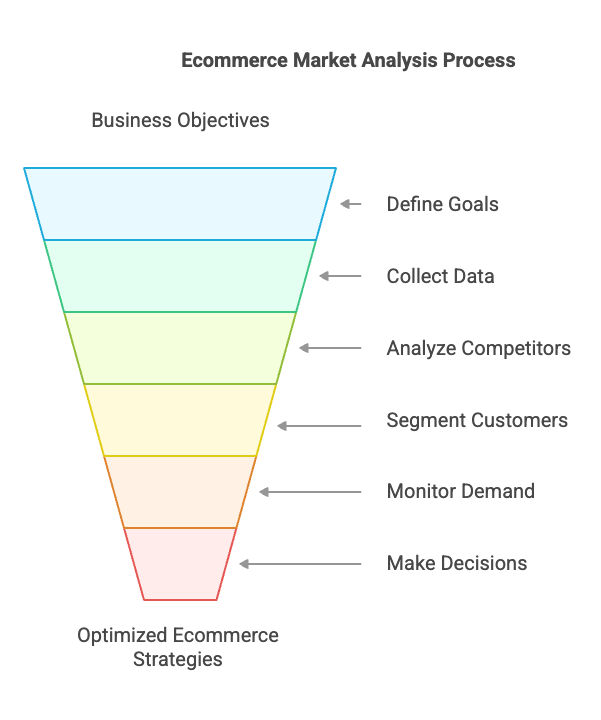
- Define Your Goals: Identify key business objectives (e.g., pricing optimization, new product launches, customer retention strategies).
- Collect Data: Record source, permissions, time window, coverage and missing fields. Separate first-party records, public observations and estimates.
- Analyze Competitor Strategies: Match comparable offers and record promotion conditions; describe what is observed without inventing competitors’ motives or private results.
- Segment Your Customers: Use relevant authorized attributes and stable cohort definitions. Avoid inferring sensitive traits from sparse observations.
- Monitor Market Demand: Compare multiple signals and test any forecast against held-out history; report its error and coverage limits.
- Make Data-Driven Decisions: State the proposed action, expected mechanism, costs and uncertainty. Choose an outcome and a stopping rule before rollout.
- Test & Iterate: Use a suitable comparison or experiment where feasible; inspect measurement consistency and uncertainty rather than attributing every before/after change to your action.
Worked example: revenue growth with a lower conversion rate. These are fictional inputs, not Easy Data customer results. Compare two equal-length periods using the same store, currency, revenue definition and session rules. In this simplified example, each purchasing session has exactly one order.
Period A has 10,000 eligible sessions, 300 purchasing sessions/orders and $15,000 defined revenue. Its conversion rate is 300 ÷ 10,000 = 3%; AOV is $15,000 ÷ 300 = $50. Period B has 12,000 sessions, 300 purchasing sessions/orders and $16,500 revenue: conversion is 2.5% and AOV is $55.
Revenue increased 10% while conversion fell 0.5 percentage points (16.7% relative). The higher AOV offsets the unchanged order count; this does not prove a campaign caused the result. Check product mix, refunds, channel mix and measurement changes before acting. If A’s defined acquisition spend was $3,000 for 150 new customers, its simple period CAC would be $20; that is not the same denominator as 300 total orders.
Conclusion
Useful ecommerce market analysis connects a decision to traceable evidence. Define the market and metrics, separate observations from estimates, and compare consistent periods. Use the tool that fits the question and verify its current availability and data coverage.
Automation can reduce repetitive work, but it does not remove sampling gaps, measurement errors or uncertainty. A forecast, recommendation or attractive dashboard should be checked against documented inputs and actual outcomes before it informs a larger commitment.
For a scoped marketplace collection, review Easy Data’s services and bring representative targets, required fields and the decision you need to support.
Leave a Reply