

Web scraping vs data mining is a comparison that sounds simple, until you actually have to make a business decision based on it. Especially in ecommerce, these two terms are often used interchangeably. This confusion cannot be overlooked, as it can lead to budget errors, tool errors, and sometimes even strategy errors. If you’ve ever wondered whether you need to improve your data collection or your data analysis, this article is for you.
What Is Web Scraping?
At its core, web scraping is the automated process of collecting publicly available data from websites and transforming it into structured datasets.
In practice, web scraping for ecommerce involves systematically extracting:
- Product listings
- Prices and discount structures
- Seller information
- Ratings and reviews
- Category structures
- Visibility signals
But here’s the nuance most definitions miss: web scraping is not about “getting data once.” Its real power lies in repeated collection over time. That’s how you track price movements, seller entry, campaign volatility, and competitive shifts.
In other words, web scraping is about data acquisition at scale.
What Is Data Mining?
Data mining, on the other hand, happens after you already have data.
It refers to the process of analyzing large datasets to discover patterns, correlations, anomalies, and predictive signals. Techniques may include:
- Statistical modeling
- Clustering
- Regression analysis
- Machine learning
- Pattern recognition
In ecommerce, data mining might help you:
- Predict which products will trend next quarter
- Segment sellers by pricing behavior
- Detect abnormal discounting strategies
- Forecast demand from historical data
If web scraping is about collecting the raw ingredients, data mining is about cooking something meaningful from them.
Web Scraping vs Data Mining: Core Differences
Web scraping and data mining are not competing techniques, they’re sequential layers. The first secures external data. The second extracts strategic value from it.
| Dimension | Web Scraping | Data Mining |
| Primary Goal | Acquire external data | Extract insight from data |
| Input | Unstructured web pages | Structured datasets |
| Output | Cleaned datasets | Patterns, models, forecasts |
| Skillset | Data engineering | Analytics & modeling |
| Risk | Infrastructure instability | Misinterpretation of signals |
The mistake many ecommerce teams make is investing heavily in data mining before securing stable, consistent scraped data. Without reliable inputs, even the most advanced models collapse.
Ecommerce Use Cases: When Scraping vs When Mining
In practice, web scraping vs data mining is rarely an either-or decision. But there are situations where one clearly comes first.
Use Cases That Primarily Require Web Scraping
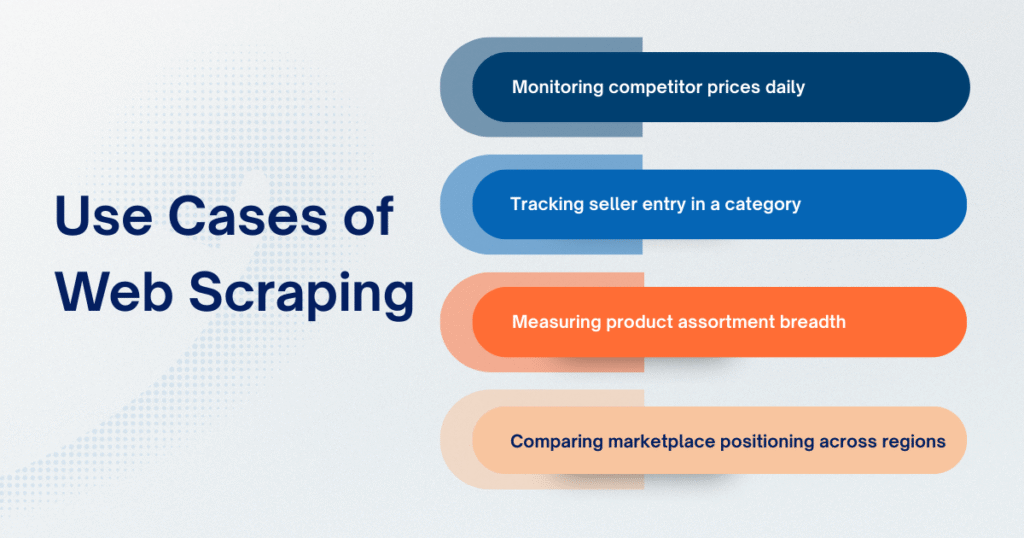
These are situations where the business problem is about visibility, not prediction:
- Monitoring competitor prices daily
- Tracking seller entry in a category
- Measuring product assortment breadth
- Comparing marketplace positioning across regions
In these cases, the insight comes directly from structured observation over time. You need stable, repeated web scraping, not advanced modeling.
For example, many Southeast Asia marketplace teams rely on continuous scraping to track campaign-driven price volatility. That data alone already reveals pricing pressure without complex mining.
Use Cases That Require Data Mining
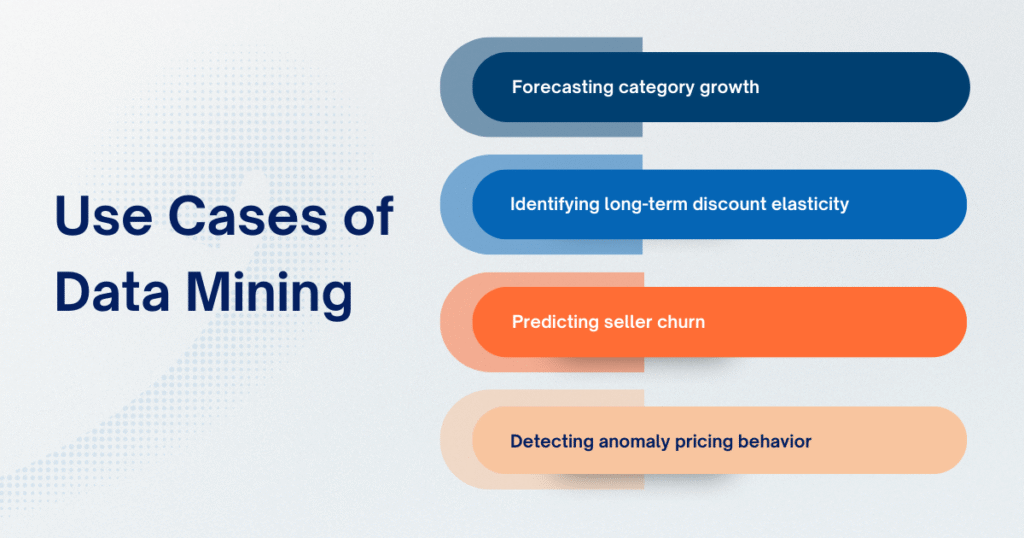
Here, the dataset already exists. The question is hidden patterns:
- Forecasting category growth
- Identifying long-term discount elasticity
- Predicting seller churn
- Detecting anomaly pricing behavior
In these scenarios, data mining extracts deeper signals from historical scraped data.
Use Cases That Require Both
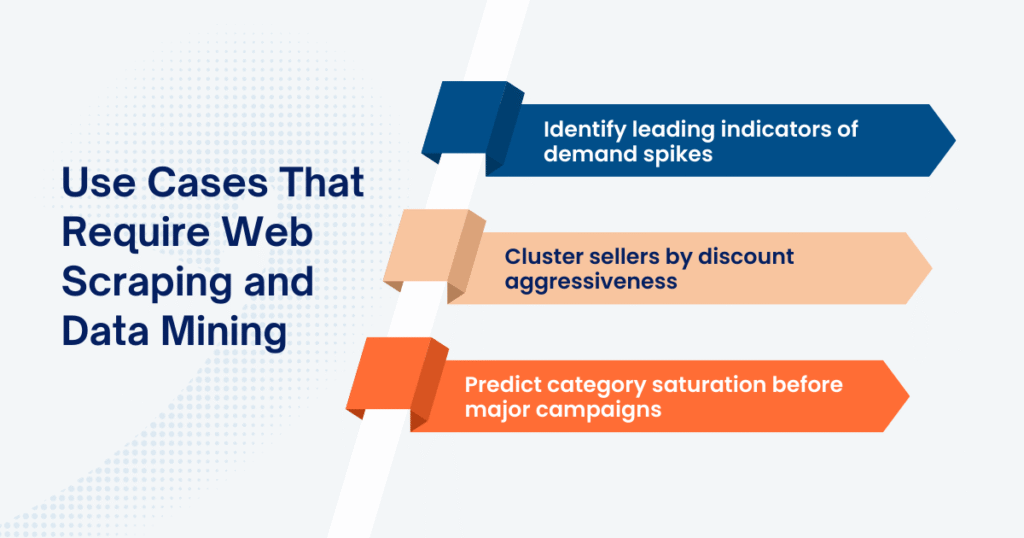
This is where most mature ecommerce operations eventually land. Example:
You scrape daily product listings across Shopee and Lazada.
Then you mine that data to:
- Identify leading indicators of demand spikes
- Cluster sellers by discount aggressiveness
- Predict category saturation before major campaigns
This is where web scraping vs data mining becomes a complementary system rather than a comparison.
Decision Framework: Which One Do You Need?
If you’re unsure whether your team needs web scraping, data mining, or both, start with three questions.
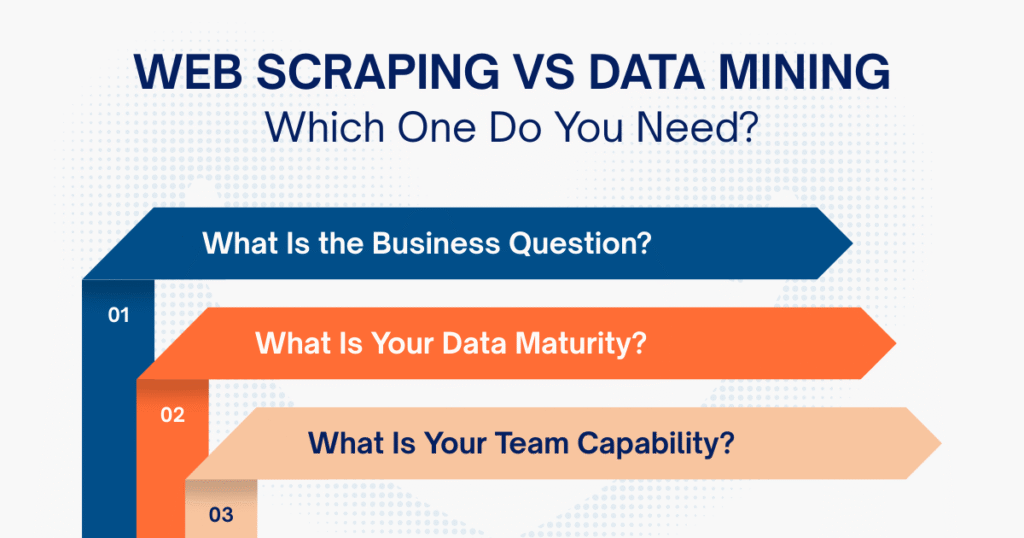
1. What Is the Business Question?
- “What are competitors pricing today?” → Scraping
- “Why are prices declining structurally?” → Mining
- “Will the category peak next quarter?” → Mining (on scraped data)
2. What Is Your Data Maturity?
- No structured external data → Start with scraping
- Structured multi-month datasets → Introduce mining
Jumping into advanced modeling without consistent historical scraping is like forecasting weather with one day of data.
3. What Is Your Team Capability?
- Strong engineering, limited analytics → Scraping focus
- Strong analytics, weak data acquisition → You may need external scraping support
This is often where organizations underestimate infrastructure complexity. Maintaining reliable ecommerce web scraping pipelines requires constant adaptation to layout changes, campaign mechanics, and marketplace volatility.
That’s why many ecommerce teams turn to third-party providers like Easy Data for managed ecommerce data scraping. Instead of maintaining scrapers internally, they rely on specialized services to ensure stable, analysis-ready datasets, so their teams can focus on strategy, not infrastructure.
How Web Scraping and Data Mining Work Together
Understanding web scraping vs data mining is useful. But the real leverage comes from combining them intelligently.
Scraping as Data Acquisition
Scraping provides:
- Market-level visibility
- Competitive continuity
- Historical tracking
- External signals unavailable in internal dashboards
Without scraping, mining is limited to internal data only, which often tells you what already happened, not what competitors are doing now.
Mining as Insight Extraction
Mining transforms scraped data into:
- Trend detection
- Predictive signals
- Behavioral segmentation
- Risk alerts
It moves teams from reactive to proactive strategy.
How to Combine Web Scraping and Data Mining Effectively
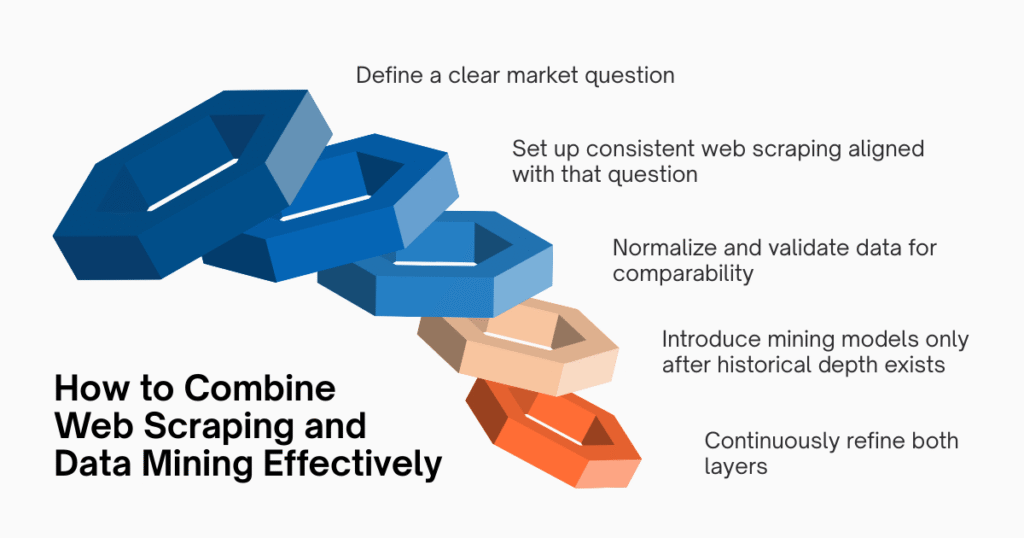
From experience, here’s a practical order:
- Define a clear market question
- Set up consistent web scraping aligned with that question
- Normalize and validate data for comparability
- Introduce mining models only after historical depth exists
- Continuously refine both layers
Many ecommerce teams in Southeast Asia begin with category-level scraping for pricing intelligence. Over time, once historical datasets stabilize, they layer in mining to forecast campaign performance or detect saturation risk. That evolution (from observation to prediction) is where competitive advantage compounds.
Conclusion
Web scraping vs data mining is not a battle between two techniques. It’s a sequencing question.
Web scraping gives you structured visibility into external markets.
Data mining transforms that visibility into predictive and strategic insight.
Confusing the two leads to misaligned investments. Understanding how they complement each other creates scalable intelligence. In fast-moving ecommerce markets, the teams that win are rarely those with the fanciest models. They are the ones who first build reliable data acquisition and then apply analysis with discipline.
If you’re unsure which layer your business actually needs today, start by asking:
Are we missing data or are we missing insight?
Leave a Reply