


Introduction
Web scraping Amazon is often proposed for price monitoring, product research and review analysis. A useful project first defines which data it is authorized to obtain and what those observations can actually measure. Public offers, seller-authorized records and affiliate product content have different access routes and use limits.
This guide explains those routes, the roles of common tools and a practical workflow for comparing permitted offer observations. It does not promise unrestricted access or a risk-free extraction method. API guidance was reviewed October 3, 2026.
For help defining a collection and validation brief, see Easy Data services. Specify the marketplace, intended use, source permission, required fields and acceptable refresh interval before choosing software.
Why Web Scraping Amazon is Valuable
1. Price Monitoring & Competitive Analysis
- Compare the same product variant and offer basis over time. Preserve seller, currency, destination and observation time alongside price.
- Distinguish a change in the displayed item price from changes in shipping, coupons, seller or pack size. Those differences can reverse a comparison.
- Use reviewed thresholds and business rules before any automated repricing. A competitor observation alone is not a margin calculation.
2. Product Research & Market Trends
- Describe the categories, queries and observation dates in the permitted sample. Search placement or a bestseller label does not reveal exact units sold.
- Use reviews you are authorized to analyze to identify candidate themes, then check examples manually and report the sample size.
- Treat apparent product gaps as research hypotheses. Validate them against your own customer, sales and cost evidence before planning a launch.
3. Review Analysis & Brand Sentiment Tracking
- Define a permitted review sample, language, period and deduplication rule before counting themes. More collected text does not automatically mean a representative sample.
- Keep rating changes separate from sentiment labels. State the denominator and whether repeated or updated reviews are included.
- Do not infer private customer-support outcomes from public review text. Minimize personal information and retain only fields needed for the analysis.
4. Inventory & Stock Monitoring
- Record the availability message as observed for a specific destination and time. It is not a measurement of the seller’s total inventory.
- Investigate unavailable offers before treating them as opportunities: location, fulfillment, selected variant and collection failure can affect the observation.
- Keep missing responses separate from observed unavailability. Report coverage alongside any availability trend.
Choose an Authorized Amazon Data Route
Understanding Amazon’s Robots.txt Policy
A robots.txt file communicates crawler rules; it does not grant permission to collect or reuse content. RFC 9309 explicitly distinguishes these rules from access authorization. Do not infer permission from the absence of a product-path restriction.
- Check the current rules for the exact host and crawler identity; do not reuse assumptions from another Amazon marketplace.
- Review applicable terms and any written permission separately from robots.txt. An allowed crawl path is not a reuse license.
- Select an API or other source according to its documented purpose and authorization, rather than treating all structured access as interchangeable.
Creators API and Selling Partner API Serve Different Uses
The original PA-API recommendation is outdated. Amazon now documents Product Advertising API 5 as deprecated, with Creators API as its successor. Creators API supports product-catalog integrations for publishers, influencers and affiliate partners; eligibility and marketplace requirements apply. It is not a general research export license. For an authorized seller or vendor workflow, evaluate the separate Selling Partner API, whose access depends on application registration, authorization and roles.
Best Practices for Ethical Web Scraping
- Confirm access first: document which source, fields and uses the project is permitted to access.
- Bound requests: follow the chosen service’s limits and retry guidance. Record errors and stop repeated failures.
- Respect access responses: resolve denied access through the source owner or approved integration; do not treat identity rotation as permission.
- Minimize personal data: omit unnecessary reviewer identifiers and assess applicable privacy obligations for the actual use.
- Check retention: the US Associates IP License restricts use, storage and repurposing of product content. Its section 2(e) requires prior written approval for specified aggregation and analysis uses. Check the license for the applicable locale before designing a history database.
Tools and Their Roles in an Authorized Workflow
1. BeautifulSoup (Python)
- Beautiful Soup parses supplied HTML or XML. It is useful for extracting fields from an authorized document or a saved test fixture.
- It does not fetch pages or execute JavaScript by itself. A requests response is still the returned HTML; browser rendering is a separate operation.
2. Scrapy
- Scrapy provides a crawling and extraction framework with request handling, selectors and output pipelines.
- Define coverage, concurrency and error handling for the permitted source. Framework throughput does not establish permission or complete data.
3. Selenium
- Selenium WebDriver controls a browser and can test JavaScript-dependent interactions.
- Use it when browser behavior is required for an authorized workflow. Browser automation does not create access to private fields or guarantee collection reliability.
4. Octoparse
- Octoparse offers a visual extraction workflow for users who prefer configuration to writing a crawler.
- Evaluate a current template against the actual permitted source, required fields and error cases. A template listing is not proof of accuracy or permission.
5. Zyte (formerly Scrapinghub)
- Zyte API offers managed request, rendering and extraction capabilities.
- Assess field quality, error reporting, cost and the provider’s applicable terms. Managed access is not a guarantee that every Amazon use case is authorized.
Amazon Data Collection: A Step-by-Step Planning Guide
Step 1: Identify the Data You Need
Write the question before the field list. For an offer comparison, record marketplace, ASIN or product identifier, exact variant and pack size, seller, condition, fulfillment, currency, item price, shipping charge, destination and observation time with timezone. Record missing values explicitly. Exact stock quantities, unit sales and profit require evidence beyond an availability label.
Step 2: Choose Your Scraping Method
- Affiliate display: evaluate Creators API only if the account and proposed use meet its requirements. Follow the current migration guide if maintaining a PA-API integration.
- Seller operations or research: use an appropriately authorized SP-API workflow or a separately licensed source suited to the question. Missing API fields do not justify switching automatically to unapproved page collection.
Step 3: Set Up Your Web Scraper
- Define a small test set of known records from the chosen source. Map each requested field to a documented response field or an authorized document element.
- Store the source time separately from processing time, and distinguish missing fields, access errors and zero values. Avoid placing credentials in shared examples or logs.
- Validate types, currency and pack-size interpretation before scaling. For page extraction, test saved fixtures after markup changes; for APIs, follow the current endpoint documentation.
Step 4: Handle Errors and Measure Coverage
- Handle rate limits: use bounded retries according to the chosen API’s documentation and record requests that did not complete.
- Handle denied access: stop and resolve authorization or account eligibility. A CAPTCHA or access-denied page is not product data.
- Measure coverage: report requested, successful, missing and invalid records separately. Do not silently convert failures to out-of-stock labels.
Step 5: Store & Analyze the Data
- Choose a format and retention period permitted by the source. Document the record key and schema; a CSV export does not confer redistribution rights.
- Compare like-for-like records, preserving missing shipping or tax values. Label whether amounts are item-only, delivered or unit-normalized.
- Reconcile a sample back to the source before generating alerts. Any automated explanation should link to its supporting observations rather than invent a market trend.
Fictional offer comparison, not Amazon observations: assume the same destination, currency, product specification and new condition. A and B contain identical units; their pack sizes differ. Offer A is the same seller at both times. For this illustration only, tax and discounts are assumed absent. Real comparisons must include or explicitly exclude those components.
| Offer and snapshot | Units | Item USD | Shipping USD | USD per unit |
|---|---|---|---|---|
| A — first | 6 | 24 | 6 | 5.00 |
| A — later | 6 | 27 | 3 | 5.00 |
| B — first | 3 | 15 | 0 | 5.00 |
| C — first | 3 | 12 | Unknown | Not calculable |
Calculate the stated unit cost as (item price + shipping) / units. A’s item price rises 12.5%, from 24 to 27, but its stated delivered unit cost remains 5.00 because shipping falls by the same amount. B also costs 5.00 per unit on this basis. C’s unknown shipping must not be replaced with zero or ranked as the cheapest offer. None of these figures measures demand, sales, profit or inventory.
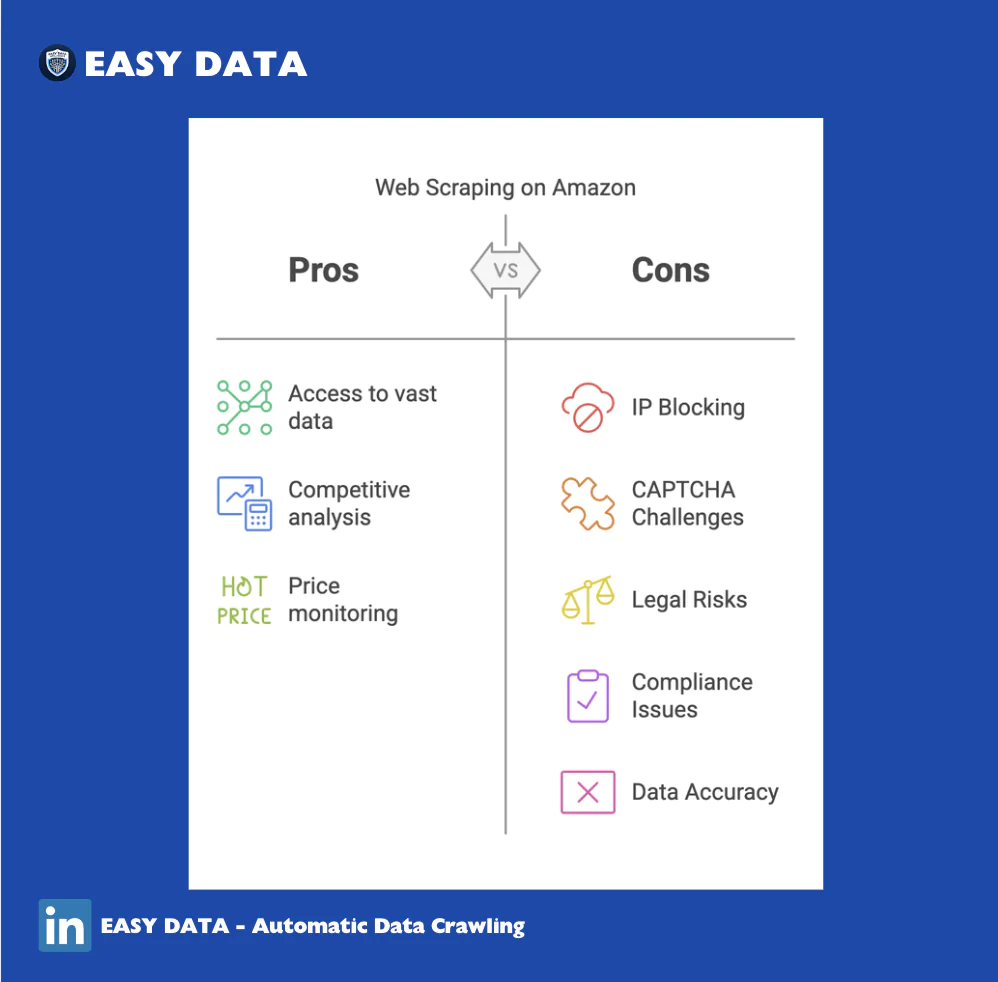
Challenges & Risks of Web Scraping Amazon
1. IP Blocking & CAPTCHA Challenges
- A challenge, error response or denied request can leave an apparently populated page without the intended data. Detect that state before parsing prices.
- Record the failure and resolve the approved access path. Do not recommend CAPTCHA solvers or proxy rotation as a universal fix.
2. Legal Risks & Compliance Issues
- Check the terms and permissions governing the particular data route and intended use. An API credential does not make every downstream use compliant.
- Keep approval and retention requirements in the project specification. If the proposed research use is not covered, obtain a suitable source before implementing it.
3. Data Accuracy & Changes in Page Structure
- A changed page layout or response schema can produce missing fields or wrong values. Treat successful HTTP delivery and correct extraction as separate checks.
- Use fixtures with expected product identity, price, currency and missing-value behavior. Pause publication of derived results if those checks fail.
Maintain the Integration and Review Its Limitations
1. AI-Powered Scraping
- AI can assist with classification or field mapping, but its output needs evaluation against labeled examples and reported errors.
- Do not use an AI-generated value to fill a missing observation without labeling it as an estimate and validating the method.
2. API Migration and Version Changes
- The concrete platform change to plan for is PA-API 5 migration to Creators API; follow Amazon’s current migration documentation.
- Treat future API capabilities as unconfirmed until documented. Keep source adapters separate from analysis so a version change can be tested before release.
3. Measured Freshness
- Define freshness as measured source age and delivery delay. Scheduled collection is not continuous observation and can miss changes between samples.
- Set an explicit maximum acceptable age for decisions and flag stale records. A faster refresh interval does not correct a mismatched product or missing shipping charge.
Conclusion
Useful Amazon-related analysis depends on a suitable source, comparable records and a clear statement of limitations. Separate affiliate display content from seller-authorized operations and independently licensed research data. A selected set of offers or reviews cannot establish complete market demand or a competitor’s stock balance.
There is no risk-free extraction recipe. Confirm the intended use and current access conditions, retain only what the source permits, and validate the fields that drive a business decision. Do not describe a blocked or incomplete response as a successful collection.
An Easy Data project brief can document the source, delivery format and validation criteria. For related preparation, read our dataset validation guide on row identity and missing values.
Primary documentation and further reading:
Leave a Reply