

Shopee Scraper vs Shopee API is one of the most common questions businesses and analysts ask when dealing with Southeast Asia’s booming e-commerce sector. With Shopee leading online retail in markets like Indonesia, Vietnam, the Philippines, and beyond, data has become a critical advantage for decision-making.
Whether you’re a seller optimizing your catalog, a brand studying competitors, or a market analyst evaluating trends, you need reliable tools to extract insights from Shopee. The challenge is choosing the right approach:
- A Shopee Scraper, which collects data directly from Shopee’s website and app.
- Or the Shopee API, Shopee’s official developer interface for sellers.
This guide breaks down their differences, use cases, and how Easy Data helps businesses leverage the best of both.
- What is a Shopee Scraper?
- What is the Shopee API?
- Shopee Scraper vs Shopee API: Key Differences
- When to Use Shopee Scraper vs Shopee API
- Combining Both Approaches
- Easy Data’s Role in Shopee Scraper vs Shopee API Analysis
- Future of E-Commerce Data in Southeast Asia
- Conclusion – Shopee Scraper vs Shopee API: Which Works Better?
What is a Shopee Scraper?
A Shopee Scraper is an automated tool designed to extract publicly available data from Shopee’s website or mobile app. By crawling through product listings, seller profiles, and customer reviews, scrapers compile structured datasets that businesses can use for analysis. Unlike manual data collection, which is time-consuming and error-prone, a well-designed scraper delivers comprehensive insights at scale.
👉 Explore more: Shopee Data Scraper for E-Commerce Market Analysts [Free Demo Available]
Key Features of a Shopee Scraper
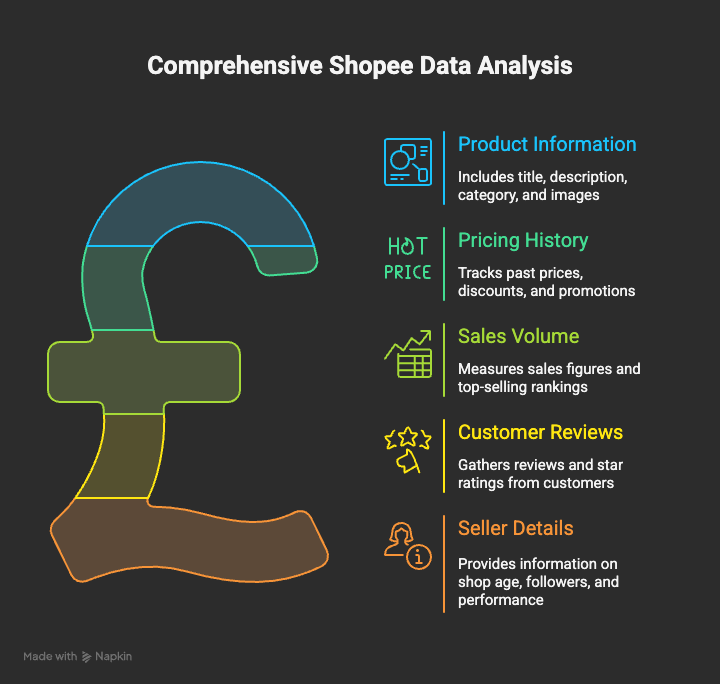
A well-built scraper can collect:
- Product Information: Captures titles, descriptions, categories, images, and specifications.
- Pricing and Promotions: Tracks historical prices, discounts, and flash sale offers.
- Sales Performance: Monitors sales volumes, top-selling rankings, and product popularity.
- Customer Insights: Collects reviews, star ratings, and sentiment data.
- Seller Metrics: Gathers details like shop age, follower count, and performance scores.
These features make scrapers indispensable for businesses seeking a comprehensive view of the Shopee ecosystem.
Benefits of a Shopee Scraper
The flexibility of a Shopee Scraper offers significant advantages for market analysts and e-commerce businesses. First, it provides access to a broader range of data than APIs, including user-generated content like reviews and ratings, which are often unavailable through official channels. This depth of information enables businesses to understand customer sentiment and identify emerging trends.
Additionally, scrapers are not limited by API rate limits or data restrictions, allowing for large-scale data collection tailored to specific needs. For example, a retailer could scrape competitor pricing across thousands of products to optimize their own pricing strategy.
Moreover, Shopee Scrapers are highly customizable. Businesses can target specific data points, such as promotional campaigns or regional price differences, to gain a competitive edge.
Limitations
Despite their advantages, Shopee Scrapers have challenges. Web scraping can be technically complex, requiring expertise to handle website updates, anti-scraping measures like CAPTCHAs, and dynamic page structures. Scrapers may also face legal and ethical considerations, as extracting data without permission can violate platform terms of service. Additionally, maintaining a scraper’s performance over time demands continuous updates to adapt to Shopee’s evolving website design. For businesses without technical resources, these hurdles can make scraping less accessible unless partnered with a provider like Easy Data, which offers robust, managed solutions.
What is the Shopee API?
The Shopee API is an official interface provided by Shopee that allows developers and businesses to access structured data directly from the platform’s servers. It offers a standardized way to retrieve information such as product details, order statuses, and sales analytics, typically for sellers or partners integrated with Shopee’s ecosystem.
Core Functionalities of Shopee API
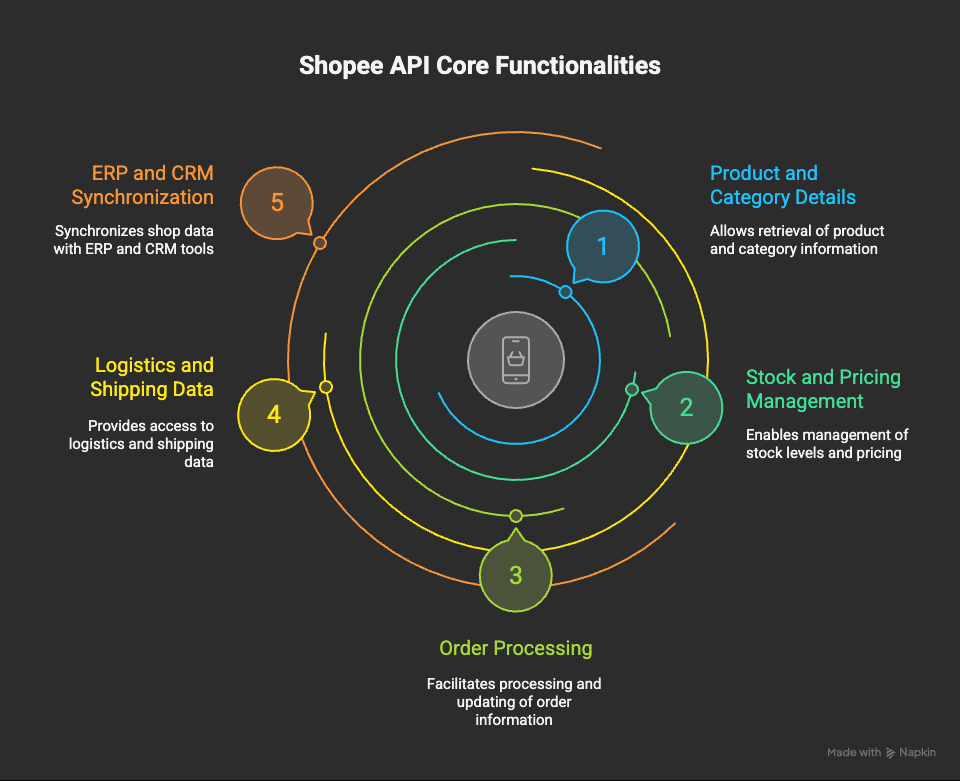
The Shopee API is designed for seamless integration with business systems, offering functionalities like:
- Retrieve product and category details.
- Manage stock levels and pricing.
- Process and update order information.
- Access logistics and shipping data.
- Synchronize shop data with ERP and CRM tools.
Benefits of Shopee API
The Shopee API offers a stable and authorized method for accessing data, reducing the risk of legal issues associated with scraping. Its structured data format ensures consistency and ease of integration with existing tools, such as inventory management systems or analytics dashboards. For sellers, the API enables real-time updates on orders and inventory, streamlining operations and improving efficiency. Additionally, the API is less likely to break due to website changes, as it relies on Shopee’s backend infrastructure rather than front-end page structures.
For businesses focused on operational efficiency, the Shopee API provides a dependable solution for automating tasks and accessing clean, structured data. It’s particularly valuable for sellers managing high transaction volumes or needing real-time insights into their store performance.
Limitations
However, the Shopee API has its constraints. It restricts access to specific data types defined by Shopee, meaning businesses cannot retrieve information like competitor pricing or customer reviews, which are often critical for market analysis. API rate limits can also hinder large-scale data collection, especially for businesses needing comprehensive market insights. Furthermore, using the API requires technical expertise for integration and authentication, which may pose challenges for smaller businesses. Finally, access to the Shopee API is often limited to registered sellers or partners, excluding analysts or competitors seeking broader market data.
Shopee Scraper vs Shopee API: Key Differences
The choice between a Shopee Scraper vs a Shopee API hinges on their fundamental differences in functionality, accessibility, and purpose. When evaluating Shopee Scraper vs Shopee API, businesses should consider their goals. Here’s a side-by-side comparison:
| Criteria | Shopee Scraper | Shopee API |
|---|---|---|
| Data Source | Crawls website/app | Official Shopee system |
| Customization | Highly flexible | Limited to Shopee endpoints |
| Data Volume | Unlimited | Restricted by quota |
| Compliance | Risk if abused | 100% legitimate |
| Setup Speed | Fast deployment | Requires approval & setup |
| Ease of Use | Needs scraping infrastructure | Needs developer knowledge |
| Best Use Cases | Market research, competitor tracking | Seller inventory & order management |
When to Use Shopee Scraper vs Shopee API
Choosing the right tool depends on your business objectives and resources. Below, we explore the best use cases for each approach and how combining them can amplify results.
Best Use Cases for Shopee Scraper
- Market Research: Scrapers enable the collection of extensive Shopee datasets to uncover market trends, customer preferences, and emerging product categories. This granular data helps businesses identify opportunities and forecast demand accurately.
- Competitive Analysis: Track competitors’ pricing, sales volumes, and new product launches to stay ahead in the market. Scrapers provide insights into competitor strategies, enabling data-driven decisions to refine your positioning.
- Price Monitoring: Monitor real-time competitor discounts and promotional campaigns to optimize your pricing strategy. This ensures you remain competitive without sacrificing profitability in dynamic markets.
- AI/ML Training: Use large, diverse scraped datasets to train AI and machine learning models for predictive analytics. These models can forecast trends, optimize pricing, or personalize marketing efforts effectively.
Example: A consumer electronics brand can scrape daily price changes for competitor headphones, analyze discount patterns, and adjust promotions to capture market share swiftly.
Best Use Cases for Shopee API
- Inventory Management: Sync real-time stock levels across multiple warehouses to prevent overselling and ensure seamless operations. The API’s structured data ensures accuracy in high-volume environments.
- Order Processing: Automate updates for order statuses, tracking, and fulfillment to reduce manual errors and enhance customer satisfaction. This streamlines operations for sellers with large transaction volumes.
- Business Integration: Seamlessly connect your Shopee store to ERP or CRM systems for unified data management. This integration improves workflow efficiency and supports scalable business growth.
- Performance Reports: Access standardized data to generate detailed sales and performance reports for strategic planning. These insights help sellers optimize store performance and identify growth opportunities.
Example: A seller managing thousands of SKUs can use the API to automatically update stock levels across warehouses, ensuring real-time accuracy and minimizing operational disruptions.
Combining Both Approaches
It doesn’t have to be Shopee Scraper vs Shopee API exclusively. Many businesses find success by combining both:
- Use the Shopee API for operational management.
- Use a Shopee Scraper for external market intelligence.
This hybrid approach balances compliance with flexibility, giving businesses a complete data advantage.
Easy Data’s Role in Shopee Scraper vs Shopee API Analysis
Easy Data is a trusted partner for businesses seeking precise and reliable data extraction from Shopee’s dynamic platform. Unlike generic scraping tools or API integrations, Easy Data provides tailored solutions designed specifically for Southeast Asia’s fast-paced e-commerce market. We deliver clean, accurate, and customized data in real time. This service ensures businesses receive the exact data points they need, seamlessly aligned with their strategic goals.
The Shopee Data Scraping Service is ideal for companies looking for a fully managed data extraction solution. Particularly valuable for businesses without in-house technical expertise, this service delivers high-quality, customized datasets tailored to specific requirements, such as competitor pricing, product details, or customer reviews. Easy Data’s localized expertise ensures that the extracted data reflects the nuances of Southeast Asia’s e-commerce landscape, empowering businesses with reliable information for informed decision-making.
Additionally, Easy Data complements Shopee API-based approaches by providing highly accurate scraped data to enhance market insights. For businesses using the API for operational tasks, integrating Easy Data’s customized datasets offers a broader perspective, enabling more effective strategies for pricing, marketing, and competitive positioning. With a focus on delivering clean and precise data, Easy Data helps businesses stay agile and competitive in Southeast Asia’s dynamic e-commerce environment.
We go beyond raw data, turning it into strategic insights that fuel smarter business decisions. 👉 Explore our Shopee Data Scraping Service
Future of E-Commerce Data in Southeast Asia
As Southeast Asia’s e-commerce continues to grow, the role of data will become even more critical. Trends include:
- Social Commerce Expansion – TikTok Shop, Instagram Shopping, and other platforms driving sales.
- AI-Powered Analytics – Predictive models improving personalization.
- Omnichannel Strategies – Integrating offline and online retail.
- Real-Time Dashboards – Immediate insights for fast decision-making.
👉 For more industry insights, check out McKinsey’s report on the future of commerce.
Conclusion – Shopee Scraper vs Shopee API: Which Works Better?
At the end of the day, Shopee Scraper vs Shopee API is not about one being “better” than the other, but about which tool suits your specific goals.
- A Shopee Scraper is ideal for market research, competitor analysis, and large-scale data collection.
- The Shopee API is perfect for store management, ERP integration, and secure automation.
The smartest businesses don’t choose one—they combine both.
💡 At Easy Data, we provide the flexibility of scraping with the stability of API integrations, ensuring you gain the best of both worlds.
👉 Ready to leverage Shopee data for your business growth?
Contact Easy Data today to transform raw data into actionable market intelligence.
Leave a Reply